
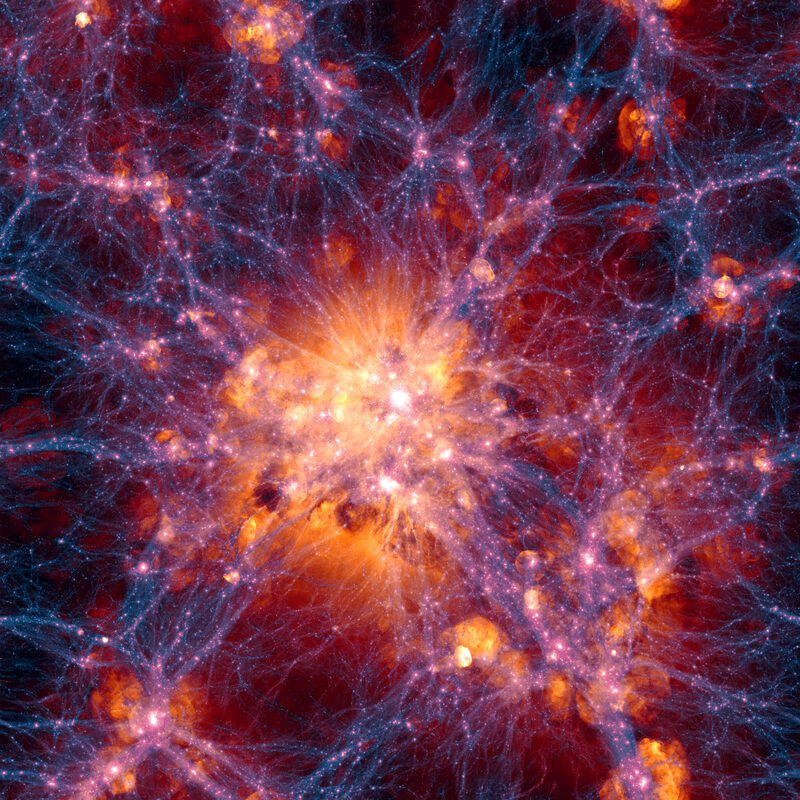
Pull back far enough from any galaxy — far enough that individual stars and gas clouds blur into smears of light, far enough that those smears of light themselves become points — and the universe reveals a structure that looks, to a biological eye, like a sponge, or a foam, or the web of a very large spider. Dense nodes of galaxies and dark matter sit at intersections of thin filaments. The filaments connect to sheets and walls of galaxies. Between the sheets lie vast empty regions, called voids, that can stretch for hundreds of millions of light-years. This is the cosmic web, and it is the largest coherent structure in the observable universe.
The web was predicted before it was observed. Numerical simulations of structure formation in the 1970s and 1980s, tracking how gravity acts on the small density perturbations imprinted by the Big Bang, consistently produced filamentary structures. The mathematics of gravitational collapse naturally sorts matter: overdense regions collapse faster along their shortest axis first, producing sheets, then filaments, then nodes. The process is called the Zel'dovich approximation in its linear form and continues to operate in the nonlinear regime as dark matter halos merge and grow. By the time the first large galaxy surveys could map three-dimensional galaxy distributions, the filaments and voids were there waiting to be seen.
Mapping the web
The CfA Redshift Survey in 1986 revealed the first clear large-scale wall of galaxies — the Great Wall, a sheet extending for 500 million light-years. The Sloan Digital Sky Survey, beginning in the early 2000s and continuing for decades, mapped the positions of hundreds of millions of galaxies and produced the most detailed three-dimensional map of the nearby universe ever assembled. Within that map, the cosmic web is unmistakable: the Sloan Great Wall, discovered in 2003, extends for roughly 1.4 billion light-years. More recent surveys have identified structures even larger — the Hercules-Corona Borealis Great Wall, controversial in its definition, may extend for 10 billion light-years, approaching the scale where the universe's homogeneity principle should prevent such structures from existing.
The filaments themselves are not merely concentrations of galaxies. They are filled with the warm-hot intergalactic medium (WHIM) — gas at temperatures between 100,000 and 10 million degrees Kelvin, too hot to form stars but too diffuse to radiate strongly. This WHIM may contain up to half of all the baryonic matter in the universe — the ordinary atoms that form stars, planets, and people. Finding and characterizing it is one of the central observational challenges in cosmology. X-ray observations can detect the hottest filamentary gas, and UV absorption spectroscopy can detect the cooler portions, but mapping the WHIM with the same fidelity as galaxy surveys requires instruments and observation times not yet available.
Voids and what grows in them
The voids are not completely empty. They contain sparse populations of galaxies, typically smaller and bluer than the galaxies in filaments and clusters — evidence that the underdense environment of a void slows galaxy evolution in ways that overcrowded environments accelerate. Void galaxies are natural laboratories for understanding how the universe's large-scale environment shapes individual galaxy properties. The boundaries of voids — the sheets and filaments — also show alignments in galaxy spin axes and morphologies that extend over scales of hundreds of millions of light-years, implying that the formation of individual galaxies was shaped by the large-scale tidal field of the web at the moment of their birth. The cosmic web is not just a backdrop. It is a causally connected structure that reaches down to the properties of individual star-forming regions within individual galaxies billions of light-years away. When the Vera Rubin Observatory completes its ten-year LSST survey, it will map galaxy positions to a depth and sky coverage that will let cosmologists measure the web's large-scale geometry with enough precision to test whether dark energy is constant or evolving — the same structure that looks like a cosmic sponge encodes the fundamental physics of the universe's long-term fate.
Sources
- Large-scale structure of the universe — Wikipedia (cosmic web, walls, voids, and survey maps)
- Galaxy filament — Wikipedia (cosmic web structure, filament formation, and WHIM)
- Void (astronomy) — Wikipedia (void galaxies, size distribution, and large-scale structure context)
- NASA NSSDC — Astrophysics archive: large-scale structure surveys and galaxy cluster data
