
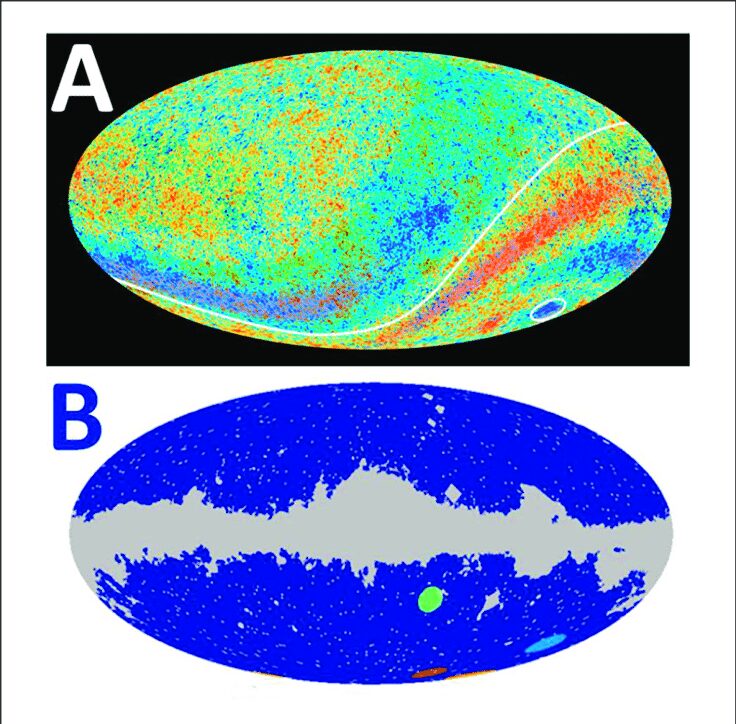
In 1965, Arno Penzias and Robert Wilson were trying to eliminate noise from a sensitive microwave receiver at Bell Labs in New Jersey. They pointed the antenna in every direction. They checked for pigeon droppings (and removed them). They found the noise everywhere, in every direction, at all times of day, in every season. It was 3.5 kelvin above absolute zero, and it was the afterglow of the Big Bang.
The cosmic microwave background radiation — the CMB — had been predicted by Ralph Alpher and Robert Herman in 1948, calculated from the theory of Big Bang nucleosynthesis that Alpher had developed with George Gamow. If the early universe was hot and dense enough to fuse hydrogen into helium, it must have been opaque to radiation. As it expanded and cooled, at around 380,000 years after the Big Bang, protons and electrons combined into neutral hydrogen and the universe became transparent. The radiation that had been trapped in the hot plasma was released and has been traveling through space ever since, cooling as the universe expanded, now redshifted into the microwave range at a temperature of 2.725 kelvin. Penzias and Wilson were not looking for it, but they found it. They received the Nobel Prize in 1978.
What the fluctuations encode
The CMB is uniform to better than one part in 10,000 — but it is not perfectly uniform. Tiny temperature fluctuations of one part in 100,000 were detected by the COBE satellite in 1992 (Nobel Prize 2006, Mather and Smoot) and mapped with increasing precision by WMAP (2001-2010) and Planck (2009-2013). These fluctuations are not noise — they are the seeds of structure. In the early universe, quantum fluctuations in the inflaton field (or whatever drove inflation) generated density perturbations. Those perturbations oscillated as acoustic waves in the plasma, compressing and rarefying like sound waves in the hot gas. When the universe became transparent, those oscillations were frozen into the CMB as a pattern of hot and cold spots.
The angular scale of those spots encodes the geometry of the universe. A spatially flat universe — one where parallel lines never converge or diverge — predicts a characteristic angular size for the largest CMB fluctuations of about one degree. WMAP and Planck measured it. The universe is flat to within one percent. Combined with measurements of the Hubble constant and the matter content of the universe, the CMB data pin down six fundamental cosmological parameters with percent-level precision: the baryon density, dark matter density, dark energy density, amplitude of primordial fluctuations, their spectral index, and the optical depth of reionization.
The tensions that remain
The Planck satellite's final analysis, released in 2018, confirmed the standard cosmological model (ΛCDM) with extraordinary precision — and revealed two significant tensions. The first is the Hubble tension: the CMB-derived Hubble constant (67.4 km/s/Mpc) disagrees with the value measured from supernovae and Cepheid distances (73 km/s/Mpc) at a level of about 5 sigma, more than enough to be statistically significant if systematic errors in both measurements are excluded. Either one measurement is wrong, or the standard model needs to be extended. The second tension involves the clustering of matter (the S8 parameter), where CMB predictions and large-scale structure surveys show a smaller but persistent discrepancy.
The next generation of CMB experiments — the Simons Observatory in Chile and the proposed CMB-S4 network — will measure the CMB polarization in unprecedented detail, potentially detecting the imprint of primordial gravitational waves from inflation. That signal, if found, would provide direct evidence for inflation and constrain its energy scale. The CMB has been mapped and remapped for six decades. It has not run out of things to say. The signal itself — a 2.725-kelvin thermal bath filling every cubic centimeter of the observable universe — is the most precisely measured blackbody spectrum in nature, fitting theory to six significant figures. In it is encoded not just the early universe's density and temperature, but potentially the fingerprints of quantum gravity at energies that no accelerator will ever reach.