
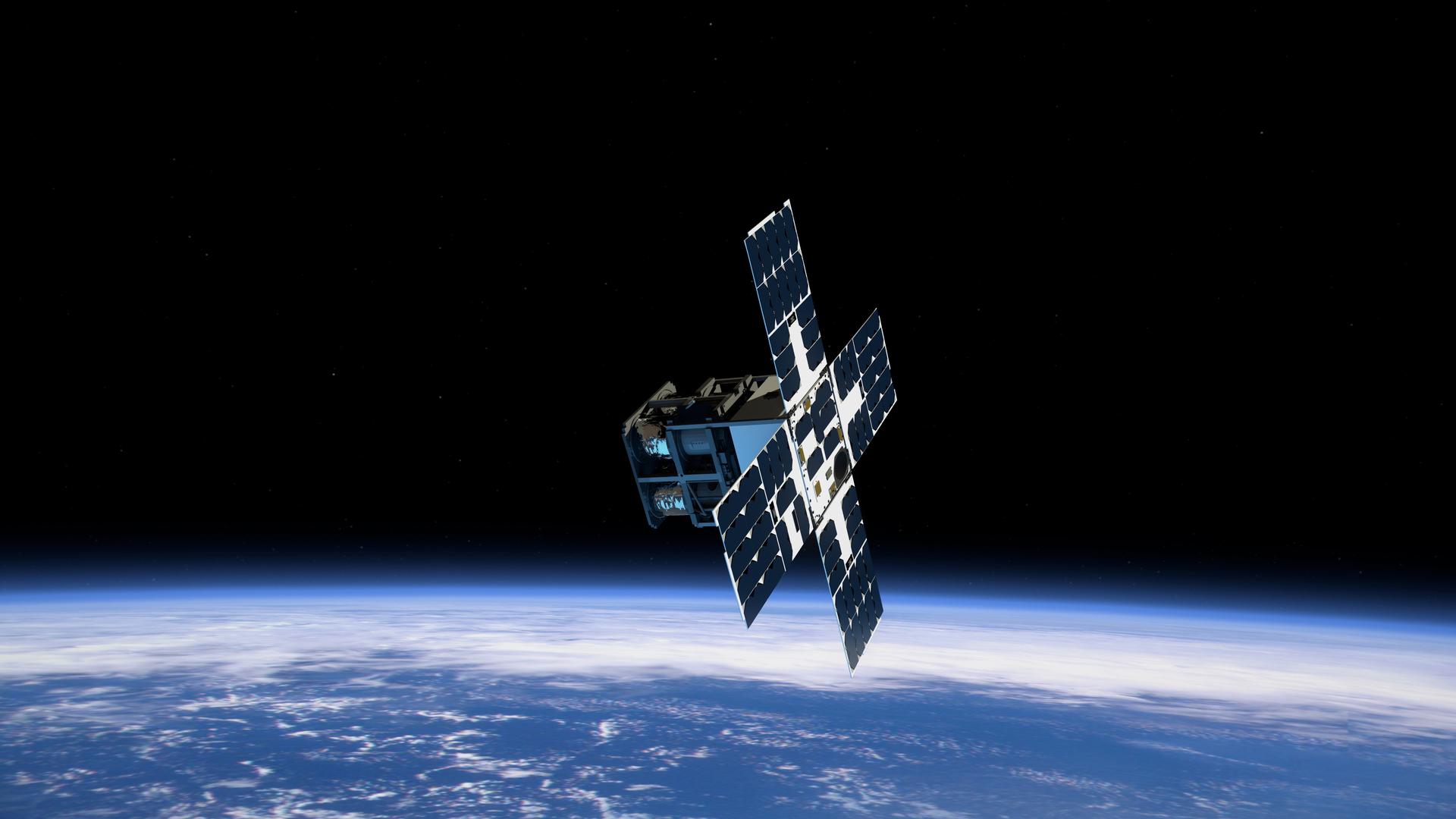
The sail was a square of polycarbonate just 0.04 millimeters thick, a little over half a meter on each side, and it lived in orbit for roughly two days. By the standards of the program behind it, that was plenty. A Cornell University team reports that its Alpha CubeSat mission released a free-flying lightsail after deployment from the International Space Station, and that the tiny computers riding on it separated from their host and talked to the ground on their own.
The headline result, as mission lead Joshua Umansky-Castro put it to Universe Today, is that this was "the first time a spacecraft this small has transmitted complete data packets from orbit to ground." Those spacecraft are ChipSats: gram-scale, chip-sized computers that act as the entire payload of a sail. The work was presented in a paper at the SmallSat Conference, with its abstract hosted by Utah State University.
The flight timeline
According to the SmallSat abstract, Alpha CubeSat launched on NG-23 on September 14, 2025, through NASA's CubeSat Launch Initiative. It was deployed from the International Space Station on December 2, 2025, as part of NRCSD-29. The authors state that the mission was a success with all primary mission objectives accomplished, and the paper focuses on the decisions the team made in the first 48 hours after deployment to deploy and establish contact with the light sail payload.
Universe Today notes that two Cornell missions, Alpha CubeSat and a companion effort called Sailing to the Stars, launched to the station in late 2025, on NG-23 and Crew-11 respectively. Both involved origami-style lightsails and ChipSats.
What actually flew
Tech Times gives the hardware numbers. The sail measures 57.5 by 57.5 centimeters and is 0.04 millimeters thick. With its ChipSats aboard, it weighs under 100 grams. The four ChipSats disconnected from the host CubeSat and relayed telemetry through a global network of amateur radio operators, which let the team collect signals from a spacecraft that was passing overhead only briefly. Tech Times puts the sail's orbital lifetime at approximately 48 hours, a consequence of flying in low orbit where the large, light sail creates heavy atmospheric drag.
Universe Today adds some of the engineering choices that kept the program cheap and compact: deployers built from 3D-printed modular components, laptop hard-disk-drive reaction wheels for spin stabilization, and commanding via TV remotes. These are the kind of improvised, low-cost solutions a student-led group reaches for when it cannot buy a flight-qualified component off the shelf. The CubeSat host also carried out secondary demonstrations, including a magnetorquer-only spin-stabilization algorithm, a fully 3D-printed chassis and the first flight of a RockBLOCK Iridium modem.
A decade of student work
Tech Times describes the project as a 150-student, 10-year development program at Cornell's Space Systems Design Studio, while the SmallSat abstract says the CubeSat program spanned 10 years and gave hands-on engineering opportunities to over 100 students. It began as an entry in the Museum of Science Fiction's 2016 CubeSat competition. That lineage is part of the story: an idea that started as a competition proposal needed roughly ten years and many cohorts of students to reach orbit and return data.
Why It Matters
Lightsails are attractive because they need no onboard propellant. Light pushes on the sail, and a large, very light sail can in principle be pushed hard. The concept most often tied to this idea is Breakthrough Starshot-style interstellar travel, in which a laser would accelerate gram-scale probes on sails. The Cornell flight does not demonstrate laser propulsion, and nothing in the sources claims it does. What it does show is more basic and necessary: a sail can be deployed from a small host, ChipSats can detach and operate independently, and their data can reach the ground in complete packets.
Universe Today says the results will inform future CubeSat and lightsail demonstrations of technologies such as steering, orbit-raising and laser propulsion. Those are the next problems. A sail that cannot be pointed cannot be steered by light, and a ChipSat that cannot reliably report home gives a mission nothing to learn from. The Cornell flight retires some of that early uncertainty on the communications and separation side.
There are limits to what a roughly 48-hour flight can show. The sail's short life means it could not demonstrate sustained thrust or long-duration operation, and the sources do not report any such measurements. The value here is in the architecture working end to end, from launch to station to deployment to ChipSat telemetry, using a student-built system and volunteer ground stations.
