
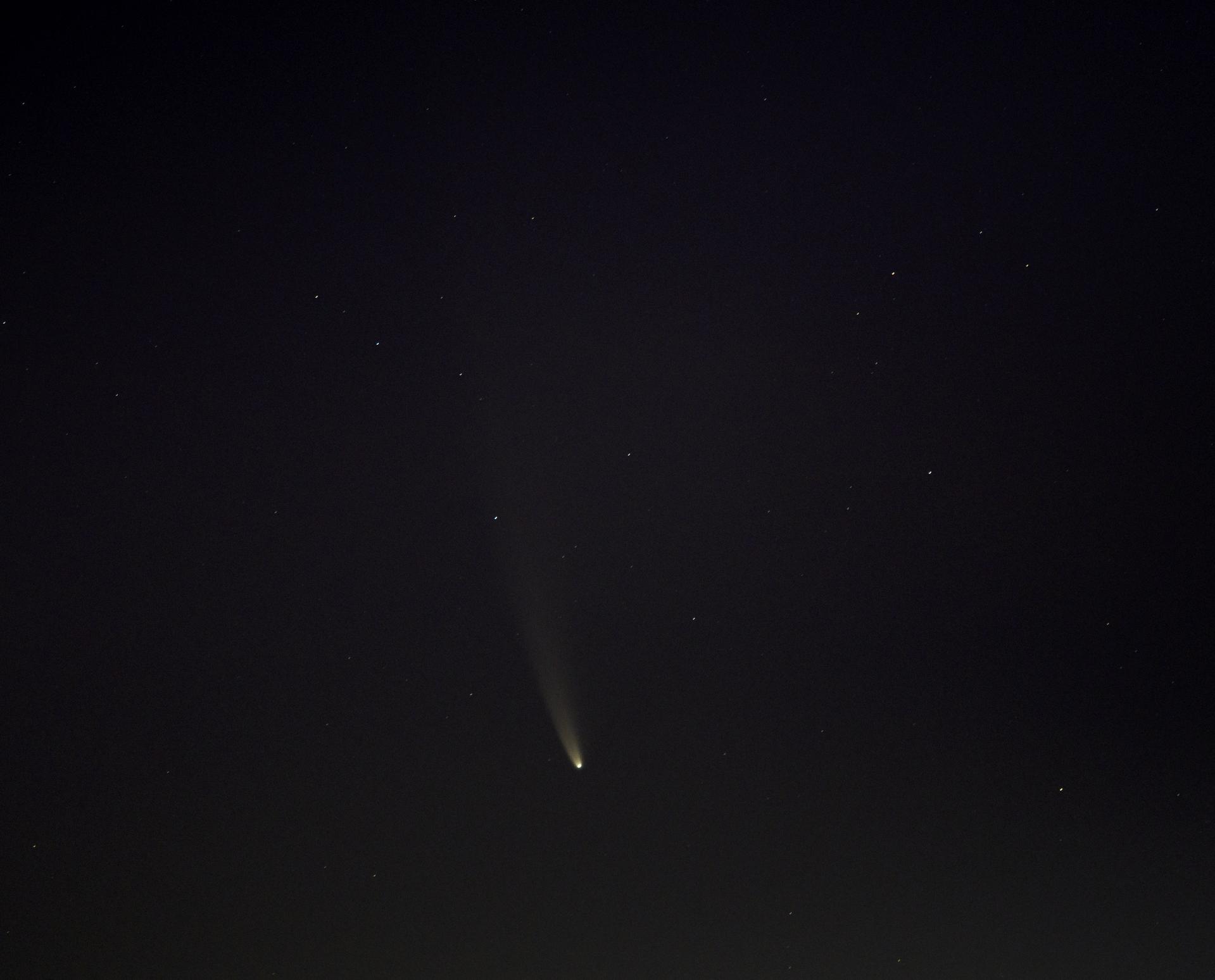
Most periodic comets live quiet lives. They swing in from the outer solar system, brighten predictably as sunlight warms their ice, round the Sun, and fade back into obscurity — visible only through large telescopes, if at all. Comet 220P/McNaught was supposed to be one of those. Instead, it has spent the summer of 2026 doing the opposite of quiet: erupting not once but twice, each time rocketing from a barely-detectable smudge into something backyard observers with binoculars can actually find.
The comet's latest moment in the spotlight came on August 24, when NASA's Astronomy Picture of the Day featured an image showing 220P roughly 20,000 times brighter than its normal baseline, its coma glowing a distinct green. The picture, credited to astrophotographer Spilios Asimakopoulos and shot from South Africa about ten days before publication, is only the most visible entry in a run of images amateur astronomers on two continents have been collecting since the comet first flared in late May.
A Comet With a Habit of Blowing Up
220P/McNaught was discovered by Robert H. McNaught on May 20, 2004, at Siding Spring Observatory in Australia, at a faint magnitude 17.7 — well beyond naked-eye or even casual-telescope range. It's a Jupiter-family comet with a 5.51-year orbital period, swinging between a perihelion distance of 1.559 AU and an aphelion of 4.68 AU. Nothing about that orbit is unusual. What's unusual is what the comet has done at this particular perihelion, which it reached on June 14, 2026.
The first outburst arrived in late May, just before perihelion: within a day or two the comet brightened by about seven magnitudes, from roughly magnitude 18 to magnitude 11, then kept climbing to a peak around magnitude 8.2 — up to an 8,000-fold increase in brightness from its normal, quiescent state. Then, on August 5, it did it again: a second outburst pushed the comet from around magnitude 14 back up to about magnitude 7, a jump of roughly 600-fold in a matter of days. Two significant eruptions from the same comet in a single apparition is a rare enough occurrence to draw sustained attention from observers.
What Observers Are Actually Seeing
The color is the first thing that stands out in the images: a distinctly green head, paired with a short dust tail trailing behind — the signature look of a comet caught near its brightest.
Two astrophotographers in Austria, Michael Jaeger and Gerald Rhemann, captured some of the more detailed structure in the outburst. Imaging from the Astronomisches Zentrum Martinsberg on August 9 at 1:35 UT, using a 16-inch telescope and an ASI 2600 MC camera in 2x2 binning mode across 18 exposures of 150 seconds each, they recorded striking structure within the coma — shell-like features that show up clearly under green-light filtering. Shells like these are typically read by cometary observers as concentric envelopes of material flung outward from the nucleus in discrete pulses, a visual record of the outburst happening in something closer to real time rather than a single instantaneous event.
Nobody Knows Exactly Why It's Erupting
Here's the part that keeps this from being a tidy story: astronomers don't have a confirmed explanation for what's triggering 220P's outbursts. The leading candidate ideas, as noted in the APOD write-up, are subsurface gas release — pockets of volatile material trapped beneath the comet's crust that suddenly vent when warmed or destabilized — or so-called "comet quakes," structural failures within the nucleus that expose fresh ice to sunlight all at once. Both mechanisms have been proposed for outbursts in other comets, but pinning down which one (or some combination) is responsible for 220P specifically remains unresolved.
What is known is where this is headed next: the comet will pass roughly 1 AU from Earth in October 2026, and observers expect it to fade rapidly afterward as its current burst of activity settles down. Whether it manages a third outburst before then is, characteristically, anyone's guess.
Why It Matters
Cometary outbursts are one of the few solar system phenomena that remain genuinely unpredictable even with modern monitoring — there's no reliable early-warning system for a comet like 220P deciding to brighten thousands of times over in a matter of days. Each documented event, especially one caught with the kind of detailed imaging Jaeger and Rhemann produced, adds a data point toward understanding what's actually happening inside these nuclei: whether it's buried pockets of subsurface gas venting to space, structural fracturing exposing fresh ice, or something else entirely. Because outbursts are transient and unpredictable, most of what's known about them comes from exactly this kind of opportunistic amateur observation — networks of astrophotographers across different hemispheres and time zones catching an object before it fades back into obscurity. 220P's back-to-back 2026 eruptions, and its upcoming close pass by Earth, give both amateur and professional observers an unusually good window to keep watching a genuinely unsolved cometary mystery play out.
