
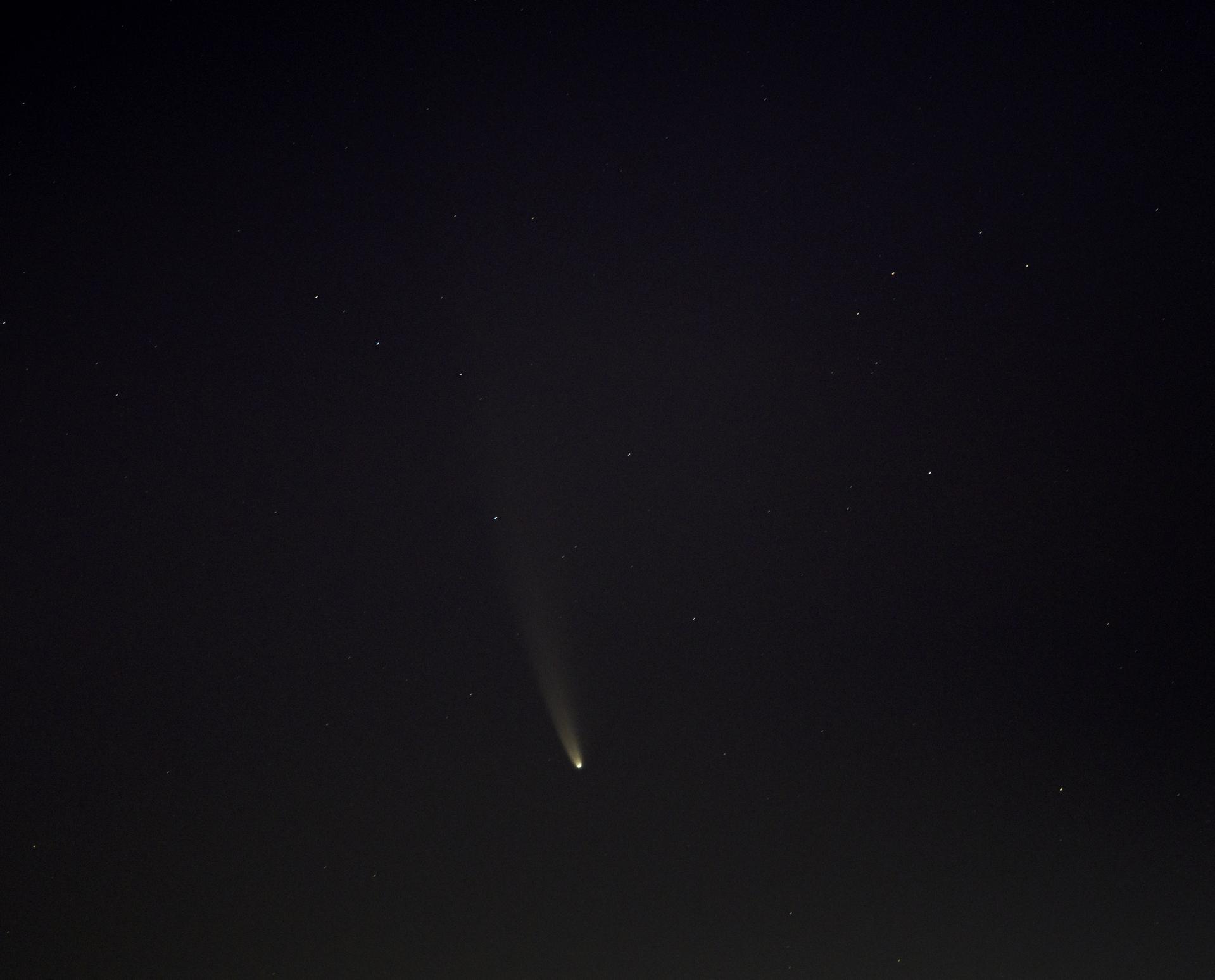
A comet that has been swinging past the Sun every five-and-a-third years since at least the 19th century just delivered its best show in decades. On August 2, 2026, 10P/Tempel 2 reached perihelion — its closest point to the Sun — at a distance of about 1.42 astronomical units (AU). Barely a day later, on August 3, the comet made its closest approach to Earth, passing roughly 0.41 AU away, or about 61 million kilometers, and brightened to somewhere around magnitude 8 to 9. That puts it within range of binoculars or a small backyard telescope under a dark sky, though nowhere near naked-eye visibility.
The timing is not a coincidence. Perihelion and closest Earth approach falling within a day of each other is exactly the geometry that makes a periodic comet's apparition worth circling on the calendar, and astronomers tracking 10P/Tempel 2 are calling this pass its best return for the remainder of the century.
What Makes This Apparition Special
10P/Tempel 2 is a Jupiter-family comet, meaning its orbit is gravitationally shepherded by Jupiter and confined to relatively modest distances from the Sun — its orbital solution puts perihelion at 1.4174 AU and aphelion out at 4.71 AU, with an orbital period of 1,958.85 days, or about 5.36 years. That solution comes from NASA/JPL's Small-Body Database, refined on July 28, 2026 using 6,347 observations stretching back to 2003.
The comet's nucleus is a substantial one by short-period comet standards, at roughly 10 kilometers across. Combine a reasonably large, active nucleus with an unusually close pass to both the Sun and Earth in the same few days, and you get a brightness spike that won't repeat on the next few trips around. According to Star Walk's August 4 report, the comet measured magnitude 9.2 that day — already fading slightly from its peak — and remains too faint to see without optical aid.
There's some divergence in the numbers on just how bright the peak got. In-The-Sky.org, reporting the day after perihelion, put peak brightness at around magnitude 7.4 on August 3, brighter than the ~8-9 range cited elsewhere. Cometary brightness estimates are notoriously fuzzy — comets don't behave like point sources with fixed reflectivity, and outbursts of gas and dust can swing estimates by a magnitude or more depending on who's measuring and when. Either way, the consensus is the same: this is a binoculars-and-small-telescope object, not a naked-eye spectacle.
Where and When to Look
10P/Tempel 2 is currently positioned in the constellation Capricornus, at right ascension 21h51m40s and declination -24°49', according to In-The-Sky.org's orbital elements sourced from the Minor Planet Center. That southerly declination is the key detail for anyone hoping to spot it: the comet sits low in the sky for observers north of the equator and is a far easier target from the Southern Hemisphere, where it climbs higher and stays visible longer after dark.
Moonlight is the other variable working against early viewers. A bright Moon washes out faint, diffuse targets like comets long before it affects sharper point sources like stars. The good news is that a New Moon falls on August 12, and the darker skies around that date should offer the best remaining window to catch 10P/Tempel 2 before it fades out of range. In-The-Sky.org's observing tables show the comet fading out of range by around August 17, giving skywatchers roughly a two-week runway from perihelion to lose it in the glare, with the New Moon window in the middle of that stretch representing the last realistic shot — and that runway stretches longer the further south an observer is located, given the comet's southerly declination.
For anyone planning to try, the practical checklist is straightforward: a pair of binoculars or a small telescope, a genuinely dark sky away from city lights, a location south enough that Capricornus climbs well above the horizon, and ideally a night close to August 12 when moonlight isn't competing. Star charts or a planetarium app will help pin down the comet's exact position night to night, since its right ascension and declination shift as it continues along its orbit.
Why It Matters
10P/Tempel 2 isn't a newly discovered object or a rare visitor from the outer solar system — it's a known, well-tracked Jupiter-family comet that astronomers have been observing across multiple apparitions since 2003 and earlier. What makes this particular pass noteworthy is orbital geometry: the near-simultaneous timing of perihelion and closest Earth approach won't recur in a way that produces a comparably bright apparition again this century. That makes August 2026 a rare opportunity to observe this specific comet at its best, and a useful data point for refining models of its nucleus activity, dust production, and long-term orbital behavior as Jupiter's gravity continues to shape its path. For amateur astronomers, it's also a reminder that some of the best celestial events aren't blockbuster naked-eye spectacles — they're modest, binocular-range targets that reward planning, dark skies, and knowing exactly when and where to look.
