
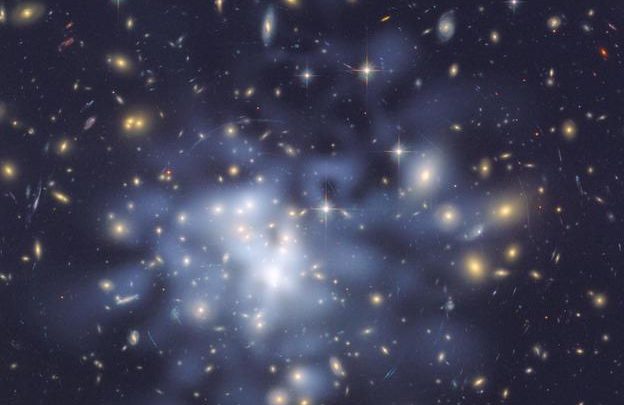
Fritz Zwicky was not a man who valued diplomatic restraint. He feuded with colleagues for decades, dismissed rivals' work with memorable contempt, and was widely considered by the astronomical community to be simultaneously brilliant and insufferable. He was also, by any reasonable historical measure, one of the most prescient astrophysicists of the twentieth century — and in 1933, while studying a cluster of galaxies in the constellation Coma Berenices, he saw something that nobody took seriously for forty years.
The Virial Theorem and a Factor of 400
The Coma Cluster sits 321 million light-years away and contains over 1,000 galaxies concentrated into a volume roughly 20 million light-years across. In 1933, Zwicky measured the line-of-sight velocities of a sample of Coma galaxies using the Doppler shift of their spectral lines. The velocity dispersion — the spread of speeds around the cluster's mean motion — was approximately 1,000 kilometers per second.
This is where the virial theorem enters. For a gravitationally bound system in equilibrium, the average kinetic energy of the members relates to the average gravitational potential energy by a fixed factor. If you know the velocities and therefore the kinetic energy of the galaxies, and you estimate the cluster's size, you can calculate the mass the system must have to keep those galaxies gravitationally bound rather than flying apart.
Zwicky ran the numbers. The mass implied by the virial theorem was roughly 400 times larger than the mass of all the visible galaxies added together. He called the missing component "dunkle Materie" — dark matter — and noted that either the cluster was not gravitationally bound or something massive and invisible was providing the gravitational glue.
Forty Years of Neglect
The scientific community mostly ignored Zwicky's result. The measurement was imprecise, the virial theorem required equilibrium assumptions that might not hold, and there was no theoretical framework that gave dark matter a compelling physical explanation. The discrepancy was noted and discussed only occasionally in the specialized literature of galaxy cluster dynamics.
The revival came in the 1970s through a different observational route. Vera Rubin and Kent Ford at the Carnegie Institution mapped the rotation curves of spiral galaxies — the velocity of stars and gas as a function of their distance from the galactic center. Standard Newtonian gravity predicted that velocities should fall off with distance. Instead, rotation curves remained flat: stars in the outer disk moved at nearly the same speed as those near the center, out to the limits of detection.
Flat rotation curves demanded mass that wasn't luminous — matter distributed throughout and well beyond the visible disk of each galaxy. The Zwicky discrepancy was no longer an isolated curiosity; it was the same problem showing up in a completely different observational context, at a completely different physical scale.
Modern Characterization
The Coma Cluster is now one of the most studied galaxy clusters in the sky. X-ray observations with the Chandra and XMM-Newton observatories reveal a vast halo of hot gas — the intracluster medium — at temperatures of 100 million degrees, trapped in the cluster's gravitational well. This gas, which outmasses the visible galaxies by a factor of six or more, was invisible to Zwicky but would itself be insufficient to resolve his mass discrepancy.
Gravitational lensing — the bending of background galaxy light by the cluster's mass — provides an independent mass measurement that requires no assumptions about the dynamical state of the cluster. Lensing maps of Coma confirm dark matter constituting roughly 80% of the total mass, broadly consistent across multiple estimation methods and fundamentally in agreement with what Zwicky inferred from first principles nine decades ago.
Within Coma, many member galaxies are "red and dead" — ellipticals that exhausted their star-forming gas long ago. The cluster environment is hostile to star formation: ram pressure stripping from the hot intracluster gas tears hydrogen away from galaxies that fall through the cluster, while tidal interactions shred smaller systems into stellar streams and ultracompact dwarfs.
The Particle Identity Problem
The particle identity of dark matter remains the most consequential open question in physics and cosmology. The leading candidates — weakly interacting massive particles (WIMPs), axions, sterile neutrinos — have each been constrained by increasingly sensitive direct detection experiments without producing a confirmed signal. The LUX-ZEPLIN experiment and XENONnT have probed WIMP parameter space that was once considered the natural target range and found nothing.
Zwicky's dunkle Materie has been confirmed across six decades of observations spanning galaxies, clusters, the cosmic microwave background, and large-scale structure. Its gravitational effects are measured with precision. Its nature — what it is made of, how it was produced in the early universe, whether it interacts with ordinary matter in any way other than gravity — remains as mysterious as it was in 1933 when an irascible Swiss astronomer looked at the Coma Cluster and noticed that the numbers didn't add up.
