
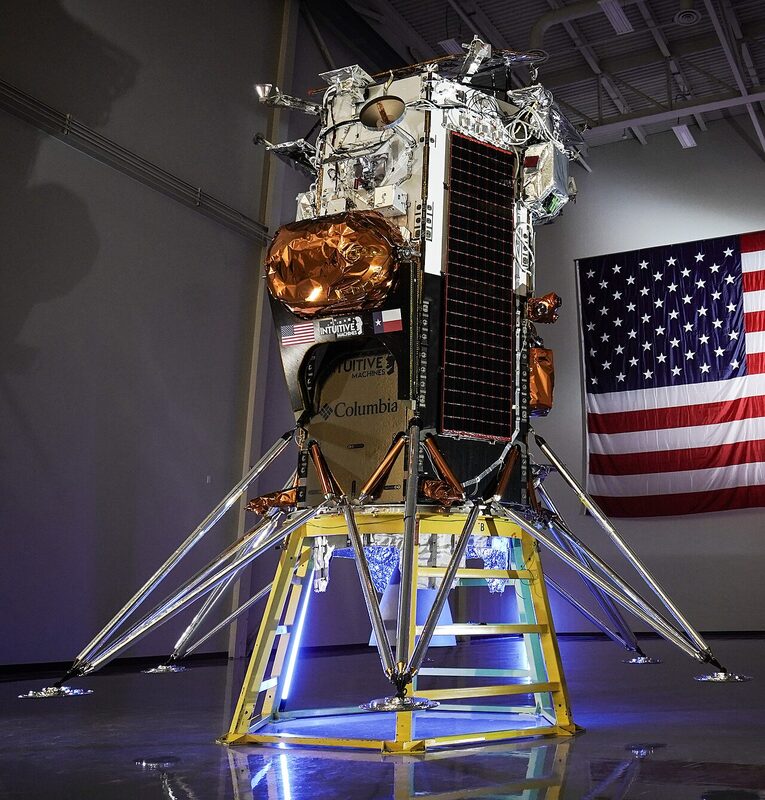
For most of the space age, landing on the Moon was something only governments did, at enormous expense, with spacecraft they designed and built themselves. NASA is now trying a different model. Through a program called Commercial Lunar Payload Services, or CLPS, the agency no longer builds its own small robotic landers; instead it buys cargo space on landers built and flown by private companies, paying a fare to deliver its instruments to the lunar surface. The idea is to seed a competitive industry of Moon-delivery firms and, in the process, get far more science to the surface for far less money. The result, in 2026, is a genuine rush of private spacecraft aiming for the Moon.
The 2026 manifest
Several missions are lined up. Intuitive Machines, the Houston company that in 2024 became the first private outfit to soft-land on the Moon, is preparing its third flight, IM-3, targeted for the second half of 2026. It aims for Reiner Gamma, one of the Moon's enigmatic "lunar swirls" — bright, looping markings associated with patches of magnetic field whose origin remains debated — carrying instruments to study that local magnetism. Firefly Aerospace, whose Blue Ghost lander pulled off a clean touchdown in early 2026, is readying Blue Ghost Mission 2, a more ambitious flight to the lunar far side that will also deploy the European Space Agency's Lunar Pathfinder communications orbiter on the way. Other entrants, including a Draper-led team flying a lander built by the firm ispace, are targeting the far side's Schrödinger Basin.
The economics are the whole argument. A traditional NASA robotic lander, designed and built in-house, can run well over a billion dollars and take many years. CLPS deliveries are a fraction of that — often in the range of a hundred to two hundred million dollars each — because NASA buys a service rather than a spacecraft and lets companies reuse the same lander design across many flights. The early returns have been mixed but real: Intuitive Machines reached the surface in 2024, the first American soft landing since Apollo, even though its craft tipped onto its side, and Firefly's Blue Ghost managed a clean, fully upright touchdown. Each flight, success or failure, is comparatively cheap, and the experience compounds.
A model that accepts failure
What makes CLPS distinctive is its tolerance for risk. Landing on the Moon is brutally unforgiving — there is no atmosphere to slow a descent, the final minutes are fully automated, and several early commercial attempts have tipped over, crash-landed, or fallen silent. NASA went into the program expecting some failures, treating CLPS as a portfolio: buy many relatively inexpensive flights, accept that some will not succeed, and still come out ahead on cost and cadence compared with the old approach of building one exquisite, expensive lander at a time. It is a philosophy borrowed from venture investing, applied to the surface of another world, and it represents a real cultural shift for an agency long defined by failure-is-not-an-option caution.
The stakes go beyond individual experiments. These landers are scouts for the Artemis program's larger ambitions, carrying instruments to probe the lunar environment, test technologies, and study the water ice locked in the Moon's polar regions — the resource that could one day make a sustained human presence affordable. They are also building something subtler: a commercial supply chain to the Moon, a roster of companies that know how to get there, so that when crewed missions and eventually lunar bases need cargo delivered, the capability already exists. The early flights are bound to include more hard landings and lost spacecraft; that is baked into the plan. But taken together, the 2026 wave marks a real transition — from the Moon as a destination reached by national flagship missions to the Moon as a place with regular, commercial, increasingly routine deliveries.
