
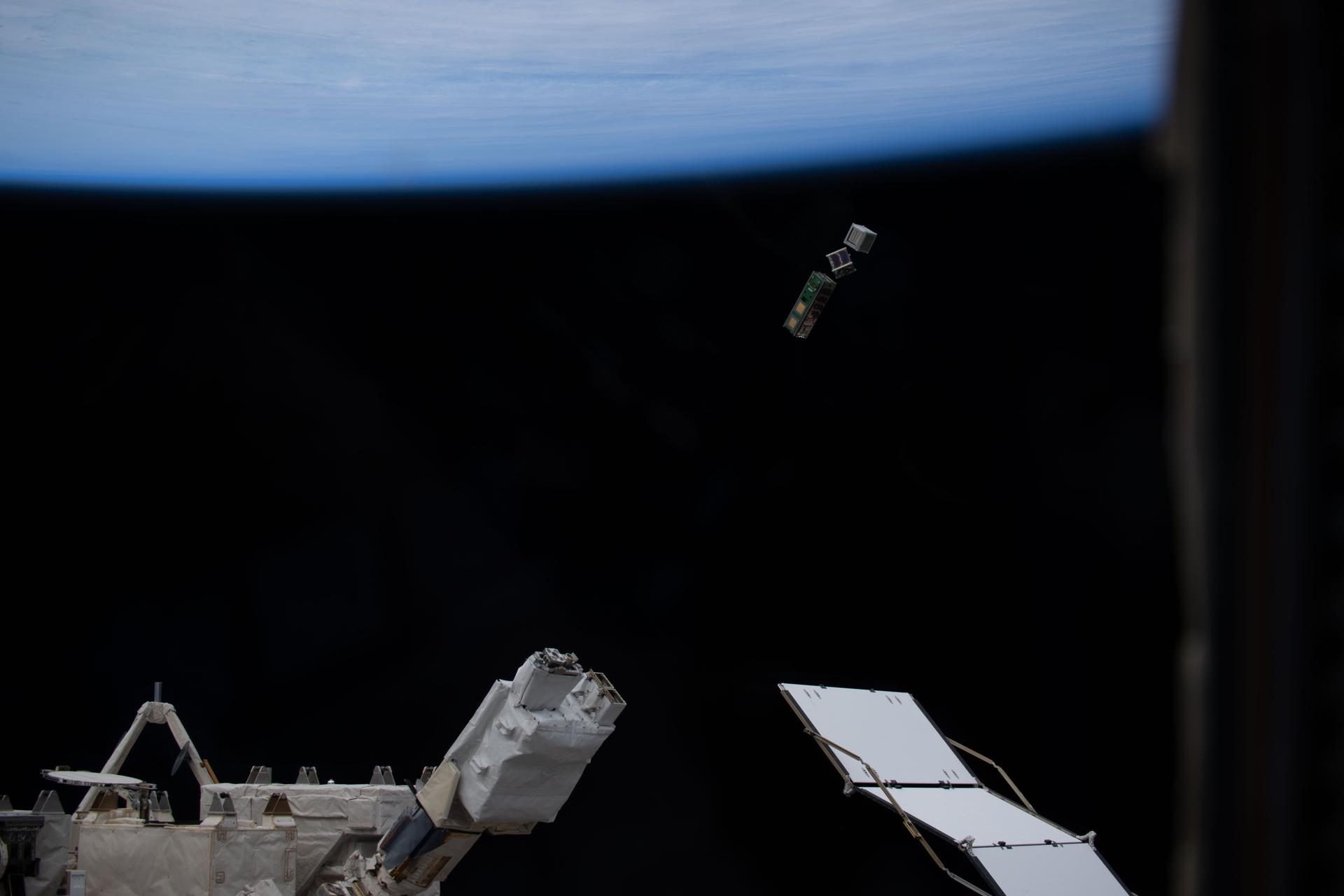
On July 7, a SpaceX Falcon 9 lifted off from Vandenberg Space Force Base carrying the usual crowded manifest of a Transporter rideshare mission — dozens of small satellites bound for sun-synchronous orbit, packed in like commuters on a rush-hour train. Tucked among them was a CubeSat that, for the first time, was drawing its power not from sunlight but from the radioactive decay of hydrogen.
The satellite is called BOHR, short for Betavoltaic Orbital High-Reliability, and it belongs to Miami-based City Labs. According to the company, BOHR is the first commercial spacecraft ever to fly with a nuclear power source, and the first commercial mission of any kind to make it through the federal government's dedicated licensing pathway for nuclear payloads.
How a Betavoltaic Cell Actually Works
City Labs' technology, branded NanoTritium, doesn't work anything like the plutonium-238 radioisotope thermoelectric generators (RTGs) that have powered NASA's deep-space probes since the Voyager era. Instead of converting heat from decay into electricity through thermocouples, a betavoltaic cell captures beta particles — electrons — thrown off as tritium decays, and lets them strike a semiconductor p-n junction directly. The particle collision generates current in much the same geometric arrangement as a solar cell generates current from photons, except the "light source" is baked into the device itself rather than arriving from 93 million miles away.
That distinction is the entire point. Tritium has a half-life of 12.3 years, and City Labs says BOHR's power source is engineered to keep functioning for more than 20 years on that slow, steady decay curve — with output that has nothing to do with whether the satellite is in daylight, eclipse, or wedged into a crater that never sees the sun at all.
Clearing a Regulatory Pathway That Didn't Exist for Commercial Players
Launching anything radioactive has historically been the domain of national space agencies, subject to interagency safety reviews that commercial companies rarely had reason to navigate. That changed with National Security Presidential Memorandum-20 (NSPM-20), which established a formal U.S. government framework for authorizing space nuclear systems — including, for the first time, a route for commercial payloads.
City Labs says the FAA issued BOHR an affirmative payload authorization on September 30, 2025, making it the first commercial mission to clear that pathway. Getting there required a criticality hazard analysis and other technical reviews described in FAA Advisory Circular AC 450.45-1, which lays out what applicants launching space nuclear systems must demonstrate before the agency will sign off on a launch as consistent with public health, safety, and national security.
The FAA didn't do that review alone. Sandia National Laboratories, which runs a standing program for space nuclear launch safety analysis under the NSPM-20 framework, independently reviewed and validated City Labs' safety case before the FAA granted authorization. Sandia's role is essentially that of a technical backstop: the lab has decades of experience evaluating radiological risk for U.S. space missions and provides the independent analysis regulators lean on when a nuclear payload is headed for the pad.
A Q&A on What This Actually Changes
Is a betavoltaic cell dangerous the way a nuclear reactor is?
No — the physics aren't comparable. There's no fission chain reaction, no criticality event to sustain, just the passive decay of tritium that would happen whether or not it was sealed inside a semiconductor sandwich. The FAA's own licensing framework for these systems still treats them seriously enough to demand a criticality hazard analysis before signing off on a launch.
Why not just use bigger solar panels?
Solar panels stop working when there's no sun, and in some of the places City Labs and its government partners are most interested in, that's a permanent condition. Permanently shadowed craters near the lunar poles — prime real estate for water-ice prospecting — never see direct sunlight. Deep space missions far from the sun face the same problem in a different form, where panel area has to grow enormously just to collect a trickle of photons.
Who's paying for this?
BOHR's funding includes a Department of War contract (FA9453-25-C-X003) and a $1.5 million DARPA award through a program called Rads to Watts, according to City Labs. The military and intelligence interest in power sources that don't care about eclipse periods or shadowed terrain is not subtle.
Why It Matters
Spacecraft power has quietly been one of the harder constraints in mission design for seventy years. Solar arrays are cheap, well-understood, and useless in the dark — a limitation that has shaped where missions can go and how long rovers, landers, and satellites can survive lean periods. RTGs solved the darkness problem for flagship NASA missions, but they rely on plutonium-238, a scarce, expensive, government-controlled material that has never been available to commercial companies at any practical scale.
A tritium betavoltaic cell is a different trade-off: lower power density than an RTG, but built from a far more available isotope and, crucially, now blessed by a licensing pathway a private company can actually use. If BOHR performs as designed over its intended multi-decade lifetime, it opens the door to commercial hardware — landers, rovers, relay satellites, sensors left in a lunar crater — that doesn't need to chase sunlight or carry batteries sized for the worst-case eclipse. That's a narrow but real expansion of where commercial space hardware can credibly operate, and it establishes a regulatory precedent that the next company with a nuclear payload won't have to build from scratch.
