
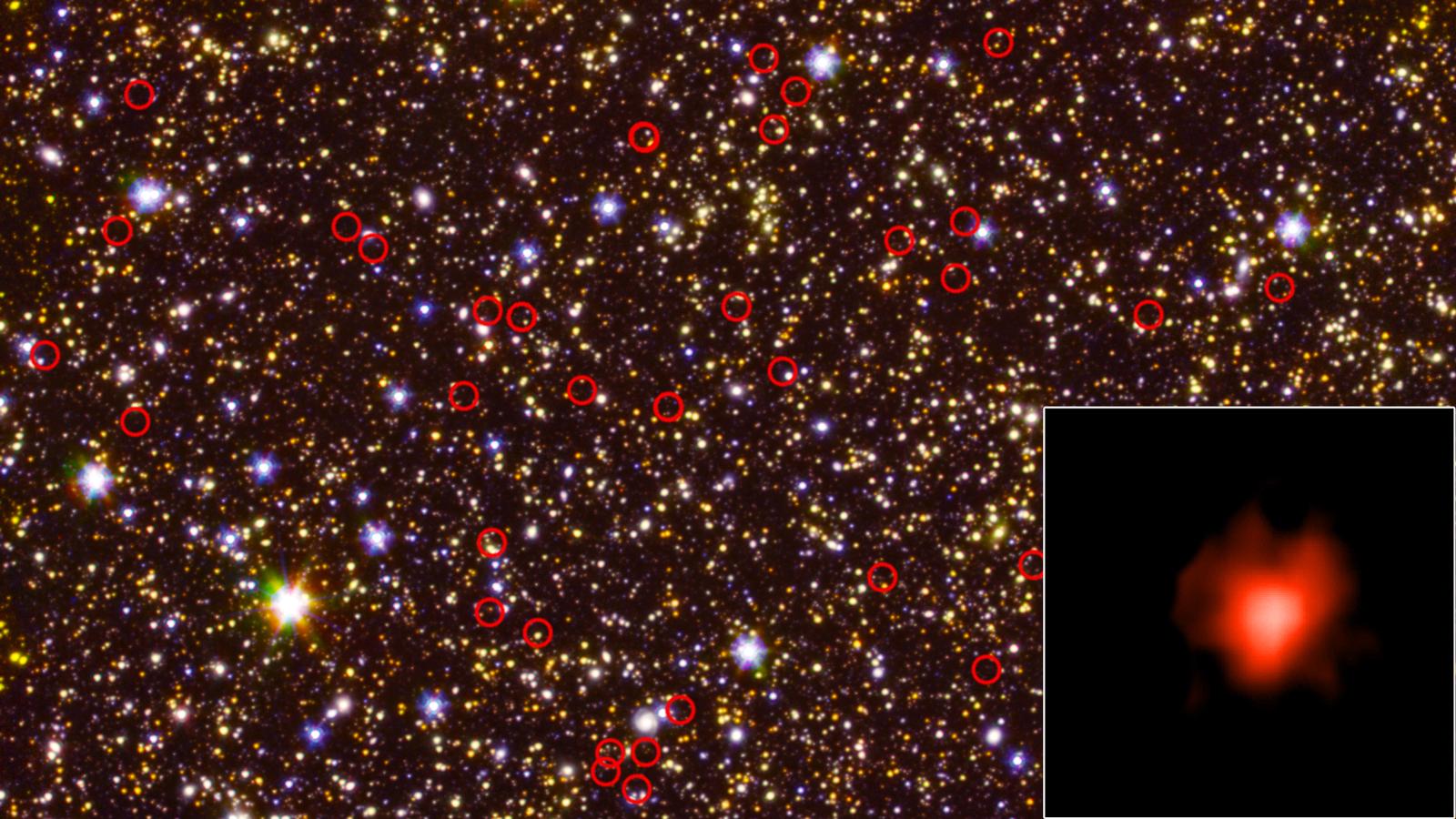
Hydrogen is the most abundant element in the universe, and it is nearly invisible at the scales cosmologists care about. Neutral atomic hydrogen emits a feeble radio line at a wavelength of 21 centimeters. Mapping the combined glow of that gas, without resolving individual galaxies, is the idea behind "intensity mapping." The Canadian Hydrogen Intensity Mapping Experiment, CHIME, has now shown that the method can stand on its own: a detection of the cosmological 21 cm signal using only CHIME's observations, from a time when the universe was about 5 billion years old.
The result appears in two papers in The Astrophysical Journal, announced on Sept. 28, 2026 through a University of British Columbia release. One reports the detection itself. The other interprets what the measured signal says about how hydrogen is distributed.
What CHIME actually saw
CHIME is a radio telescope near Penticton, British Columbia, hosted by the National Research Council of Canada. According to the UBC release, it is built and operated by scientists at the University of British Columbia, McGill University, the University of Toronto and the Dominion Radio Astrophysical Observatory, along with other North American collaborators that include Arizona State University.
The detection paper, "Detection of the Cosmological 21 cm Signal in Auto-correlation at z~1 with CHIME", was first submitted to arXiv on Nov. 24, 2025, with a second version posted March 26, 2026. It uses 94 nights of data and the frequency range 608.2 to 707.8 MHz. Because the 21 cm line is stretched by cosmic expansion, that band corresponds to redshifts from z=1.34 down to z=1.01. The measurement covers wavenumbers between 0.4 and 1.5 h/Mpc, which is to say structure on large scales.
The overall detection significance is 12.5 sigma. Split into two independent sub-bands, the signal shows up at 8.7 sigma at z~1.08 and 9.2 sigma at z~1.24. The UBC release says the data came from 94 nights of observations in 2019, a small fraction of the nearly seven years of data CHIME has collected.
"Auto-correlation" is the point
Until now, the UBC release says, CHIME had to cross-correlate its observations with galaxy survey data from other telescopes. Auto-correlation asks the radio map to correlate with itself, with no external catalog involved.
That is harder because the distant hydrogen glow is easily swamped. Independent coverage from Knowridge notes that noise from nearby technology, the telescope itself and much brighter sources in space can hide it. The authors describe novel radio-frequency-interference detection and masking, achromatic beamforming and foreground filtering before time averaging as improvements to the processing pipeline. The abstract says the result demonstrates CHIME's capability to probe large-scale structure through 21 cm intensity mapping without reliance on external galaxy surveys.
The UBC release says the team spent more than a year testing the finding to confirm it was a signal from the universe and not a false alarm. For a measurement that has to be separated from much stronger contaminating sources, that caution is appropriate.
The interpretation paper and a tension
The companion paper, "Interpretation of 21 cm Auto Power Spectrum Measurement at z~1 by CHIME", was submitted March 26, 2026, and covers the same band and k range. Its abstract reports that the measurement disagrees with the TNG100 simulation at 3.1 sigma and the TNG300 simulation at 4.0 sigma. The authors say the disagreement is most likely attributable to the strength of nonlinear redshift-space clustering of neutral hydrogen in the simulations. The UBC release lists the interpretation paper's DOI as 10.3847/1538-4357/ae9747 and the detection paper's as 10.3847/1538-4357/ae9835, both in The Astrophysical Journal.
A mismatch with a simulation is not a problem with the detection. It is arguably the opposite: a clean measurement that the models do not yet reproduce is useful data about how hydrogen actually traces matter.
How much hydrogen are we talking about?
Not much, proportionally. In the UBC release, co-author Shabbir Shaikh says the data indicate that roughly 2% of the hydrogen in the universe was in neutral atomic form at this time, broadly consistent with other measurements. Neutral atomic hydrogen is the form that radiates at 21 cm. That CHIME can pick out a large-scale pattern from such a small fraction, through much brighter contaminating signals, is much of what makes the result notable.
Why It Matters
The release frames the result as a new route for investigating dark energy, the mysterious force thought to be driving the universe to expand faster over time. Knowridge describes it the same way: a step toward a new way of studying dark energy, using CHIME's own observations without data from another galaxy survey.
The practical value is in cost and reach. According to the release, galaxy surveys cost millions more dollars and focus only on the part of the universe hot and dense enough to form stars. A radio telescope that maps the combined glow of hydrogen directly does not need to resolve individual objects. If auto-correlation measurements can be made reliable, large-scale structure at these epochs becomes accessible from radio data alone.
There are caveats. This is one detection, from a slice of the available data, and the 4.0 sigma tension with the TNG300 simulation shows that interpreting the signal will take modeling work. The release carries comments from researchers including Arnab Chakraborty, Mark Halpern and Simon Foreman, and is the place to read the team's own framing; the papers themselves do not yet deliver a dark energy constraint.
What comes next
The next step named in the release is extending the analysis to earlier periods in cosmic history, when the universe was only about 3 billion years old, and using more of CHIME's nearly seven years of observations rather than 94 nights from 2019. More data should tighten the error bars on the measurement.
The Phys.org posting of the UBC release carries the full quotes and the institutional details.
Sources
- Detection of the Cosmological 21 cm Signal in Auto-correlation at z~1 with CHIME (arXiv:2511.19620)
- Interpretation of 21 cm Auto Power Spectrum Measurement at z~1 by CHIME (arXiv:2603.25680)
- Hydrogen's distant glow opens new way to investigate dark energy (University of British Columbia release via Phys.org)
- A Faint Hydrogen Glow Could Help Reveal How the Universe Expands (Knowridge)
