
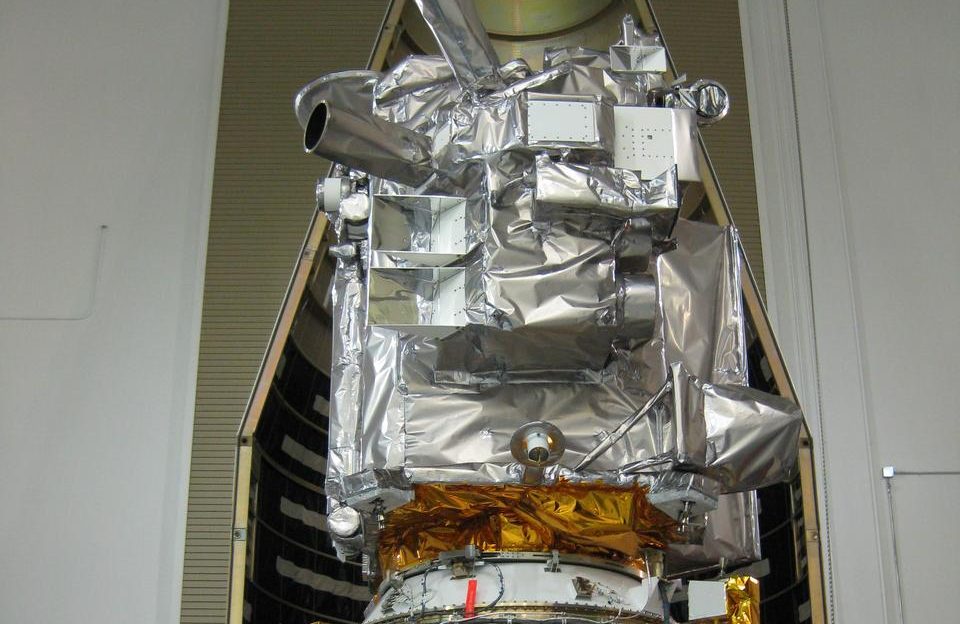
The lunar south pole is the most contested piece of real estate in the solar system right now, and no one has actually been there yet. NASA's Artemis program has spent years pointing at it from a distance, delayed by politics, hardware, and the perennial optimism of institutional schedule-making. China's Chang'e program, operating with less fanfare and considerably more consistency, is closing in. Chang'e 7 — scheduled for launch no earlier than 2026 — represents Beijing's most technically ambitious robotic lunar mission to date, and its scientific objectives are far more precise than the vague "we're going to the south pole" headline suggests.
The mission isn't a single spacecraft. It's a convoy: an orbiter, a lander, a rover, a relay satellite, and — most unusually — a small flying probe designed to do something no lunar surface mission has ever done. Understanding what Chang'e 7 is actually attempting requires understanding the peculiar physics of the south polar region, and why that frozen geography has become the central obsession of every major space agency on Earth.
Why the south pole, and why now
The Moon's axial tilt is only about 1.54 degrees — nearly perpendicular to its orbital plane. The practical consequence of this is that the floors of deep craters near the poles never see sunlight. Never, in any meaningful sense. Some of these permanently shadowed regions, or PSRs, have not received direct solar radiation in billions of years. They are, thermally speaking, among the coldest stable environments in the solar system, with temperatures that can drop below 40 Kelvin. At those temperatures, volatile compounds — water ice, carbon dioxide, ammonia, methane — can persist essentially indefinitely.
Evidence for water ice in these regions has been accumulating for decades. NASA's LCROSS mission in 2009 intentionally crashed a spent rocket stage into the Cabeus crater and confirmed the presence of water in the resultant plume. India's Chandrayaan-1 orbiter detected hydrogen signatures consistent with ice deposits. More recently, data from the Lunar Reconnaissance Orbiter has mapped PSRs in fine detail, and the picture that emerges is of a south polar terrain threaded with cold traps holding a potentially enormous inventory of frozen volatiles. Some estimates put the total water ice content in the billions of tons, though the distribution and accessibility remain uncertain.
This is not an academic question. Water ice at the lunar south pole is the most strategically valuable resource in cislunar space. Electrolyze it, and you have oxygen for life support and hydrogen for rocket propellant. A depot of locally sourced propellant at the lunar surface dramatically changes the economics of deep space exploration. It's why NASA, China, Russia, the European Space Agency, and a growing number of commercial operators have all converged on the same target. The south pole is not just scientifically interesting. It is potentially the key node in a future infrastructure for sustained human presence beyond Earth orbit.
Five spacecraft, one mission
What distinguishes Chang'e 7 from every prior lunar south pole mission — including the largely successful Chandrayaan-3, which landed near but not in a permanently shadowed region in August 2023 — is the sheer operational complexity of what China's National Space Administration is attempting simultaneously.
The relay satellite, which will be inserted into a halo orbit around the Earth-Moon L2 Lagrange point, handles a fundamental communications problem: the south pole's topography is rugged and the horizon low, making direct radio contact with Earth intermittent. The orbiter carries a suite of scientific instruments including a microwave radiometer and a synthetic aperture radar to characterize the surface from above. The lander and rover handle surface operations from a sunlit ridge near Shackleton Crater — one of the best-characterized potential landing zones, where solar power is available for extended periods while the PSRs lie within relatively close proximity.
Then there is the flying probe. This small vehicle — sometimes called the mini-flying detector in Chinese space agency documentation — is designed to detach from the lander, hop on a cold-gas thruster system, and fly into the permanently shadowed interior of a nearby crater. It carries a mass spectrometer and cameras intended to directly sample and characterize the volatile-rich environment inside a PSR for the first time. No spacecraft has ever deliberately entered a permanently shadowed lunar region and returned data. The technical demands are severe: the vehicle must operate in extreme cold, in complete darkness, with limited communication windows and no ability to recharge its batteries via solar power. The entire excursion would likely last only a few hours.
This is the element of Chang'e 7 that deserves far more attention than it typically receives. If the flying probe successfully enters a PSR and returns compositional data on the volatiles present, it will represent a genuine first in lunar exploration — more scientifically consequential in some respects than any lunar landing since Apollo 17.
The geopolitical subtext
It would be naive to discuss Chang'e 7 purely in terms of its scientific program. The mission is taking place against the backdrop of explicit competition between the United States and China for influence over the norms, standards, and physical presence that will define the next era of lunar activity. NASA's Artemis Accords — a set of bilateral agreements governing responsible behavior in space — now count over forty signatory nations, but China and Russia have declined to join, viewing the framework as a unilateral attempt by the United States to set terms favorable to American interests.
China has instead developed its own framework, the International Lunar Research Station, a proposed permanent robotic and eventually crewed facility at the lunar south pole, developed in partnership with Russia and open to other nations. Chang'e 7 is explicitly the first mission in the ILRS program. Chang'e 8, planned for around 2028, would follow with resource utilization experiments. Crewed landings could follow in the early 2030s.
The practical question of who gets to land where matters more than it might seem. The most accessible PSR cold traps, the sunlit ridges with line-of-sight to them, and the relatively flat terrain suitable for landing are not evenly distributed across the south pole. There are a limited number of truly premium sites, and both Artemis and ILRS planners have identified many of the same locations. The Outer Space Treaty formally prohibits national appropriation of the Moon, but it says nothing about physical presence, and presence tends to create facts on the ground. NASA's Artemis III, when it eventually flies, will put astronauts somewhere in the south polar region. If Chang'e 7 and 8 have already established operational infrastructure at the most desirable sites, the coordination challenges — and the potential for friction — become considerably more complex.
None of that changes what Chang'e 7's instruments will actually measure. The science is real regardless of the politics driving the timeline. A successful mission would give planetary scientists their first in-situ confirmation of what, exactly, is sitting in those ancient frozen craters — and that data will be shared, at least eventually, because scientific reputations depend on publication. The Moon is large enough for both programs to operate. Whether the humans running those programs can manage the proximity remains the more open question.
