
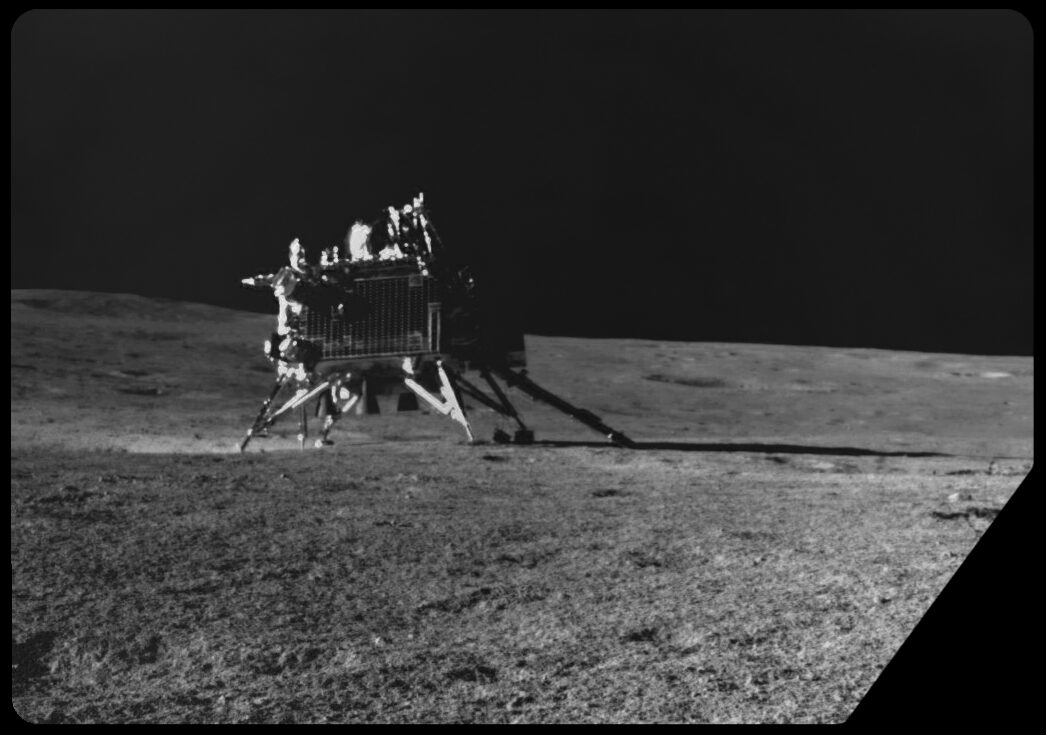
Russia's Luna-25 crashed four days before Chandrayaan-3 landed. The contrast was stark: a nation with 60 years of lunar spaceflight heritage failed at a site near the same target, while India's third lunar mission succeeded with a lander design that had been revised specifically to handle the failures that had caused Chandrayaan-2's lander to crash in 2019. The landing, at 6:04 PM Indian Standard Time on August 23, 2023, was broadcast live and watched by tens of millions. The Vikram lander touched down at approximately 69.37 degrees south latitude — the highest latitude ever achieved by a soft landing on the Moon — and the Pragyan rover deployed from its belly the following day.
The south polar region was targeted because it is where water ice is most likely to survive. Permanently shadowed craters in the south hold some of the coldest surfaces in the solar system, where temperatures can drop below minus 200 degrees Celsius and ice deposited over billions of years by comets and asteroid impacts may have been preserved intact. This ice is scientifically interesting as a record of volatile delivery to the inner solar system, and practically interesting as a potential resource for future human missions. Chandrayaan-3 did not land inside a shadowed crater — Vikram would have lost solar power — but landed on a sunlit plateau near enough to the polar region to conduct the first in-situ geochemical investigation of the south polar terrrain.
What the instruments found
Pragyan carried two scientific instruments: a laser-induced breakdown spectroscope (LIBS) that vaporizes small surface patches to identify their elemental composition, and an alpha particle X-ray spectrometer (APXS) that does the same more slowly. The rover drove approximately 100 meters during its two-week operational window and performed compositional measurements at multiple locations. The results confirmed the presence of sulfur — the first in-situ detection of sulfur at the lunar south polar region — along with aluminum, calcium, iron, chromium, titanium, manganese, silicon, and oxygen. The sulfur concentration was unexpectedly high compared to near-side Apollo samples, suggesting either a compositional difference between near and far side (or polar) terrain or a contribution from impactors.
Vikram's seismometer recorded what mission scientists described as a "natural event" — a vibration lasting about 4 seconds — that may have been a small moonquake or a meteorite impact. The instrument was too simple to distinguish between the two sources definitively, but the detection confirmed the instrument's sensitivity.
Sleep and silence
After two weeks, Pragyan and Vikram entered sleep mode as the lunar night approached, with temperatures expected to drop below what their batteries could survive. Mission controllers programmed both to attempt to reactivate when sunlight returned two weeks later. Neither did. ISRO announced in September 2023 that no contact had been re-established, suggesting the extreme cold of the lunar night damaged one or both spacecraft beyond recovery. The mission had nevertheless achieved its primary objectives and returned data from a region never before accessed in situ.
Chandrayaan-3's success reshaped the lunar exploration landscape. India is now a demonstrated soft-landing nation, with the operational competence to return and iterate. ISRO's next lunar mission, Chandrayaan-4, aims for a sample return — a significantly more complex objective. The south pole region Pragyan explored will be revisited by Artemis astronauts before the end of this decade, by JAXA's LUPEX rover with ESA collaboration, and by multiple commercial landers. Chandrayaan-3 was the first to arrive in that neighborhood and find it remarkable. The unexpected sulfur detection is already generating papers: sulfur on the lunar surface at polar latitudes has implications for the regolith chemistry that future human settlers would need to understand, since sulfur compounds affect the sintering behavior of regolith used in construction and the toxicology of dust that astronauts would inevitably breathe. Pragyan's two weeks of driving produced data that will inform mission planning for years before any boots touch the same soil.
