
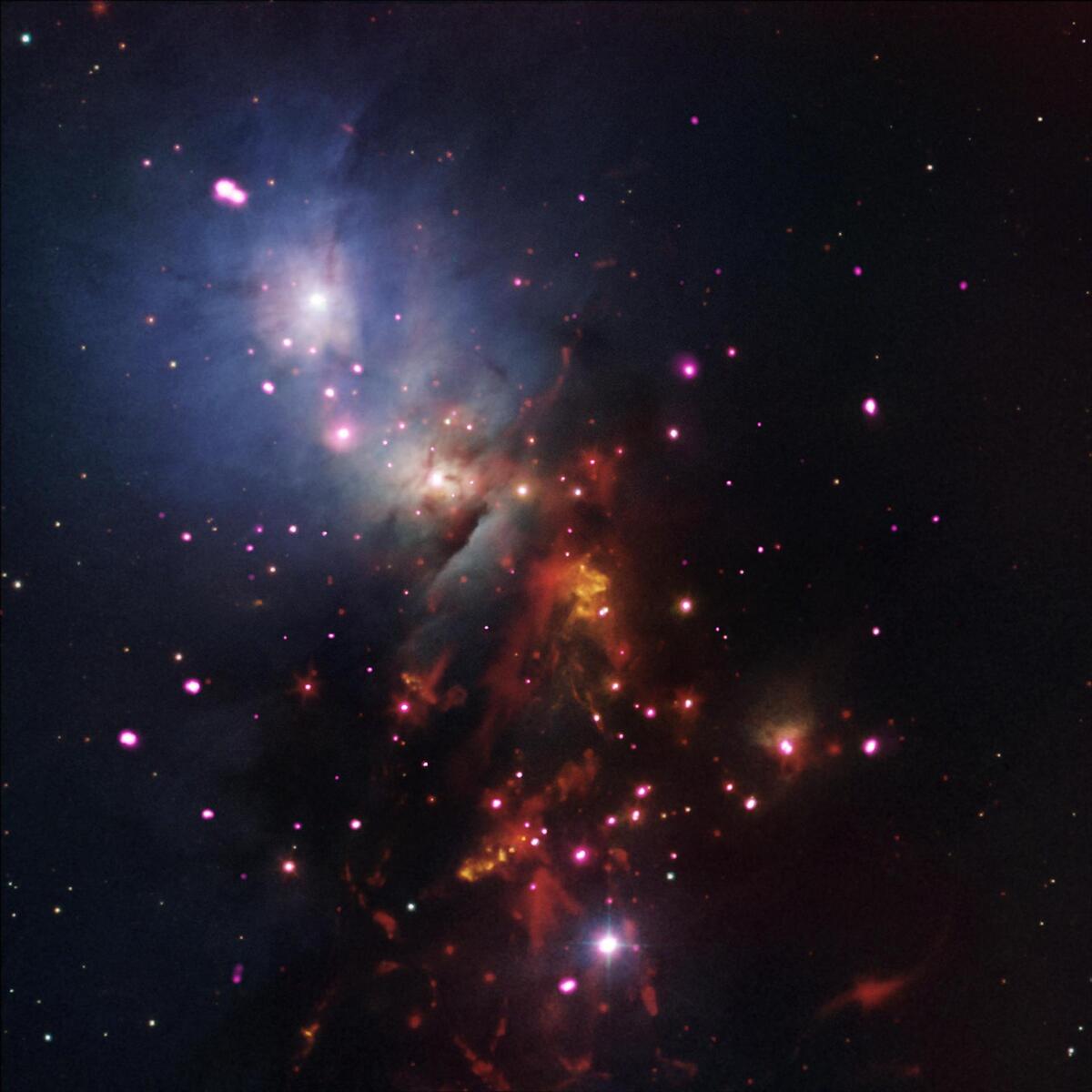
In September 2005, astronomers observing the globular cluster NGC 6540 witnessed something unusual: a transient X-ray source that flared up abruptly, brightening roughly 100-fold over the course of five minutes before fading away. The event was brief—just 300 seconds of intense activity—yet its sheer luminosity and peculiar characteristics made it difficult to classify. Was it a stellar outburst? A cataclysmic event in a binary system? Something more exotic? For two decades, the answer remained unclear.
Today, new observations using NASA's Chandra X-Ray Observatory have transformed that single mysterious event into a more complex story. Instead of one source, researchers resolved the flare region into three distinct X-ray sources, separated by just 1.5 to 2.5 arcseconds on the sky. The resolution finally allowed astronomers to begin sorting through the possibilities—while simultaneously revealing that the mystery may be deeper than anyone expected.
The Resolution Challenge
Globular clusters like NGC 6540 are dense, ancient collections of stars packed into regions only a few light-years across. In such crowded environments, X-ray astronomy becomes an exercise in precision. Without sufficient angular resolution, multiple nearby sources can blur together into what appears to be a single object. For decades, earlier X-ray missions simply didn't have the sensitivity to separate closely-spaced sources in such a dense stellar environment.
That changed with Chandra's deep observations. The facility's exceptional angular resolution made it possible to tease apart what had previously looked like a single flaring event. What emerged was not one mysterious transient, but three separate sources labeled A, B, and C, each with its own properties and position.
Beyond resolving the flare region itself, Chandra also detected six additional X-ray sources within just one arcminute of NGC 6540's center, enriching the cluster's known X-ray population and providing important context for understanding its stellar composition and evolution.
What the Flare Was Not
The improved positional accuracy from Chandra's observations allowed researchers to narrow down optical counterparts for the sources, particularly source A, which was considered the most likely candidate for the original flare. This process of elimination proved almost as revealing as a positive identification would have been.
Type I X-ray bursts from accreting neutron stars in low-mass binary systems emerged as an obvious candidate—these events can produce sudden, dramatic brightening events lasting seconds to minutes. Yet the 300-second duration and the observed luminosity didn't quite fit this scenario. Similarly, stellar flares, whether driven by magnetic reconnection or other processes, typically produce much softer X-ray emission and lack the characteristic signatures seen here.
The researchers also ruled out more exotic possibilities, including binary self-lensing (where one component of a binary temporarily magnifies light from its companion) and the involvement of an intermediate-mass black hole—objects whose presence in globular clusters remains theoretically contentious. The flare's properties simply didn't align with these mechanisms.
What remained was a more limited set of possibilities, yet none fully satisfying. The resolution of the flare into three sources actually deepened the puzzle: which, if any, of the three sources was responsible for the original brightening? And if none of them were accreting neutron stars or stellar flares, what could produce such a transient event?
The Broader Context
This investigation exemplifies how astronomical mysteries often don't yield clean answers. Instead, deeper observations reveal layers of complexity that prevent simple classification. The three resolved sources and the additional X-ray detections now offer astronomers a more complete picture of the cluster's hot stellar population. Whether the original flare proves to be a rare event from one of these sources, or whether it represents an entirely different class of transient phenomenon yet to be understood, remains an open question that future observations may eventually resolve.
Why It Matters
Transient and variable X-ray sources in globular clusters serve as cosmic laboratories for understanding extreme physics—accretion, neutron stars, binary evolution, and stellar interactions in dense environments. A single unexplained flare might seem like a minor mystery, but such anomalies often hint at either rare events or entirely undiscovered phenomena. The characterization of NGC 6540's X-ray population and the resolution of its 2005 flare into distinct sources advances our ability to catalog and classify such events, refining our understanding of what globular clusters can produce.
More broadly, this work demonstrates the enduring scientific value of archival data combined with improved instrumentation. A transient event that occurred more than two decades ago has become newly interpretable thanks to Chandra's capabilities and the persistence of astronomers willing to revisit old puzzles. As X-ray astronomy technology continues to advance, similar re-examinations of archival mysteries may yield new insights into the high-energy universe.
