
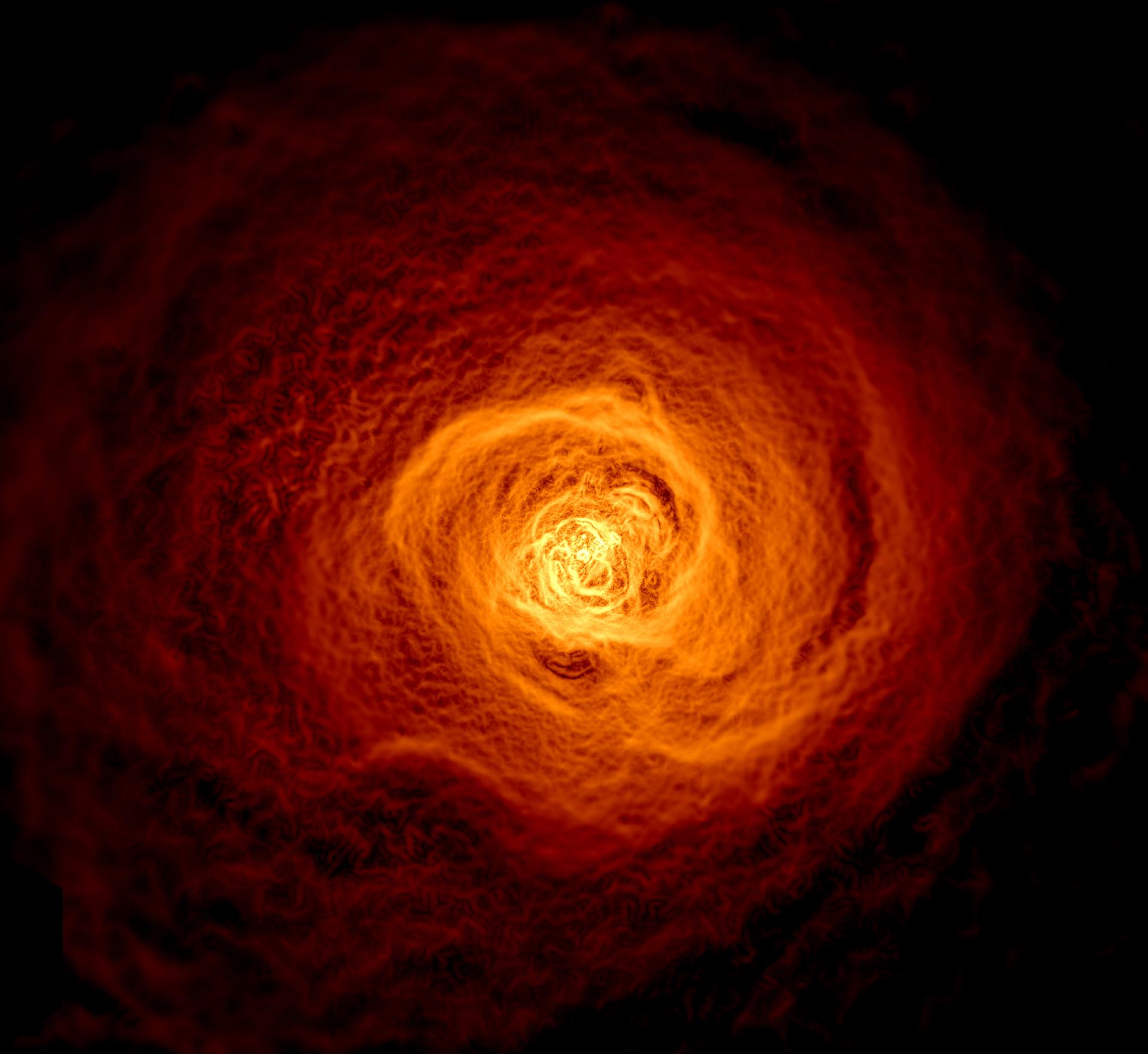
Some of the strangest objects in the radio sky sit where astronomers can least easily study them. VLSS J0318.9+5755, nicknamed the "Treble Clef" for its curling shape, lies almost directly behind the plane of the Milky Way. Our galaxy's stars, gas and dust largely block the view from Earth, which made an explanation for the structure particularly difficult to find.
A new analysis combining X-ray data from NASA's Chandra X-ray Observatory and the eROSITA telescope with radio observations from LOFAR and infrared imaging from UKIRT has worked out its origin. According to NASA, the Treble Clef likely took shape in two steps. First a supermassive black hole erupted. Later, two galaxy clusters collided and brought the faded remains of that eruption back into radio view. The paper, led by Andrea Botteon of Italy's National Institute for Astrophysics (INAF), appears in Astronomy & Astrophysics, and the findings were released on Oct. 14, 2026.
Looking Through the Zone of Avoidance
Astronomers call the strip of sky behind the galactic plane the Zone of Avoidance. A preprint on arXiv titled "The Treble Clef radio phoenix and its old nonthermal filaments" reports that the team noticed a peculiar, bright and filamentary radio source in data from the LOFAR Two-meter Sky Survey (LoTSS) at a Galactic latitude of only about 0.5 degrees. In practice that puts it almost exactly on the Milky Way's midplane.
That location helps explain why the object's identity was uncertain. The arXiv paper notes that the source was originally believed to be a pulsar, and was later suggested to sit in a heavily obscured galaxy cluster behind the Galactic plane. The new work characterizes that host cluster for the first time.
X-rays settled the question. NASA says Chandra and eROSITA found diffuse, hot gas at the location of the Treble Clef, showing that a galaxy cluster hosts the object. The X-ray data showed one more thing: the researchers determined the cluster is, in fact, two clusters in the process of merging, not one settled cluster.
The preprint says the team used Chandra and SRG/eROSITA to work out the host cluster's redshift, mass, temperature, X-ray luminosity and dynamical status. It describes the result as a massive, merging galaxy cluster in the Zone of Avoidance.
Two Steps: Outburst, Then Collision
The proposed history has two stages.
Stage one: the eruption. An earlier outburst from a supermassive black hole in the galaxy cluster's center drove clouds of charged particles and magnetic fields away at close to the speed of light. NASA says this initially produced bright radio waves. The glow did not last. As the particles lost energy, the radio emission faded.
Stage two: the revival. Then the two galaxy clusters collided. According to NASA, the collision compressed or re-energized the cloud, which became brighter again in radio waves. Shock waves from the collision, which NASA likens to the sonic booms from supersonic jets, may have played a role in that re-energizing. The arXiv preprint classifies the Treble Clef as a radio phoenix.
The X-rays also give a rough timeline. By removing the symmetrical, roughly oval shape of most of the cluster's hot gas, the team produced a residual X-ray image that is brightest on the left and right and faintest in the center. NASA says that pattern implies a collision along the left-right direction in the composite image. The researchers think the direct collision happened a few hundred million years ago, and the clusters are now moving away from each other.
Reading the Radio Spectrum
The radio data supports the story in its own way. The preprint describes a multifrequency, spatially resolved spectral analysis that combines new follow-up data from the upgraded Giant Metrewave Radio Telescope (uGMRT) with the LOFAR LBA Sky Survey (LoLSS). The key figure is a spectral index, alpha, reaching values greater than 4 between 400 and 650 MHz.
That is an extremely steep spectrum, meaning the emission gets much fainter as the observing frequency increases. The authors describe it, together with the source's highly filamentary morphology and its brightness at frequencies at or below about 1 GHz, as what makes the source an ideal follow-up target. The preprint's title also refers to "old nonthermal filaments," which points to the stringy structure within the source.
The Treble Clef may not be the only interesting radio feature in this cluster. The preprint says the gas motions generated during the ongoing merger are also likely responsible for a candidate radio halo tentatively observed in the cluster center. The authors say the source is an ideal target for high-resolution, very-low-frequency follow-up observations with LOFAR2.0.
About That Shape
The musical symbol is a coincidence. NASA's release calls the resemblance pareidolia, the phenomenon in which people see familiar shapes in random data, since there is no scientific connection to the musical notation. The release adds a second reading of the same structure: a dragon viewed from the side. The preprint speculates that the source's complex morphology is shaped by gas motions generated in the intracluster medium during the ongoing merger.
The official Chandra Photo Album release from the Chandra X-ray Center presents the composite image. It shows Chandra and eROSITA X-rays, LOFAR radio data and UKIRT infrared data, and gives the same account: a black hole outburst followed by a two-cluster collision.
Why It Matters
The Treble Clef is presented as a radio phoenix: radio emission that faded after a black hole outburst and was brought back by a later cluster merger. Working out that sequence for one object, as the Botteon team has done, gives astronomers a worked example to compare with other sources.
The location matters too. The Treble Clef shows that a massive merging cluster almost exactly behind the Milky Way's midplane can still be characterized using radio, X-ray and infrared observations together. Here that combination identified a source originally believed to be a pulsar as a radio phoenix in a merging cluster, a cluster whose two components collided a few hundred million years ago and are now moving apart.
The open questions are where the authors point. They include the candidate radio halo at the cluster's center, the old filaments and the very steep spectrum. The preprint names LOFAR2.0 as the instrument for follow-up observations.
