
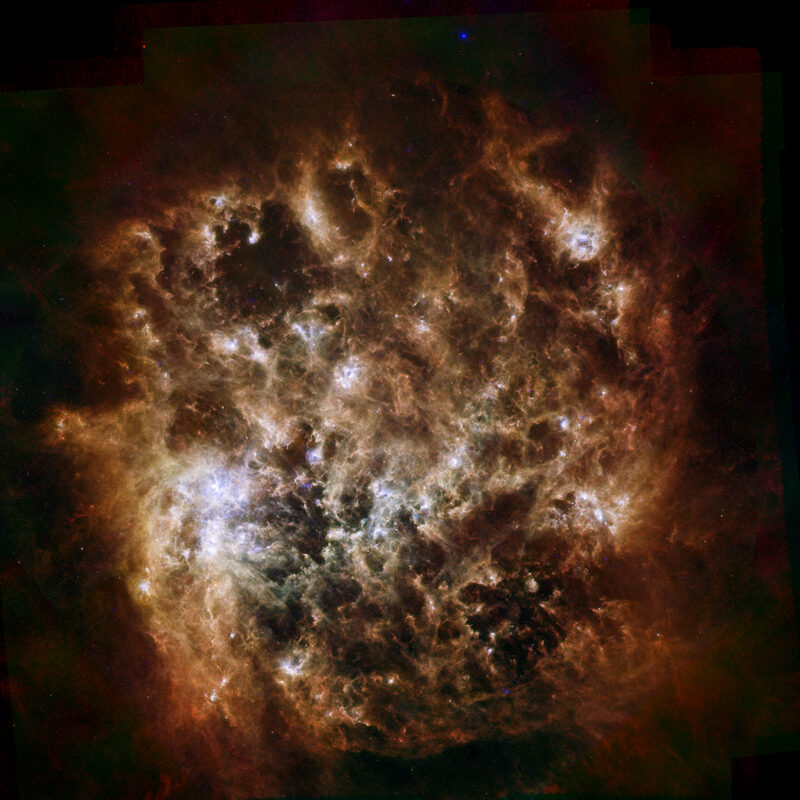
Henrietta Swan Leavitt worked at the Harvard College Observatory at the turn of the 20th century as a "computer" — a woman hired to analyze photographic plates for low wages, performing the mathematical work that the observatory's male astronomers required but would not do themselves. Her assignment was to catalog variable stars in the Small and Large Magellanic Clouds, the satellite galaxies of the Milky Way visible from the southern hemisphere. In 1908, and then more definitively in 1912, she published a result that would reshape the scale of the known universe: among the Cepheid variable stars she had cataloged, the brighter ones pulsed more slowly. The relationship between pulsation period and intrinsic luminosity was not approximate or statistical. It was a tight, smooth line that held across the full range of Cepheids she could measure.
Cepheids pulse because of an instability in their outer layers. The ionization state of helium in the atmosphere changes cyclically: when helium is doubly ionized, the layer is opaque and traps radiation, driving expansion; as the layer expands and cools, helium recombines into a more transparent state, releasing radiation and allowing contraction. The cycle repeats with a period that depends on the star's surface gravity and temperature — and since gravity and temperature scale with luminosity in a predictable way, the period is directly linked to luminosity. A Cepheid with a period of 10 days is intrinsically about 3,000 times more luminous than the Sun. A Cepheid with a period of 50 days is about 20,000 times more luminous. Measure the period from your telescope; look up the luminosity; compare with the apparent brightness; compute the distance. The technique works across millions of light-years.
Hubble's expansion
In the 1920s, Edwin Hubble used Leavitt's period-luminosity relationship to measure the distance to the Andromeda Nebula. His result — roughly 900,000 light-years, later revised to 2.5 million — placed Andromeda decisively outside the Milky Way, settling the decade-long "Great Debate" about whether the spiral nebulae were inside or outside our galaxy. Hubble then extended the Cepheid distance ladder to more distant galaxies and combined the distances with recession velocity measurements to establish what became Hubble's Law: galaxies recede at a velocity proportional to their distance. The proportionality constant, now called the Hubble constant, describes the expansion rate of the universe. Cepheids measured the distance. Cepheids anchored the expansion.
A century later, the Hubble Space Telescope's Key Project used Cepheids to measure the Hubble constant more precisely than anything that had come before. The result — 70 to 72 km/s/Mpc, depending on calibration choices — established the modern framework of cosmology. But Gaia satellite parallax measurements have refined the Cepheid calibration at the closest distances, and Hubble followed by Webb has pushed Cepheid measurements deeper into the universe. The result from the Cepheid distance ladder is now converging on about 73 km/s/Mpc, in persistent tension with the 67.4 km/s/Mpc derived from the cosmic microwave background. This "Hubble tension" is one of the most significant open problems in cosmology, and at its root sits Leavitt's 1912 period-luminosity relationship — the same discovery that has been calibrated, recalibrated, extended, and argued over for a century without losing its central role.
Leavitt's legacy in the modern era
Henrietta Leavitt never received the Nobel Prize. She died in 1921, and the Prize is not awarded posthumously. In 1924, the Swedish mathematician Gösta Mittag-Leffler wrote to Leavitt intending to nominate her, unaware she had died three years earlier. Her colleague Edwin Hubble, who used her work to measure the scale of the universe, received the glory. The Leavitt Law — the period-luminosity relationship she discovered — now anchors a century of cosmic distance measurement. The Hubble Space Telescope, which extended her work to the edge of the observable universe, was named for the man who applied what she found. Her name was given to an asteroid, a crater on the Moon, and a law of physics that underlies everything cosmologists know about how far away anything is. The Hubble tension — that 5-sigma disagreement between CMB and distance-ladder Hubble constants — sits at the intersection of her work and the work of everyone who came after her. The distance ladder stands on what she built; so does the argument about whether it is correctly calibrated.
