
For most of astronomy's modern history, our solar neighborhood has seemed reasonably well-mapped. We knew the stars within 30 or 40 light-years. We tracked the stellar nurseries where new ones were being born. We had a functional taxonomy of what kinds of objects populated the local galaxy. Then the James Webb Space Telescope started pointing at seemingly empty patches of sky, and the census started coming apart.
Brown dwarfs — the failed stars that never achieved the core temperatures needed to sustain hydrogen fusion — have always been theoretically abundant. The models predicted them in large numbers. But they are cold, dim in visible light, and radiate most of their energy deep into the infrared, where ground-based observatories struggle and where the Hubble Space Telescope was essentially blind. Previous surveys like 2MASS and WISE caught the brightest, warmest members of this population. The coldest and most distant ones were invisible. Webb, with its 6.5-meter segmented mirror cooled to near absolute zero and instrumented specifically for mid-infrared light, does not have this problem.
What it has found is a population of objects hiding in plain sight.
The Coldest Objects, Seen at Last
Brown dwarfs span an enormous temperature range. The warmest, classified as L and T dwarfs, were accessible to earlier infrared missions and number in the thousands of known examples. But below roughly 500 Kelvin — the Y dwarf regime — objects become extraordinarily faint. Their atmospheres begin to form water ice clouds and, at the coldest end, possibly ammonia ice. These are conditions more reminiscent of a gas giant's atmosphere than anything we usually call a "star." Before Webb, only a handful of Y dwarfs had been confirmed, and their measured temperatures and luminosities were poorly constrained because even Spitzer, NASA's previous infrared space telescope, could barely detect them.
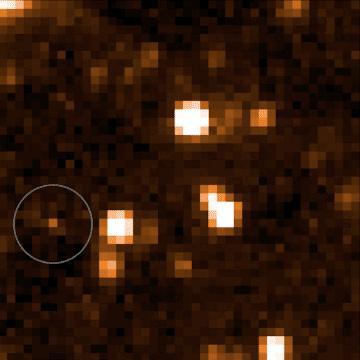
Early Webb programs targeting the solar neighborhood have changed that picture rapidly. The JWST GLIMPSE survey and dedicated programs using NIRCam and MIRI have identified candidate brown dwarfs at distances where they would have been completely undetectable to prior missions. Some of these objects have estimated effective temperatures below 400 Kelvin — cooler than a kitchen oven — and would have remained unknown indefinitely without Webb's sensitivity. Several confirmed discoveries sit within 15 light-years of the Sun, filling in what researchers now recognize as genuine gaps in the local stellar inventory, not just observational limitations that could be explained away.
The JWST data have also produced surprises about brown dwarf companions. A number of nearby stars previously thought to be single turn out to have dim substellar companions orbiting at wide separations. These objects were not missed because they are rare — they were missed because the contrast ratio between a star and a cold brown dwarf companion is enormous at visible wavelengths and only becomes manageable in the mid-infrared, where Webb excels.
What the Numbers Might Mean
The question of how many brown dwarfs exist relative to stars is, technically speaking, a question about the stellar initial mass function — the distribution of masses that emerge from a star-forming cloud. At the low-mass end, this distribution has been contested for decades. If it is flat or rises toward lower masses, brown dwarfs could be at least as common as hydrogen-burning stars. Some theoretical models allow for a population that exceeds the stellar count in the galaxy by a factor of several. The observational evidence, long hampered by detection limits, has consistently suggested high numbers without nailing them down.
The accumulating Webb detections are beginning to provide the statistics needed to constrain the function properly. The specific shape of the mass function at the hydrogen-burning limit — roughly 0.075 solar masses — has implications not just for stellar demographics but for estimates of baryonic dark matter (the ordinary matter we cannot easily see), the kinematic heating of the galactic disk over time, and the likelihood of free-floating planetary-mass objects, which occupy the blurry boundary below brown dwarfs and above the canonical gas giants.
That boundary is itself a matter of active debate. Webb has already found free-floating objects in the Orion Nebula Cluster — dubbed "Jupiter Mass Binary Objects" or JuMBOs — that appear to be planetary-mass bodies ejected from forming stellar systems or possibly formed directly from cloud fragmentation. These discoveries complicate the categorization scheme that separates planets from brown dwarfs from stars, which has always been partly definitional rather than reflecting a clean physical divide. Formation pathway matters as much as mass when classifying these objects, and Webb is finding examples that strain both criteria simultaneously.
Reading an Atmosphere Through a Cold Haze
Beyond counting brown dwarfs, Webb is enabling detailed atmospheric characterization at a level that simply did not exist before. The telescope's NIRSpec and MIRI instruments can capture transmission and emission spectra that reveal molecular abundances, cloud structure, and chemical disequilibrium in brown dwarf atmospheres — the same techniques used to study exoplanet atmospheres, applied here to objects close enough to yield high signal-to-noise data.
The cold Y dwarfs are particularly revealing. Their spectra show absorption features from water, methane, and carbon monoxide in ratios that depend sensitively on the temperature and gravity of the object. Carbon-to-oxygen ratios in these atmospheres carry information about where and how the object formed, offering a window into the conditions in the protostellar cloud that produced it. Some brown dwarfs show evidence of vertical mixing that dredges up chemical species from deeper, hotter layers — a process called disequilibrium chemistry that was theorized long before it could be confirmed observationally with this clarity.
This matters because brown dwarfs are the nearest analogs we have to directly imaged giant exoplanets. The exoplanets detected by direct imaging around other stars are, at current technology limits, mostly young and hot — they are easier to see precisely because they retain the heat of formation. Studying the spectral properties of cold brown dwarfs gives atmospheric scientists the calibration data they need to interpret those exoplanet spectra correctly. A model tuned to match a Y dwarf is a model that can be trusted on a cold directly-imaged exoplanet.
There is also the question of habitability, which sounds counterintuitive for objects that are not stars. Brown dwarfs do sustain a period of hydrogen fusion — specifically deuterium fusion — for the first tens of millions of years after formation, and they radiate warmth for billions of years after that. Several researchers have pointed out that a planet orbiting a brown dwarf in the appropriate zone could, in principle, maintain liquid water conditions for geological timescales. Webb has not found such planets, but it has now established that brown dwarfs are sufficiently common in the solar neighborhood that searching for orbiting companions becomes scientifically reasonable rather than speculative.
The revised count is still taking shape. As dedicated survey programs accumulate data and work through the follow-up observations needed to confirm candidates and measure parallaxes, the true local population of cold brown dwarfs will sharpen into focus. The current expectation among researchers working the data is that the final number will be substantially higher than pre-Webb estimates. The galaxy, it turns out, is full of dim, cold, failed stars that spent billions of years evading our instruments. Webb is finding them now, one dark patch of sky at a time.
