
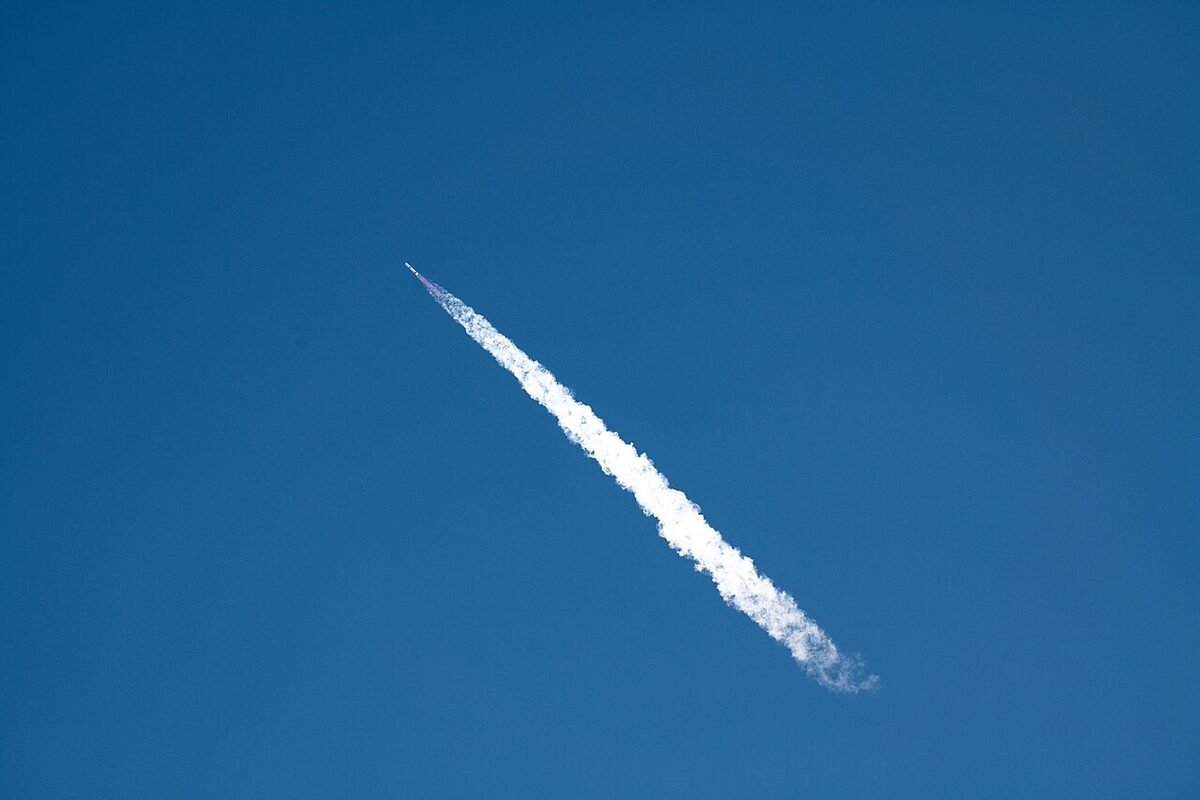
On 28 May, a New Glenn rocket detonated during a static-fire test at Launch Complex 36 at Cape Canaveral, in what observers described as the largest explosion the spaceport has seen. The vehicle was destroyed and the pad badly damaged. No one was hurt — static fires are uncrewed, ground-bound tests — but the blast did something a launch failure usually doesn't: it took out the infrastructure as well as the rocket, turning a vehicle problem into a facility problem.
Blue Origin's response was characteristically ambitious. Chief executive Dave Limp said the company intends to repair the complex and have another New Glenn on the pad before the end of 2026 — a timeline that, for the scale of damage involved, is roughly half what comparable rebuilds have taken elsewhere. Whether that holds is an open question. Pads are not quick to resurrect, and the investigation into what caused the explosion has to conclude before anyone bolts a new rocket down on the same concrete.
The lander caught in the blast radius
The reason this matters beyond Blue Origin's own ledger is sitting in a test chamber. The company's Blue Moon Mark 1 lander — an uncrewed cargo lander named Endurance — was selected by NASA for an early Moon Base delivery and has been moving through environmental testing, including a run in a giant thermal-vacuum chamber. It is meant to demonstrate the cryogenic propulsion, avionics, and precision-landing systems that a later, crew-capable Blue Moon Mark 2 will need under Artemis. And it was supposed to fly on New Glenn.
With New Glenn grounded indefinitely, NASA has moved to separate the two problems. The agency is, in effect, decoupling the lander from its launch vehicle — keeping Blue Moon's development on track while treating the question of how it gets to space as a solvable, swappable variable. NASA's leadership has gone further, publicly urging that an alternative launcher be lined up for Blue Origin's landers so the hardware isn't held hostage to a single rocket's recovery. The message is that the lander is too important to Artemis to let a pad explosion stall it.
What Endurance is meant to prove is worth spelling out, because it explains why NASA is so reluctant to let it slip. The Mark 1 is a cargo-class lander — no crew — built to demonstrate the building blocks a human lander needs: cryogenic propulsion that can be stored and reignited in space, avionics to navigate to the surface autonomously, and precision landing accurate enough to set down near pre-positioned assets. Get those working on Mark 1 and the larger, crew-rated Blue Moon Mark 2 inherits a proven foundation. Lose a year, and the whole Blue Moon timeline — already aimed at supporting an Artemis crewed landing later this decade — slides with it. That is the calculation behind NASA's unusual move to find Endurance a different ride rather than wait for New Glenn: the lander's schedule has value independent of the rocket that was supposed to carry it.
What it means for the Moon program
Step back and the strategic picture sharpens. NASA deliberately bought two lunar landers — SpaceX's Starship variant and Blue Origin's Blue Moon — precisely so it would not be captive to either. The logic was redundancy. But in mid-2026 both providers are wrestling with their flagship rockets: Starship is grounded pending a mishap investigation of its own, and New Glenn has just destroyed its pad. For the moment, NASA's near-term lunar ambitions lean heavily on SpaceX, the further-along of the two, while Blue Origin rebuilds.
That is an uncomfortable place for a program whose entire premise is competition and backup. It also vindicates the decision to fund two landers in the first place: a single-provider Artemis would now be entirely at the mercy of one company's bad month. Redundancy is expensive and looks wasteful right up until the moment one of your options is sitting in pieces on a launch pad. NASA is betting that decoupling lander from rocket buys it the flexibility to keep both paths alive. The next year of pad repairs and return-to-flight investigations will show whether the bet pays.
