
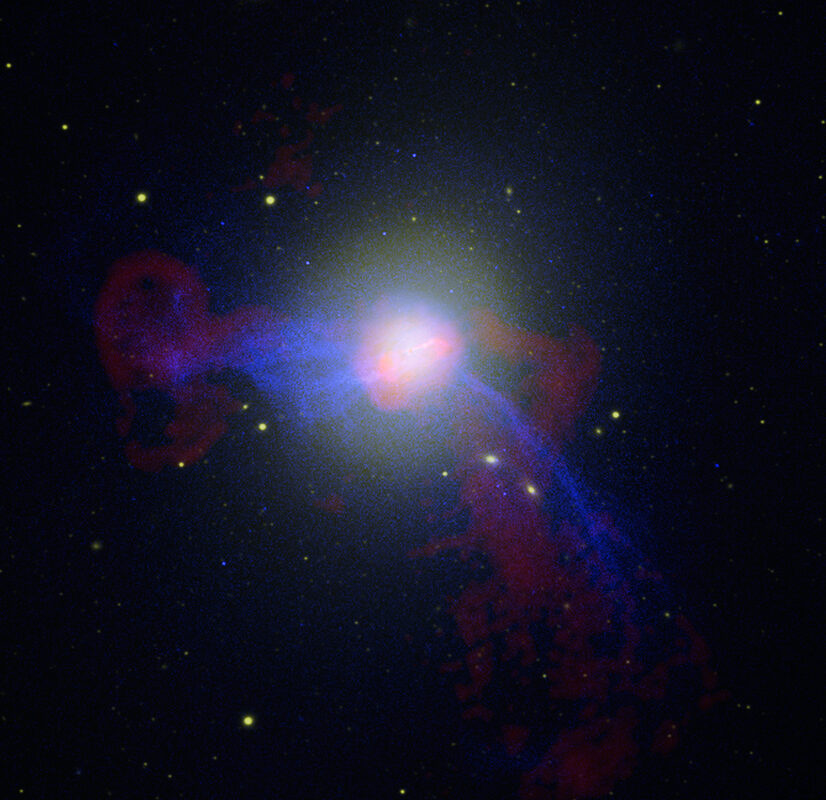
The galaxy M87 is an elliptical giant in the Virgo Cluster, 55 million light-years away, and it has been photographed thousands of times. What makes it unusual is what the photographs show: extending from its core, a jet of blue-white plasma stretching 5,000 light-years into the surrounding space, moving outward at an apparent velocity greater than the speed of light. The apparent superluminal motion is an optical illusion of geometry — the jet is aimed nearly toward Earth, and the geometry of relativistic motion makes a plasma blob approaching at 99 percent of light speed appear to cross the sky faster than light. The jet is real. The plasma in it is real. The violence required to launch it is real. The physics of how it forms is one of the central unsolved problems in high-energy astrophysics.
M87's jet emerges from an active galactic nucleus powered by a supermassive black hole — the same black hole photographed by the Event Horizon Telescope in 2019. That image, the first direct photograph of a black hole's shadow, showed a bright ring of emission surrounding a dark central region 6.5 billion solar masses in extent. The ring is radiation from the accretion disk of infalling gas. The shadow is the photon capture sphere, the region from which even light cannot escape. The jet emerges from somewhere in this environment, likely from the interaction between the accretion disk and the black hole's magnetic field.
The Blandford-Znajek mechanism
The leading theoretical explanation for jet formation is the Blandford-Znajek mechanism, proposed in 1977 by Roger Blandford and Roman Znajek. A rotating black hole, surrounded by a magnetized accretion disk, can transfer rotational energy from the black hole itself to plasma in the jet through the frame-dragging of spacetime. The magnetic field lines threading the ergosphere (the region outside the event horizon where spacetime is dragged along by the rotating black hole) become twisted by the rotation, extracting angular momentum and powering the jet. The process can in principle extract enormous amounts of energy from a black hole spin — in M87's case, the jet luminosity is consistent with powering by a rapidly spinning 6.5-billion-solar-mass black hole through this mechanism.
The question of how plasma is loaded into the jet — where the particles that form the observable jet come from — is separate from the question of how the jet is powered. Pair production from high-energy photons near the black hole, entrainment of gas from the accretion disk wind, or injection from the corona of the disk are all viable mechanisms. The 2019 EHT image resolved the jet launching region at the scale of a few Schwarzschild radii — the size of the event horizon — and subsequent observations with a higher frequency array have begun to show the transition between the jet base and the extended structure. The observations are converging with the Blandford-Znajek model at the qualitative level, but the quantitative details of particle acceleration and the jet's collimation into the narrow beam observed at large distances remain active areas of theoretical and observational work.
Beyond M87
Relativistic jets are not rare. Every quasar — the most luminous objects in the universe — has a jet or had one in the past. Blazars, the most extreme AGN, are quasars with their jets aimed directly at Earth, the beam amplified by relativistic beaming to apparent luminosities exceeding the brightest galaxies by factors of thousands. Gamma-ray bursts, the most energetic explosions in the universe, are likely powered by jets from collapsing massive stars or neutron star mergers. The physics that launches plasma from M87 at near light speed is the same physics that generates the most energetic photons ever detected — the jet problem is not a specialized corner of astrophysics but a central thread running through all of high-energy astronomy.
