
Charles Messier compiled his catalog of nebulae and star clusters in the 1770s and 1780s not to celebrate them but to avoid being confused by them. He was a comet hunter, and fuzzy objects that didn't move were a nuisance — he cataloged 110 of them so other comet hunters would know what to ignore. The irony is that the Messier catalog became one of the most celebrated observing lists in amateur astronomy, a collection of objects that includes some of the most visually striking things in the northern sky. And a surprisingly large fraction of them are accessible with nothing more than binoculars.
The advantage of binoculars over a telescope for the beginning observer is not magnification — it's field of view and ease of use. A telescope at 100x gives you a tiny circle of sky, making navigation difficult until you know the star patterns intimately. Binoculars at 7x to 10x give you a patch of sky several degrees across that you can hold up, sweep around, and compare to a printed chart with both eyes open. For extended objects — large star clusters, bright nebulae, nearby galaxies — the wide field is an advantage even optically, letting you see the whole object at once. The minimum binoculars worth using for deep-sky objects are 7x50 (7 magnification, 50mm aperture) or 10x50; the larger aperture collects more light and reveals fainter objects more clearly.
Where to start: the Pleiades, Hyades, and open clusters
Open clusters are the most forgiving binocular targets. The Pleiades (M45) in Taurus are visible to the naked eye — most people can count six to nine stars — but binoculars transform them into a stunning field of perhaps a hundred visible stars, bright and blue-white, set against a faint nebulosity. The Hyades, the nearest open cluster to Earth at 153 light-years, form the V-shape of Taurus's face; binoculars make the pattern vivid and reveal member stars invisible to the naked eye. M44, the Beehive Cluster in Cancer, looks like a fuzzy patch naked-eye and resolves into a rich cluster of about 50 easily visible stars in binoculars. M41 in Canis Major, about 4 degrees south of Sirius, is another rich binocular cluster. These are the foundation: once you can find a cluster and appreciate it, you have the basic skills for everything harder.
Nebulae, globular clusters, and galaxies
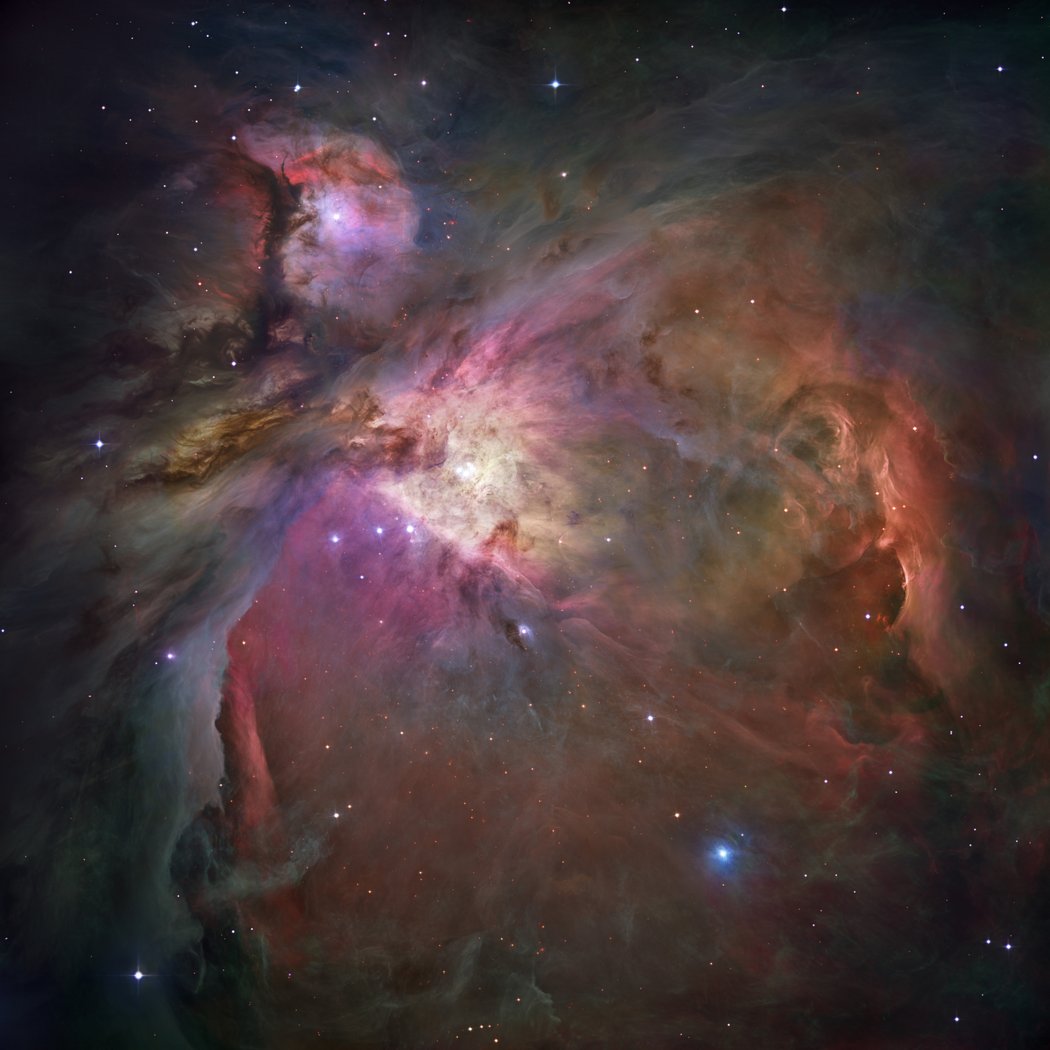
The Orion Nebula (M42) is the showpiece of the winter sky: visible as a fuzzy star to the naked eye below Orion's Belt, it opens in binoculars to a glowing cloud with a bright core and four hot young stars (the Trapezium) at its center. It is the most-observed deep-sky object in amateur astronomy for a reason — even small binoculars show its structure clearly. Globular clusters are tighter targets: M13 in Hercules, the finest globular visible from mid-northern latitudes, is a compressed ball of several hundred thousand stars that appears as a round, slightly fuzzy star in binoculars — beautiful but not fully resolved without more aperture. The Andromeda Galaxy (M31) is the most distant object visible to the naked eye at about 2.5 million light-years; in binoculars it shows as an elongated glow with a bright nucleus, flanked by its satellite galaxy M32 as a separate fuzzy point. What you're seeing, in a real sense, is two trillion stars at once. Finding these objects requires a dark-enough sky, a good star chart, and patience. The payoff is the direct experience of a universe far vaster than the planet you're standing on.
Building a personal observing list is one of the most rewarding habits in amateur astronomy. A target log — a simple notebook recording date, sky conditions, what you saw, and what you used — transforms isolated observing sessions into a cumulative project. The Messier catalog makes an ideal foundation: 110 objects spanning the full range of deep-sky types, spread across both hemispheres of the celestial sphere, ranging from trivial (M45, the Pleiades) to genuinely challenging (M74, the faint face-on spiral galaxy in Pisces). Completing the "Messier Marathon" — observing all 110 in a single night in March when they are all above the horizon at some point — is an annual rite of passage in clubs worldwide and an excellent practical education in navigating the night sky.
