
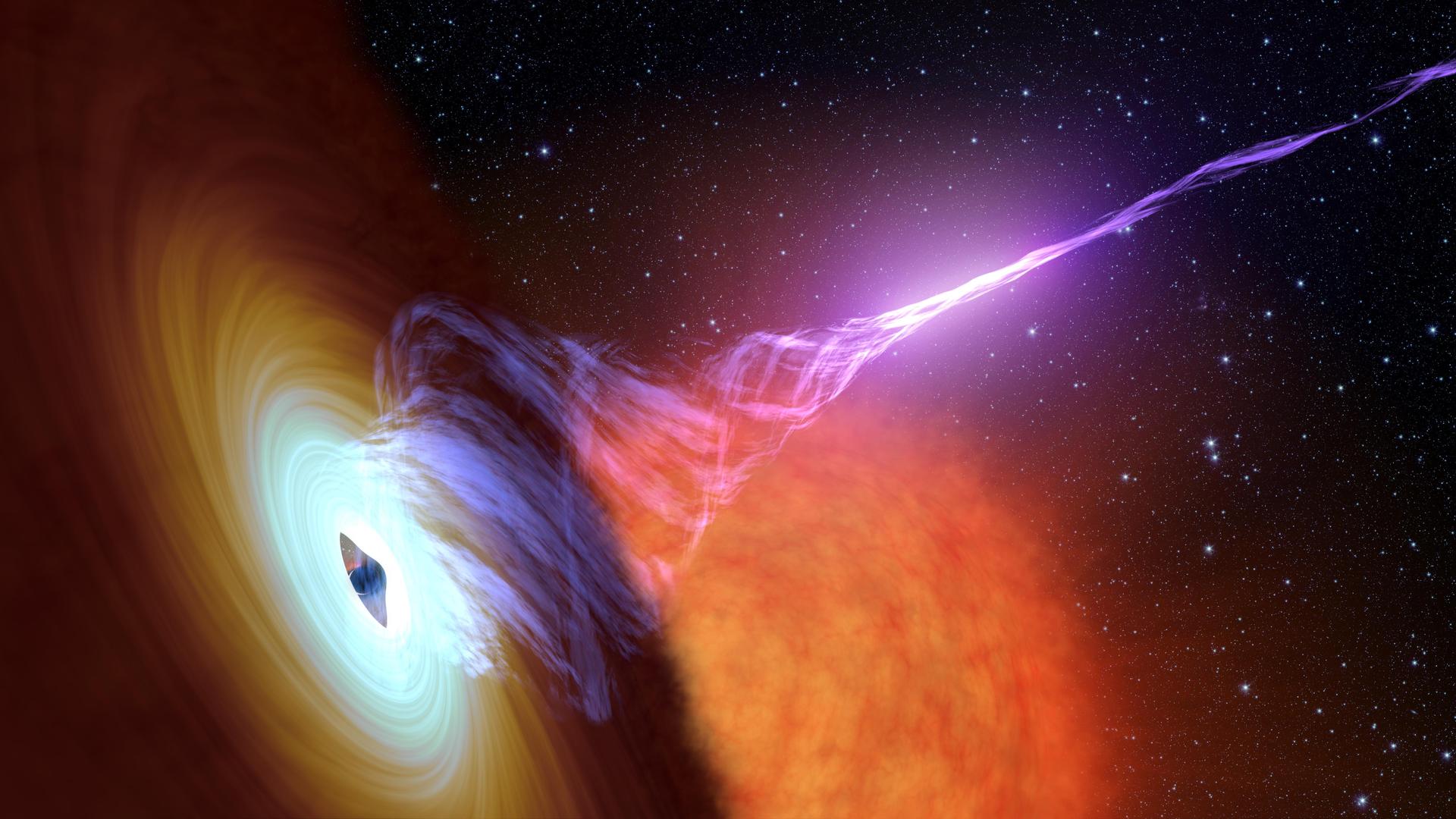
When a star wanders too close to a black hole and gets torn apart, the resulting flash is usually a short-lived spectacle: a bright optical flare that peaks within days and fades over weeks. That's what AT2019ijn looked like when it was first spotted as a bright blue flash in optical surveys, rising to peak brightness within days before fading more slowly than similar transients usually do. But astronomers using the Very Large Array (VLA) have now shown that the visible flash was only the opening act. Behind it, hidden from view for nearly two years, a relativistic jet was quietly building toward a radio afterglow that, at 3 GHz, grew more than 100 times more luminous than typical fast blue optical transients — and the black hole driving it appears to belong to a population astronomers have struggled for decades to pin down: intermediate-mass black holes.
The findings, accepted for publication in The Astrophysical Journal Letters, come from a team at the National Radio Astronomy Observatory (NRAO) that combined data from the VLA, the VLA Sky Survey, the Australian Square Kilometre Array Pathfinder (ASKAP), and the upgraded Giant Metrewave Radio Telescope (GMRT) in India. Together, those instruments turned what looked like an unremarkable stellar disruption into a multi-year radio story.
An Afterglow That Took Its Time
Tidal disruption events, or TDEs, happen when a star strays into a black hole's gravitational reach and is ripped apart by tidal forces, with the resulting debris falling onto the black hole. That infall can power flares across the electromagnetic spectrum, and in a subset of cases, launch a jet of material moving at a significant fraction of the speed of light.
AT2019ijn's optical flare came and went quickly, the kind of brief flash classified as a fast blue optical transient. Had astronomers stopped watching there, the story would have ended. Instead, radio observations kept tracking the source, and the signal kept climbing — brightening steadily for close to two years before beginning a slow decline that has now stretched on for at least four more years. At 3 GHz, the jet's radio luminosity ultimately exceeded that of typical fast blue optical transients by more than a factor of 100.
That delay is the key clue. A jet pointed directly at Earth tends to announce itself immediately and brightly, in both optical and radio light. A jet angled away from our line of sight, by contrast, stays dim in radio waves at first, only becoming visible as its edges decelerate and spread into our view — a process that unfolds over months to years. The slow-rising, slow-fading radio light curve from AT2019ijn matches that off-axis picture, meaning the jet was there from close to the start, just not pointed where anyone was looking.
Why an Intermediate-Mass Black Hole?
The mass of the black hole doing the disrupting matters because it sets the scale of everything downstream — how a star gets shredded, how fast debris falls in, and how a jet forms and evolves. The properties of AT2019ijn's afterglow point the NRAO team toward an intermediate-mass black hole: something heavier than the stellar-mass black holes left behind by collapsing stars, but far lighter than the supermassive black holes of millions or billions of solar masses that anchor large galaxies. That places AT2019ijn's central engine in a range astronomers have long suspected exists but have rarely been able to confirm directly.
Intermediate-mass black holes are sometimes called the "missing link" of black hole astrophysics because they should, in theory, bridge the gap between stellar remnants and galactic monsters — and because they may represent the seeds from which supermassive black holes grew in the early universe. Yet direct evidence for them has been scarce, in part because they don't sit at the centers of large, easily observed galaxies the way supermassive black holes do.
Why It Matters
Intermediate-mass black holes have been one of the more stubborn gaps in the black hole census. Stellar-mass black holes are detected routinely, and supermassive black holes are catalogued at the centers of countless galaxies. The middle tier, falling between those two populations, has produced far fewer confirmed candidates, despite its importance for understanding how the earliest supermassive black holes got their start.
AT2019ijn matters because it demonstrates a detection method that doesn't depend on catching a jet aimed at Earth. Most known relativistic TDE jets were found because they beamed directly toward observers, producing immediate, unmistakable radio and X-ray signatures. Those are the easy cases. An off-axis jet like this one reveals itself only through patient, long-term radio monitoring of a source that might otherwise be written off as a fading optical afterglow. Because off-axis geometries should be far more common than the rare direct hits, this approach opens the door to finding many more hidden jets — and, by extension, many more of the intermediate-mass black holes that launch them — sitting quietly in TDE data that already exists.
What Comes Next
The NRAO team's approach essentially argues for treating tidal disruption events as multi-year radio targets rather than one-off optical alerts. Wide-field surveys like the VLA Sky Survey and ASKAP's ongoing programs are well suited to that kind of long-baseline monitoring, since they revisit the same patches of sky repeatedly over years rather than making a single pointed observation. Combined with the sensitivity of instruments like the upgraded GMRT, astronomers now have a template for sifting through archival and future TDE catalogs for the tell-tale signature AT2019ijn displayed: a radio source that keeps getting brighter long after the visible flash has faded.
