
On any clear evening, a three-inch refractor aimed at the star Albireo — the beak of Cygnus the Swan — will show you something that stops conversation cold. The single point of light your naked eye sees resolves into two stars hovering side by side: one a warm amber-gold, the other a crisp sapphire blue. The contrast is not subtle. It looks painted. For most people, it is the first moment a telescope feels like a genuine portal rather than a complicated toy, and it costs nothing but patience and a decent night.
Double stars are routinely skipped in favor of galaxies and nebulae, which occupy the aspirational center of amateur astronomy culture. That preference is understandable and almost entirely backwards. Nebulae from a suburban backyard are pale, smudged disappointments — the Orion Nebula looks like a dim fingerprint on glass, not the saturated Hubble poster on your wall. Double stars, by contrast, look better in a small telescope than in any photograph. Their colors are vivid. Their separations are sharp. They reward the eye rather than frustrating it, and they work from a light-polluted driveway as well as a dark-sky site, because you are looking at point sources of light against black, not diffuse faint photons drowning in skyglow.
What you are actually seeing
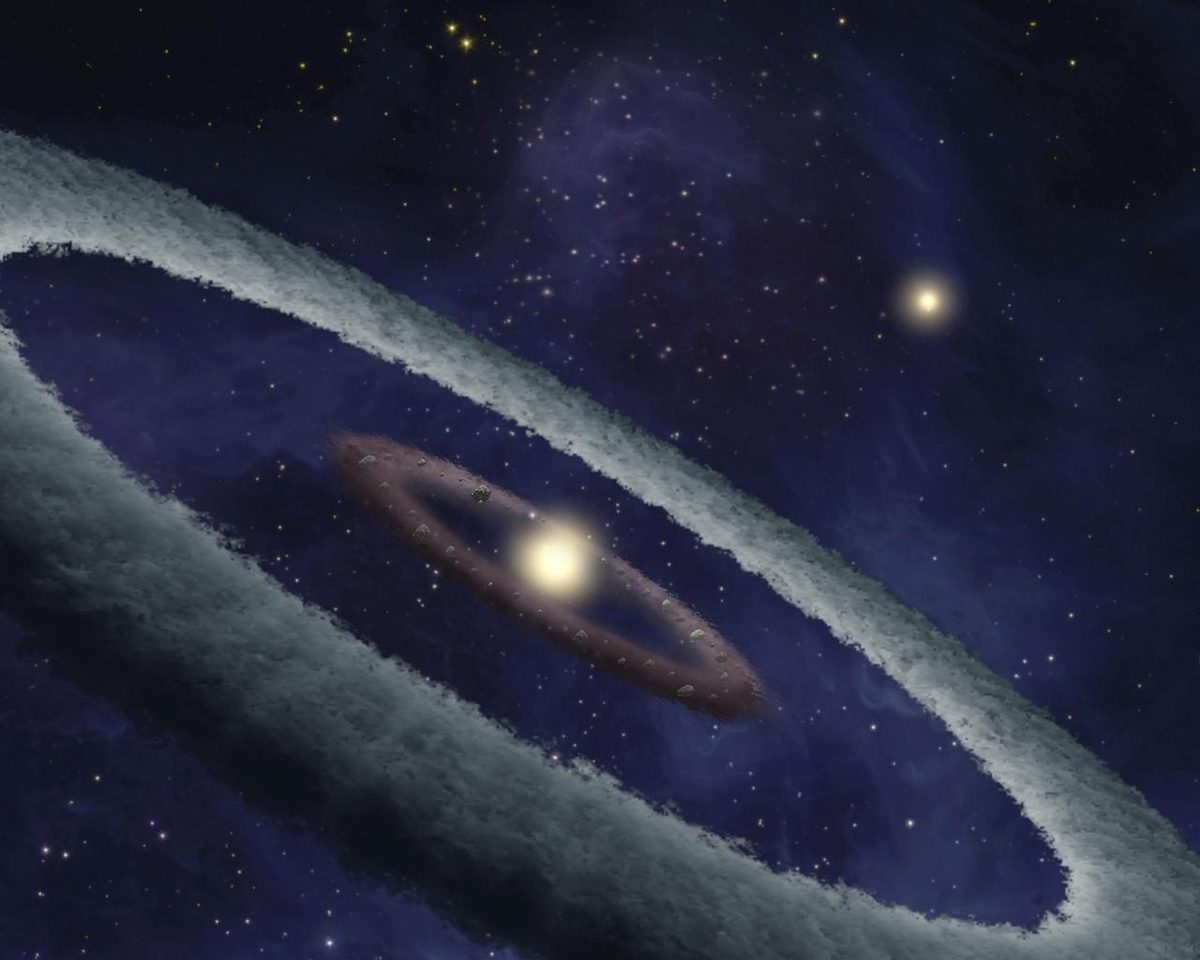
The term "double star" covers two distinct phenomena that visually resemble each other. Optical doubles are chance alignments — two stars at very different distances that happen to share nearly the same line of sight from Earth. They are coincidences of geometry, not physics. True binary systems, by contrast, are gravitationally bound pairs in genuine mutual orbit, and they are far more common than the alignment accidents. The Washington Double Star Catalog, maintained by the U.S. Naval Observatory, contains over 150,000 entries, and the majority of those are physical pairs. In fact, surveys suggest that more than half of all sun-like stars in the galaxy belong to multiple-star systems. Our own solar system's single-star architecture is arguably the exception.
Binary star dynamics span an enormous range. Some pairs orbit each other in hours, so close that they are nearly touching — these are called contact binaries, and their light curves show continuous ellipsoidal variation as each star distorts the other gravitationally. Others have orbital periods measured in centuries or millennia, and their angular separation changes so slowly that multiple generations of astronomers have contributed to calculating a single orbit. The visual doubles accessible through a small telescope tend to be the latter: wide enough to split cleanly with modest aperture, distant enough that their mutual gravity plays out on timescales longer than recorded history.
The colors visible in double stars reflect genuine stellar physics. Albireo's gold star is a K-type giant, cool and evolved, burning at around 4,400 Kelvin. Its blue companion is a B-type main-sequence star, roughly 10 times hotter. Blackbody radiation does the rest — hotter stars emit more toward the blue end of the spectrum, cooler stars toward the red and orange. The eye is particularly sensitive to color contrast when the comparison is direct and simultaneous, which is why the color difference in a binary looks more dramatic through an eyepiece than a photograph, where the camera's sensor response often compresses the chromatic range.
The canonical targets
Mizar and Alcor in the handle of the Big Dipper are the oldest known double star, mentioned in Arabic astronomical texts and identified as a test of visual acuity in antiquity. They are an easy naked-eye split, but a small telescope shows that Mizar itself divides into two components — Mizar A and Mizar B — orbiting each other over a period estimated at thousands of years. Later spectroscopic analysis revealed that both Mizar A and Mizar B are themselves spectroscopic binaries, making the system a gravitationally linked sextuple when Alcor's own binary companion is included. What looks like two stars to the naked eye is actually six.
Epsilon Lyrae, close to the brilliant Vega, is known as the "Double Double." Binoculars split it into two stars. A telescope at 100x or more splits each of those two stars again into a pair — four stars in two close orbital systems, sharing a slow common proper motion across the sky. Castor in Gemini adds another layer: visually a clean double through any small telescope, it is actually a six-star system like Mizar, with three spectroscopic binary pairs sharing a loose gravitational embrace.
For color contrast beyond Albireo, the southern sky's Beta Cygni rival is Almach — Gamma Andromedae — which shows a gold primary and a blue-green secondary at moderate magnification. The secondary is itself a close double, requiring higher power and steadier air to split. Eta Cassiopeiae, nearby on the sky, pairs a yellow sun-like star with a distant orange-red companion over a 480-year orbit, the two stars separated by roughly 70 AU at present — a solar system width of space between them, close enough that they genuinely affect each other's dynamics over geological time.
The Pleiades star cluster contains at least a dozen visual double stars accessible to binoculars and small telescopes. Sigma Orionis, near the belt of Orion, is a naked-eye triple that expands into five components through a four-inch telescope. Iota Cancri, less famous but often praised by observers, offers another gold-and-blue combination with an easy split even at low power.
The practical case for double stars
Observing double stars has one quality that deep-sky work rarely offers: immediate, objective feedback. Either you split the pair or you don't. The moment of successful resolution at the diffraction limit of your optics — when two Airy disks just separate and you can slip a sliver of dark sky between them — is among the most satisfying experiences available through an eyepiece. It tells you something true about your telescope, your eyepiece, and the steadiness of the atmosphere above you, all at once.
Atmospheric seeing is the limiting factor for double-star work more than aperture is. A night of excellent seeing lets a modest 80mm refractor split pairs under two arcseconds apart, which is the kind of performance that feels improbable until you experience it. Conversely, a night of turbulent air will defeat even a large aperture. Serious double-star observers learn to read the seeing quickly, and they learn that the hours after local midnight, when the ground has lost its daytime heat, are often steadier than the first hours of darkness. These are lessons that translate directly to planetary observing and high-resolution work generally.
The Washington Double Star Catalog is freely searchable online and lists separation, position angle, magnitude, and color for every catalogued pair. A productive first list needs no more than a dozen objects — Mizar, Albireo, Epsilon Lyrae, Almach, Eta Cassiopeiae, Iota Cancri, Sigma Orionis, 61 Cygni (a famous nearby pair of orange K-dwarfs), Delta Cephei, and the Trapezium at the heart of the Orion Nebula, which is not technically a double star but resolves into four hot young stars through a 3-inch aperture. That list spans every season visible from mid-northern latitudes, covers the full range of colors the stellar main sequence produces, and includes systems from nearby neighbors to distant associations hundreds of light-years out.
The case for double stars is not that they are a consolation prize for cloudy suburbs or cheap equipment. It is that they offer something genuinely different from the rest of amateur astronomy: real stellar physics, vivid color, crisp optics, and the specific satisfaction of resolving something that is actually hard to resolve. The universe is mostly multiple-star systems. When you look at Albireo, you are looking at the normal condition of stellar existence, not the exceptional one. The exceptional case is our own sun, alone in space.
