
Mercury is 77 million kilometers from Earth at closest approach, takes 88 days to orbit the Sun, and has a surface temperature that swings from 430°C at noon to minus 180°C at night. It has a magnetic field that makes almost no physical sense given its size. Its core is disproportionately large, its surface is peppered with hollows that no planetary geologist has fully explained, and its exosphere — the tenuous shell of atoms liberated from its surface by solar bombardment — is unlike any atmosphere in the solar system. It has been visited by exactly two spacecraft in human history, and neither could orbit it. BepiColombo is fixing that.
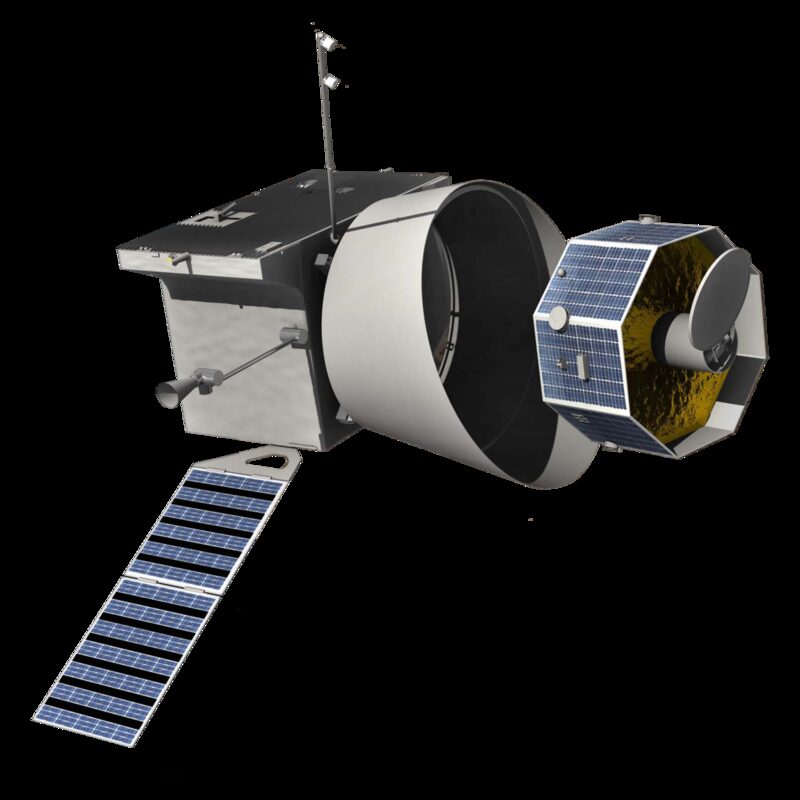
The mission is a partnership between the European Space Agency and the Japan Aerospace Exploration Agency, carrying two separate orbiters stacked together for the transit: ESA's Mercury Planetary Orbiter (MPO) and JAXA's Mercury Magnetospheric Orbiter (MMO, nicknamed Mio). They launched together in October 2018 aboard an Ariane 5, and spent seven years executing one of the most elaborate gravity-assist sequences in spaceflight history — one Earth flyby, two Venus flybys, and six Mercury flybys — before Mercury's gravity was sufficient to capture them into orbit in November 2025. The transfer required a solar electric propulsion module (the Mercury Transfer Module) that has no scientific payload; its entire purpose was to provide continuous thrust during the long interplanetary cruise, braking against the Sun's gravity well that pulls everything sunward as you approach Mercury.
Why Mercury is hard to reach
Counterintuitively, Mercury is one of the most difficult bodies in the solar system to orbit. It sits deep inside the Sun's gravity well, meaning that anything falling toward it arrives very fast. To orbit rather than fly past, a spacecraft must shed enormous amounts of kinetic energy through braking. Traditional chemical propulsion cannot carry enough fuel to do this from a direct trajectory. The solution — used by both Messenger (NASA, 2004-2015) and BepiColombo — is to use gravity assists to gradually lower the spacecraft's velocity relative to Mercury over multiple flybys before final orbit insertion. BepiColombo's six Mercury flybys progressively bent its trajectory until capture was possible. The approach took years and required navigation precision measured in kilometers at distances of hundreds of millions.
The separation of the two orbiters after capture will allow the science teams to study the same phenomena from two different orbital geometries simultaneously. MPO orbits closer to Mercury's surface, focused on geology, topography, mineralogy, and exosphere composition. Mio takes a more elliptical orbit that extends further from the planet, optimized for the magnetosphere and solar wind interactions. Together they will produce the most complete picture of Mercury's magnetic environment ever assembled — and it is the magnetic field that makes Mercury most scientifically puzzling.
The magnetic field mystery
Mercury should not have a magnetic field. Planetary magnetic fields are generally thought to require a combination of a liquid conductive core and sufficient rotation to drive a dynamo. Mercury rotates slowly (one Mercurian day equals roughly 59 Earth days) and is small enough that its interior should have cooled and solidified billions of years ago. Yet Mariner 10, which flew past Mercury three times in 1974-1975, detected a dipole magnetic field — weak, about 1 percent of Earth's, but definitively present. Messenger confirmed the field and found it is offset from Mercury's center, stronger in the northern hemisphere than the southern.
BepiColombo's dual magnetometers will map the field with far greater precision than Messenger could, at both global and local scales. The data will constrain models of Mercury's interior — specifically the size and state of its outer liquid core, the thickness of any solid inner core, and the dynamics of core convection. The offset geometry of the field is particularly interesting: most dynamo models produce symmetric fields, and the cause of Mercury's asymmetry is actively debated. High-resolution magnetometry from two simultaneous orbital positions will provide the best opportunity yet to test competing dynamo models against reality.
The hollows — shallow, irregular depressions on Mercury's surface with no clear impact origin, highly reflective, and seemingly young — are another target that Messenger's cameras could only partially address. MPO's imaging system will cover Mercury's surface at resolutions approaching meters per pixel, and its spectrometers will map surface composition in detail. The hollows may be forming today, volatiles sublimating directly from the surface into Mercury's exosphere under bombardment by solar ultraviolet. If so, they are the only known example of ongoing volatile-loss landform generation in the inner solar system — geology happening in near-real-time on a world that was supposed to be geologically dead.
