
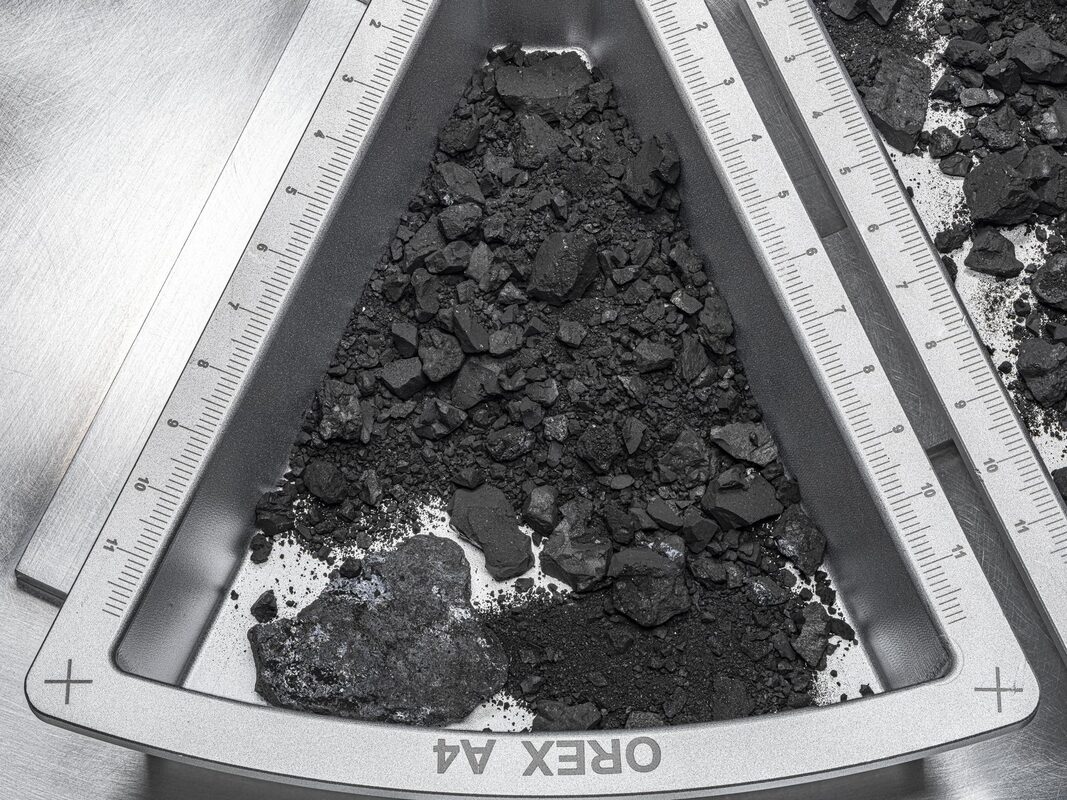
Asteroid Bennu has already given up a long list of organic compounds. The sample OSIRIS-REx brought home in 2023 holds 14 of the 20 amino acids that life uses to build proteins, plus four of the building blocks of DNA and RNA. Researchers opened the material under sterile conditions, so they can be confident it is pristine and not contaminated by Earth. A new study asks a narrower and harder question about one of those molecules. It doesn't ask what is there. It asks where the molecule came from, and whether it formed the same way as similar material that fell to Earth in a famous meteorite.
The answer, published in Communications Earth & Environment by a Penn State-led team, is that it apparently did not. The isotopic fingerprints of beta-alanine from Bennu and from the Murchison meteorite are different. The authors say the differences are hard to reconcile with recognized parent-body processes.
One molecule, measured carbon by carbon
Beta-alanine is an amino acid, but it is not one of the 20 that make proteins. That makes it a useful test case. Penn State describes it as one of the most abundant amino acids found in asteroid and meteorite samples, and it shows up in both samples here, so it can be compared directly.
Isotope ratios are the standard forensic tool for organic matter from space. Heavier versions of carbon (carbon-13) and nitrogen (nitrogen-15) get enriched or depleted depending on the temperature, radiation environment and reaction pathways a molecule went through. Usually researchers measure one average ratio for a whole molecule. This team went further. They separated the carbon isotope signal of the carboxyl (COOH) carbon from that of the molecule's other two carbons, the alpha and beta positions, measured together.
According to Penn State, this required a new technique for measuring individual carbon isotopes within a molecule. It combines pico-CSIA, a capability the university says exists only at Penn State, with a modified GC-Orbitrap mass spectrometer. The lead author is Ophelie Mcintosh. Co-authors include Christopher House and principal investigator Katherine Freeman.
The numbers
The values are given in delta notation, as parts-per-thousand (permil) deviations from a reference standard. Here are the results for beta-alanine:
- Bennu: carboxyl carbon δ13C = 363 ± 29‰; alpha+beta carbons δ13C = −163 ± 13‰; nitrogen δ15N = 170 ± 4‰.
- Murchison: carboxyl carbon δ13C = 111 ± 22‰; alpha+beta carbons δ13C = −44 ± 10‰; nitrogen δ15N = 63 ± 4‰.
Two things stand out. First, the overall shape is the same in both samples. In each one the carboxyl carbon is strongly enriched in carbon-13 and the rest of the carbon backbone is depleted. The paper calls this consistent with a common synthetic route. Second, the magnitudes are very different. Within a single molecule, the gap between the carboxyl carbon and the other carbons is 526 ± 32‰ for Bennu and 155 ± 24‰ for Murchison.
Subtracting Murchison from Bennu position by position gives differences of 252 ± 36‰ for the carboxyl carbon, 119 ± 16‰ for the alpha and beta carbons, and 107 ± 6‰ for nitrogen. These differences are many times larger than the error bars. Bennu's beta-alanine is more extreme in every measured position.
Why parent-body processing doesn't explain it
The usual way to explain differences between meteoritic organics is to point to what happened on the parent body. Asteroids were warmed, altered by water and chemically reworked after they formed, and each of those processes can shift isotope ratios. The authors argue that this explanation struggles here. The Bennu-minus-Murchison differences are large, they appear at every position, and the internal pattern is similar in both samples. In the paper's words, these differences are difficult to reconcile with recognized parent-body processes.
Their interpretation is that the raw ingredients differed. The paper says the results could provide direct geochemical evidence for spatial heterogeneity in organic synthesis across the protoplanetary disk. If the precursor molecules that became beta-alanine formed under different conditions in different parts of the disk, the asteroids that later collected them would have inherited different isotopic signatures. Similar reaction chemistry would still produce similar intramolecular patterns, but the starting values would differ, and that fits what the team measured.
The result also adds to earlier Penn State work. Isotopic analysis of glycine from Bennu had suggested that it may have formed in a harsh, cold environment. The beta-alanine data don't contradict that picture. They complicate it: whatever chemistry made these molecules apparently didn't produce uniform results across the disk.
Freeman, in Penn State's release, described her reaction to the gap between two neighboring carbon positions in the same molecule: "I was genuinely gobsmacked by the enormous isotope difference between two neighboring atom positions within the same molecule." Penn State also says the enriched Bennu carbon is the highest isotope anomaly recorded in an organic molecule from space.
Why It Matters
Meteorites like Murchison have long served as the reference library for prebiotic chemistry in space. If their organics were representative of the whole early solar system, a well-studied meteorite would be a reasonable stand-in for any primitive asteroid. This study is a warning against that assumption. Two carbon-rich bodies can carry the same molecule with similar internal chemistry and still record very different origins.
Several implications follow. Organic synthesis in the protoplanetary disk may have been spatially heterogeneous: local conditions could have shaped the isotopic character of the building blocks that later reached planets. Returned samples like Bennu's, collected directly and handled under controlled conditions, offer pristine material unaffected by terrestrial contamination. And position-specific isotope measurement, which lets researchers look inside a single molecule, may tell apart formation histories that whole-molecule averages would blur together.
The study has limits. It covers one amino acid in two samples. Whether the heterogeneity holds for other molecules, and how it maps onto specific regions or conditions in the disk, are questions for further work on the Bennu material and on other carbonaceous samples. Still, the direction is suggestive. The early solar system's organic chemistry may look less like one well-mixed pot and more like a patchwork of local chemical environments.
Sources
- Nitrogen and intramolecular carbon isotopic measurements of beta-alanine in samples from asteroid Bennu and the Murchison meteorite (Communications Earth & Environment)
- Bennu asteroid analysis suggests unexpected origins of organics in space (Penn State)
- Asteroid Bennu's Sample Delivers Another Surprise (Universe Today)
