
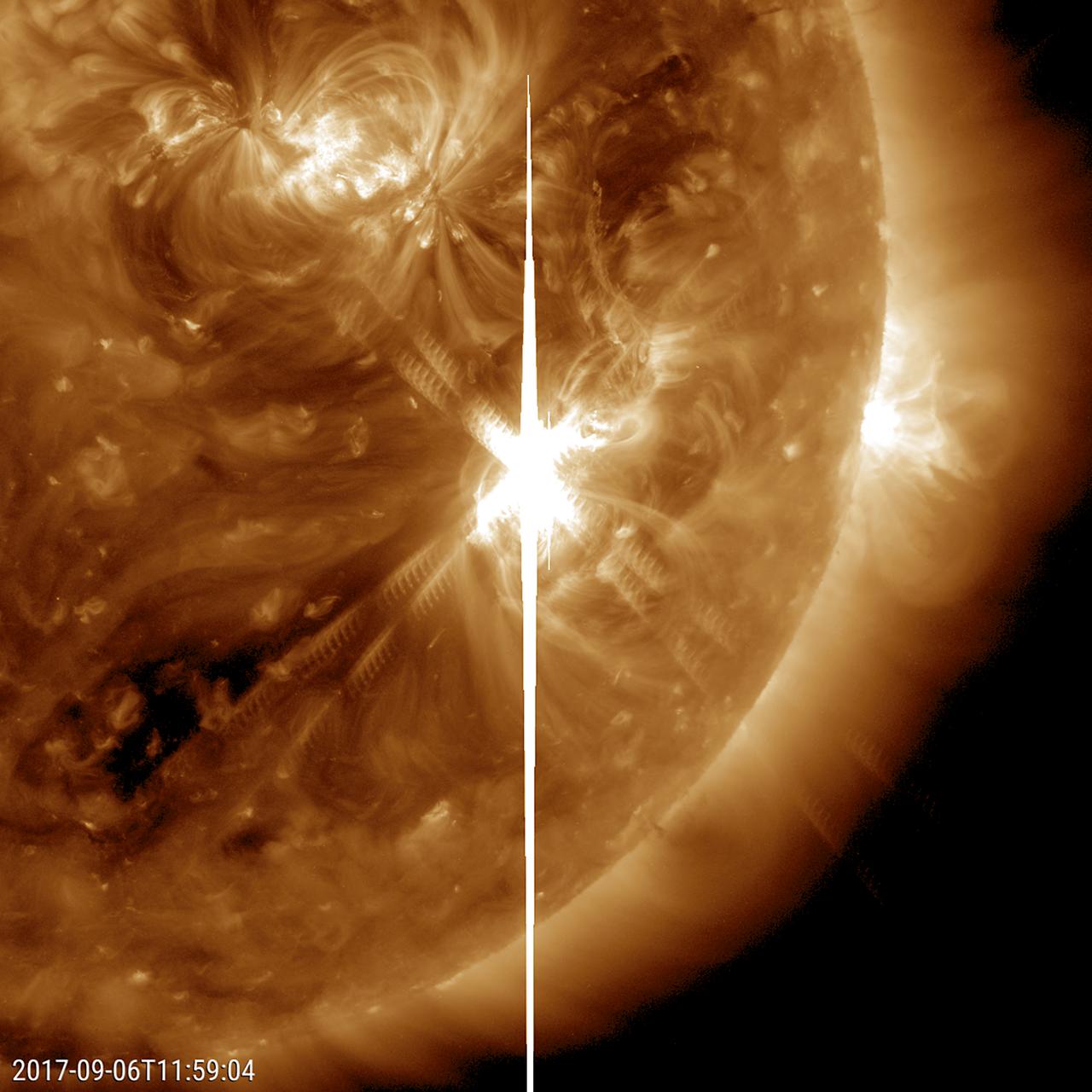
The sun has a repeat offender this week. Active region AR4482, a sunspot cluster carrying what solar physicists classify as a "beta-gamma-delta" magnetic configuration, spent July 8 and into July 9, 2026 as the sun's dominant flare source — and it isn't done yet. NOAA's Space Weather Prediction Center (SWPC) is holding its three-day forecast at a 40% chance of R1-R2 (minor to moderate) radio blackouts and a 10% chance of R3 (strong) blackouts each day through July 11, with AR4482 the most likely trigger.
Two flares from the region have already made their mark. An M1.5-class flare erupted from AR4482 on July 8 at 17:56 UTC, causing an R1 minor radio blackout centered over northeast Mexico. About eight and a half hours later, at 02:27 UTC on July 9, a second flare — M1.2-class — fired off and blacked out shortwave radio over a swath of the Philippine Sea. Both events register as "minor" on NOAA's R-scale, but they illustrate exactly the kind of intermittent disruption a magnetically complex sunspot like this one is prone to producing.
What makes a beta-gamma-delta spot different
Not all sunspots are equally dangerous. Forecasters classify active regions by the complexity of their magnetic field, and "beta-gamma-delta" sits near the top of that scale — it describes a sunspot group where opposite magnetic polarities are packed closely together within a single penumbra. That crowding stores up magnetic stress, and when field lines snap and reconnect, the result is a flare. It's why AR4482 has been able to produce multiple M-class events within hours of each other rather than a single isolated outburst.
AR4482 isn't flying solo, either. A newer active region, AR4485 — carrying a beta-gamma configuration — has also been active over the same stretch, producing a handful of C- and B-class flares on July 9. Both belong to the same broader flare-producing family that included AR4479, a beta-gamma-delta region that dominated the sun's flare output on July 5-6 (including an M5.3 flare that triggered an R2 blackout across the Americas and eastern Pacific) before rotating out of view by July 7. That same family also produced the sun's most powerful event of the week: an X1.3-class flare that erupted from AR4482 itself on July 4, as the sun's activity continued to intensify in early July 2026.
The forecast, in plain terms
SWPC's official three-day outlook does not currently call for any G1-or-higher geomagnetic storm over July 9-11. What it does flag is a steady, non-trivial chance of radio interference: 40% odds of an R1-R2 blackout and 10% odds of an R3 blackout on each of the three days, with the maximum forecast 3-hour Kp index reaching as high as 3.67 across the period — a modest, unremarkable geomagnetic reading on its own.
Radio blackouts of this kind are a direct, near-instant effect of flare X-ray and extreme-ultraviolet radiation slamming into Earth's dayside ionosphere. There's no delay, no lag time — the blackout hits the sunlit hemisphere facing the sun at the moment of the flare, which is why the Mexico and Philippine Sea blackouts landed in such specific, separated locations: each corresponded to wherever the sunlit side of Earth happened to be pointed at that instant.
A coronal hole adds an aurora wrinkle
Separately from AR4482's flare output, a high-speed solar wind stream flowing from a coronal hole was expected to reach Earth around July 9. Coronal holes are cooler, less dense patches of the sun's corona where magnetic field lines open into space, letting solar wind escape at elevated speed. When that faster wind arrives, it can jostle Earth's magnetic field enough to spark minor G1 geomagnetic storming — not a major event, but enough to push the aurora oval slightly equatorward.
Forecasters flagged the possibility of aurora visibility as far south as Seattle and similar latitudes, along with Edinburgh, and generally across the northern United States and Canada, if the coronal hole stream and any lingering flare-related disturbance line up favorably. That's a modest, latitude-dependent chance rather than a guarantee — G1 storms produce faint, low-horizon displays rather than the sweeping shows associated with stronger storms — but it's enough to make the northern sky worth a glance after dark this week for anyone in range.
Why It Matters
Radio blackouts from M-class flares are minor by space-weather standards, but they're a real-world reminder of how directly solar activity intersects with technology we rely on. R1 and R2 blackouts primarily degrade high-frequency (HF) radio communication on the sunlit side of Earth — the band used by aviation, maritime operations, and amateur radio. A sustained 40% daily chance of that kind of disruption, from a sunspot that has already proven it can fire multiple times in a single day, is the sort of thing HF radio operators and aviation dispatchers track closely even when the public impact is invisible. It's also a useful entry point for skywatchers: the same active-region complexity that drives radio blackouts is often the precursor to the more energetic coronal mass ejections that produce major aurora displays, so a persistently active, magnetically tangled sunspot like AR4482 is worth watching even when this particular round of activity stays modest.
