
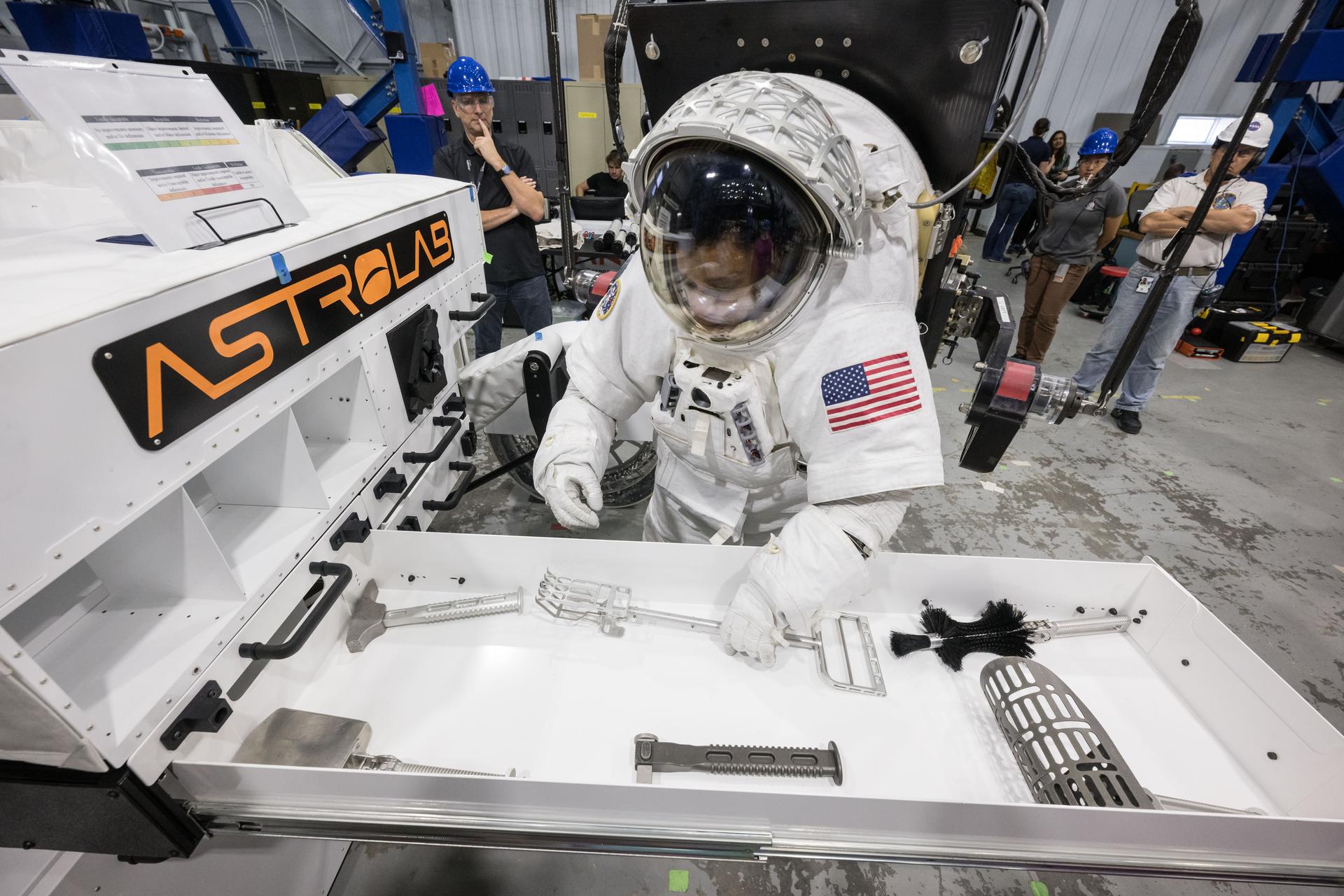
NASA has started talking about its lunar rover program in the language of logistics rather than aspiration. In late June 2026, agency officials laid out a concrete sequence: deliver two commercially built, crewed Lunar Terrain Vehicles to the Moon's surface by November 2027, have them waiting and charged when the Artemis 4 crew arrives in early 2028, and let those astronauts drive farther than any human has on another world.
The two vehicles in question come from Venturi Astrolab, which is building a rover it calls CLV-1, and Lunar Outpost, whose Pegasus rover is being developed with General Motors, Goodyear and Leidos. Both fall under NASA's Lunar Terrain Vehicle Services contract — an indefinite-delivery, indefinite-quantity arrangement with a combined maximum value of $4.6 billion and task orders that can run through 2039. Intuitive Machines is the third provider named on that contract.
Park it, then leave it alone for months
The operational concept NASA sketched out is unusual, and it is worth dwelling on because it shapes nearly every engineering requirement.
The rovers do not arrive with the crew. They arrive first, on cargo landers, and then they sit. Ryan Stephan, NASA's acting director for cargo landers, said the vehicles would be staged roughly two kilometers from where the crewed lander is expected to touch down. That gap is deliberate — you do not want a parked rover anywhere near the plume and debris of a descending lander — but it means the rover has to autonomously drive itself to the meeting point, or wait to be driven, after potentially months of dormancy.
Once astronauts are aboard, Stephan said, the vehicles are rated to traverse up to 10 kilometers during a single crewed outing, and to cover up to 400 kilometers over their operational lifetime. Those are not Apollo numbers. The Apollo lunar roving vehicles were single-mission machines; these are meant to be semi-permanent infrastructure, surviving across multiple crew visits and the long stretches of nobody at all in between.
That dormancy is the brutal part. The lunar South Pole, where Artemis is headed, subjects hardware to extended periods of darkness and cold that have killed plenty of robotic landers. Astrolab says its CLV-1 is designed to survive up to 150 days of lunar darkness at temperatures around -400°F. The survival strategy, as described, leans on battery hibernation and on covering the rover's radiators with its solar arrays — the same surfaces that dump heat during operation become a liability when there is no sunlight and the problem flips from staying cool to not freezing solid.
Why two rovers, and why launch flexibility suddenly matters
NASA is not betting on a single vehicle, and recent events explain why. Carlos García-Galán, the Moon Base program executive, stressed the need for flexibility in launch vehicles following Blue Origin's New Glenn setback. The subtext is straightforward: when your delivery schedule depends on rockets that are themselves still maturing, you do not want your entire surface-mobility plan riding on one launcher or one provider. Two rovers from two companies, deliverable on whatever heavy-lift capacity is actually available in 2027, is a hedge against exactly the kind of slip that a single rocket failure can impose.
It is a notable shift in tone. The original NASA framing of the LTV Services awards emphasized capability — a vehicle built for extreme South Pole conditions, with advanced power management, autonomous driving and navigation, letting astronauts range beyond walking distance and collect samples across a wider area. Agency officials Vanessa Wyche and Jacob Bleacher framed the program around enabling lunar science. The June reporting kept that science goal but layered on a much more schedule-and-risk-aware posture.
The robots go first
Before either crewed rover lands, smaller robotic precursors from the same companies will already be operating on the Moon — which gives both firms flight heritage to point to rather than pure paper designs.
Astrolab's FLIP rover is set to launch this year aboard the Griffin-1 mission. Lunar Outpost's MAPP rover has been flying on Intuitive Machines lunar missions, having been manifested on IM-2 in 2025 with IM-3 upcoming. These are far smaller than the crewed LTVs, but they exercise the hard parts — landing, deploying, driving, surviving — in the actual environment the big rovers will inherit.
Lunar Outpost frames its Pegasus work as serving a broad set of South Pole activities: site exploration, foundational science, resource prospecting and surface site preparation, all in service of what NASA describes as working toward a permanent human presence by 2030. The company was selected for what NASA calls a High Achievability Mission task order under the LTVS contract — agency shorthand for an early, well-defined deliverable rather than an open-ended development effort.
Why It Matters
For most of the Artemis era, the surface side of the program has been the vaguest part. We have heard a great deal about the Space Launch System, the Orion capsule, and the lander competition, and comparatively little about what astronauts actually do once they are standing on the regolith. Crewed rovers are the difference between a flags-and-footprints repeat of Apollo and something closer to a working field station, because mobility is what turns a single landing site into a region you can actually study.
The timeline NASA described — rovers delivered November 2027, crew arriving early 2028 — is aggressive, and it depends on launch vehicles and cargo landers that have not yet proven themselves at this cadence. The candor about Blue Origin's New Glenn setback, and the explicit pivot toward launch flexibility, is a sign the agency is planning for slippage rather than pretending it away. Whether the dates hold is an open question. But the structure — two competing commercial providers, robotic precursors flying first, a contract vehicle that stretches to 2039 — is built to absorb the kind of delays that have defined every previous step of the program. If it works, the first thing Artemis 4 astronauts see waiting for them on the surface will not be a flag. It will be a vehicle, already charged, ready to drive.
