
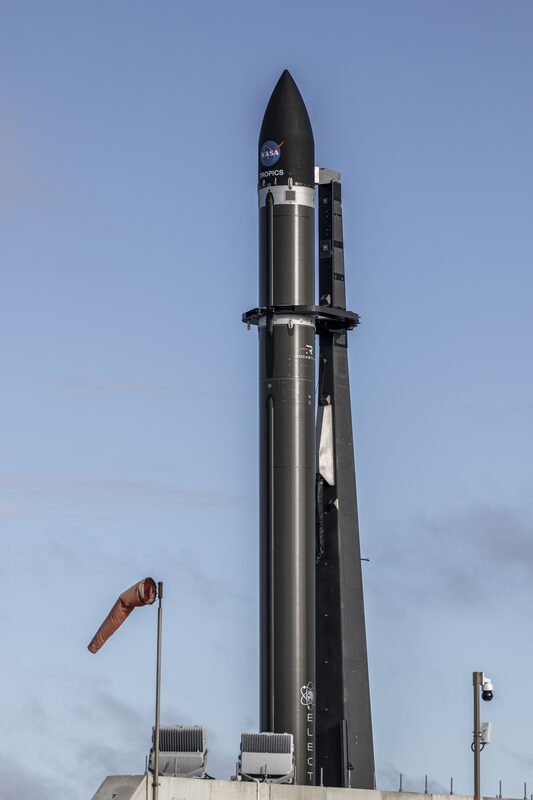
Launch companies build the rockets. Satellite operators build the businesses that ride them. On June 29, 2026, Rocket Lab announced it intends to collapse that division of labor by buying one of the oldest names in mobile satellite communications outright.
The company said it will acquire Iridium in a cash-and-stock transaction valuing the operator at roughly $8 billion, or about $54 per share. That figure represents a premium of roughly 24 percent over where Iridium's stock closed on June 26, the last trading day before the announcement. The transaction was disclosed in a Form 8-K filed with the U.S. Securities and Exchange Commission, with the two companies issuing a joint announcement on June 29.
Rocket Lab CEO Peter Beck did not undersell it. He called the merger "a defining moment for the space industry and the start of a new era of strategic, accelerated growth for Rocket Lab and Iridium." Strip away the superlatives and the logic is straightforward: Rocket Lab builds and launches spacecraft, and Iridium already operates a global constellation that generates recurring revenue. Buying it is a shortcut past years of deployment.
What Rocket Lab Is Actually Buying
The headline asset is the constellation itself: 66 operational satellites in low Earth orbit, backed by 14 on-orbit spares. That in-space redundancy is part of what makes Iridium's network reliable enough for maritime, aviation, defense, and remote-industrial customers who need coverage where cellular networks simply do not reach.
Arguably more valuable than the hardware is the spectrum. Iridium operates in L-band, a slice of radio frequency that is comparatively rare and well suited to reliable, weather-resistant links to small, low-power devices. Spectrum rights are difficult and slow to acquire; a buyer cannot simply manufacture more of them. Acquiring Iridium hands Rocket Lab an operating position in that band without a regulatory campaign to secure it.
The deal also brings two businesses layered on top of the raw connectivity. There is Aireon, Iridium's aircraft-tracking operation, which uses payloads on the constellation to follow aircraft across oceans and other regions beyond ground-based radar. And there are Iridium's positioning, navigation, and timing (PNT) services, which offer an alternative to GPS-based systems for customers who want resilience against jamming or outages.
How the Money Works
The structure is more intricate than the round $54-per-share number suggests. Per the SEC filing, each Iridium share converts into $27.00 in cash plus a portion of Rocket Lab stock determined by an exchange ratio that flexes with Rocket Lab's own share price.
That ratio is bounded. If Rocket Lab's volume-weighted average price (VWAP) comes in at or below $67.50, holders receive a fixed 0.4000 Rocket Lab shares per Iridium share. If the VWAP lands at or above $112.50, the ratio drops to 0.2400. In between, the stock portion is calculated as $27.00 divided by the VWAP — meaning the stock leg targets roughly $27.00 in value across that middle band, so the two halves of the payment are designed to be balanced near the $54 mark. The collar protects both sides from wild swings in Rocket Lab's stock between signing and closing.
The overall figure is described as an enterprise value of approximately $8.0 billion. Rocket Lab CFO Adam Spice called the transaction "significantly accretive," and Iridium CEO Matt Desch was quoted alongside Beck in the announcement — signaling that Iridium's leadership is presenting this as a deal done with them, not to them.
The Trade Each Side Is Making
For Rocket Lab, the appeal is time. Standing up a revenue-generating constellation from scratch means years of manufacturing, launches, regulatory filings, and customer acquisition before a single recurring dollar arrives. Buying Iridium delivers an operating satellite-services revenue stream and a spectrum position on day one of close.
For Iridium, the pitch runs the other way. The operator gains in-house manufacturing and launch integration — a captive path to building and orbiting its next generation of satellites rather than contracting that work out. For a company whose entire business depends on periodically refreshing an aging constellation, owning the factory and the rocket is a meaningful hedge against cost and schedule risk.
Put together, the combination is vertical integration in its most literal form: one company that designs the spacecraft, builds them, launches them, operates the network, and sells the service.
Why It Matters
Space has spent the last decade splitting into specialists — dedicated launch providers, dedicated bus manufacturers, dedicated constellation operators. This deal points the other direction, toward consolidation and full-stack ownership, echoing the integrated model that SpaceX has demonstrated pairs launch capability with an operating network.
If it closes, Rocket Lab stops being purely a company that sells rides to orbit and becomes one that also owns what sits in orbit and the customers who pay for it. That is a structurally different business, with recurring service revenue rather than one-off launch contracts, and control over a scarce spectrum asset that competitors cannot easily replicate.
The caveats are real. The transaction is expected to close in mid-2027 — a long runway during which Iridium stockholders and regulators both have to sign off. Antitrust and national-security reviews of space assets, spectrum, and defense-adjacent services are not rubber stamps, and the deal is not done until they clear. But the intent is unambiguous, time-stamped, and filed with the SEC: a launch company has decided the fastest way into the satellite-services business is to buy one.
