
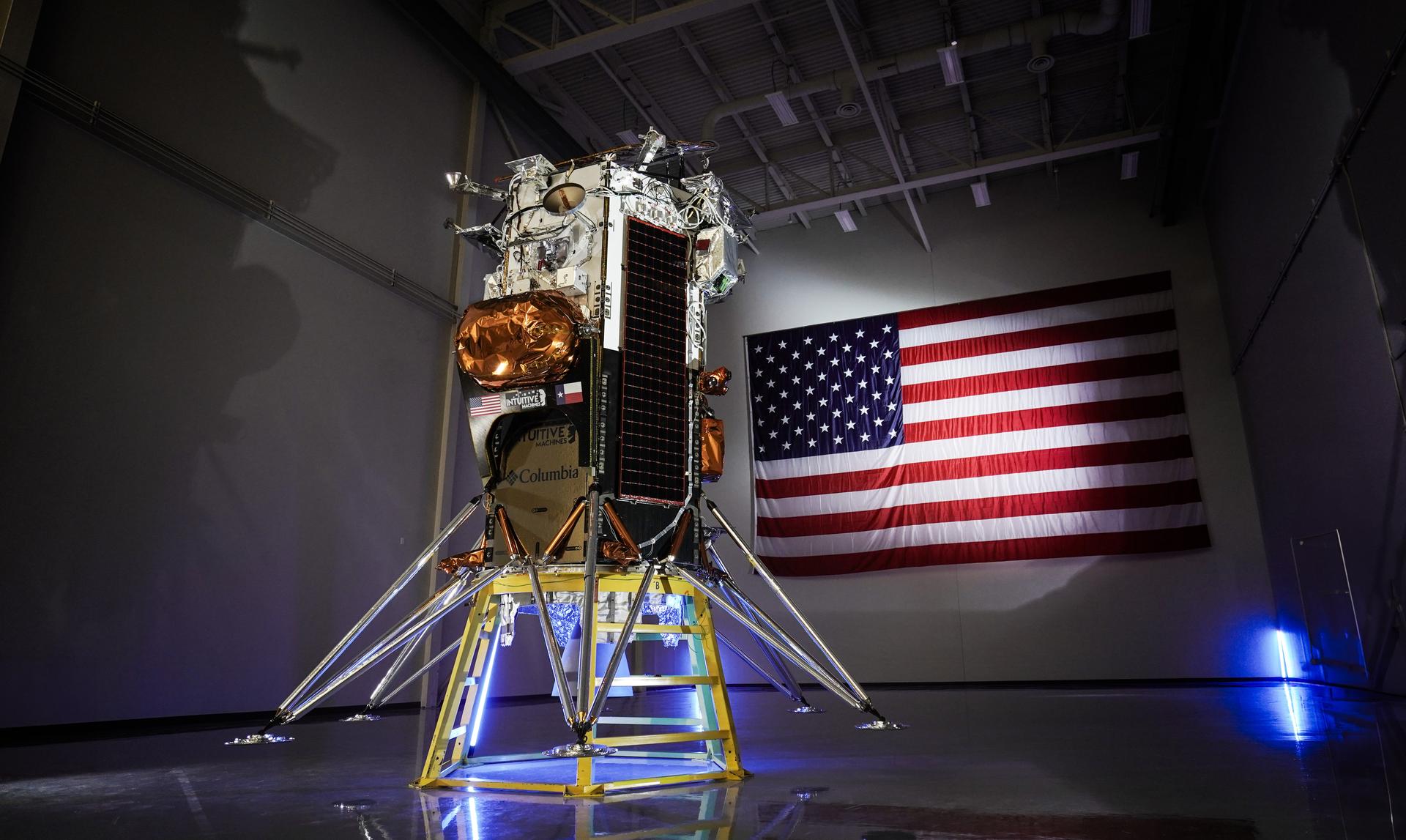
NASA is buying lunar landings the way an airline buys seats: in bulk, and increasingly on aircraft that have already flown. On June 30, 2026, the agency announced four new task orders under its Commercial Lunar Payload Services (CLPS) program, dividing roughly $590 million among three companies to put four robotic landers on the Moon in late 2028. It is explicitly framed as an on-ramp to a much higher flight rate.
The split is uneven by design. Astrobotic took the biggest share — $297.9 million for two separate deliveries. Intuitive Machines secured a firm-fixed-price contract valued at up to $148.3 million for a single Nova-C landing, which the company describes as its sixth CLPS award. Firefly Aerospace rounded out the group with roughly $144.2 million for one delivery on its Blue Ghost lander. Four missions, three vendors, one target window.
Buying flight-proven hardware on purpose
The most consequential detail in NASA's announcement isn't the dollar figure — it's the hardware strategy. All four deliveries are built around updated versions of lander designs that have already flown, rather than clean-sheet vehicles. That is a deliberate lever for cadence: by ordering iterations of already-flown lander designs, NASA is betting that companies can compress schedules and hit a higher launch rate without reinventing their spacecraft each time.
The vendors are echoing that language. Firefly says it will design, build, test, and deliver its accelerated Blue Ghost mission in roughly two years, targeting a 2028 launch. Intuitive Machines framed its award around a "production-line-qualified" Nova-C lander delivered to the Moon no later than 2028, tied to what it calls a high-volume lunar utility pipeline. The through-line is manufacturing repeatability: treat the lander as a product line, not a one-off.
What's actually riding along
Each of the four deliveries carries three NASA payloads. The one NASA singled out is SCALPSS — the Stereo Camera for Lunar Plume Surface Studies. It's a four-camera stereo-photogrammetry system that images what an engine plume does to the lunar surface during descent, capturing how exhaust scours and displaces regolith as a lander comes down.
That sounds niche until you consider the stakes. Plume-surface interaction is one of the genuinely hard, under-measured problems standing between occasional robotic touchdowns and a permanently crewed presence. Kicked-up dust can sandblast nearby hardware, obscure sensors, and — as landers get bigger and cluster closer together — threaten anything already sitting on the surface. Flying SCALPSS on multiple descents across different landers and sites is precisely the kind of repeated, comparable measurement campaign that a higher flight rate makes possible. The cadence isn't just about delivering more cargo; it's about collecting more of the same data under varied conditions.
The Moon Base Program context
These task orders sit inside NASA's Moon Base Program, the framework under which the agency is trying to scale robotic lunar delivery. NASA notes it now has 17 lunar surface deliveries lined up across multiple providers, and it is previewing further solicitations. Against that backdrop, four missions in a single late-2028 window reads less like a milestone and more like a proof of concept for the supply chain NASA wants to stand up — can three commercial providers deliver four vehicles into overlapping schedules using iterated hardware?
That is the real test buried in this announcement. CLPS has always leaned on fixed-price contracts and commercial risk-sharing, and the early record has been mixed, with landers that have arrived, tipped, or failed outright. Ordering four at once, built on already-flown designs, is NASA's way of pressing on cadence and reliability simultaneously — and finding out whether "flight-proven, iterated, and fast" can be true all at the same time.
Why It Matters
This award is a bet that lunar delivery can be industrialized. By spreading roughly $590 million across three companies and four missions — all using updated versions of landers that have already flown — NASA is trying to convert one-off robotic touchdowns into a repeatable pipeline; it now counts 17 lunar surface deliveries lined up across multiple providers. If it works, the payoff is twofold: routine, lower-cost access to the surface, and repeated science like the SCALPSS plume-imaging campaign that a crewed lunar base will need before humans and hardware can safely share the same landing zones. If it doesn't, the failures will show up fast, because NASA has now committed to four descents in a single window rather than spacing its risk out one mission at a time.
