
When NASA describes the Artemis program, it frames the goal not as "landing astronauts on the Moon" but as "establishing a sustained human presence" in the lunar environment. The distinction matters architecturally. Apollo was a flags-and-footprints campaign — intensive, technically brilliant, and geographically limited to equatorial landing sites chosen partly for their visibility during the mission and partly for safe abort trajectories. Artemis targets the lunar south pole, the most scientifically interesting and operationally challenging terrain on the Moon, and intends to return to it repeatedly with rotating crews rather than as a series of one-off expeditions.
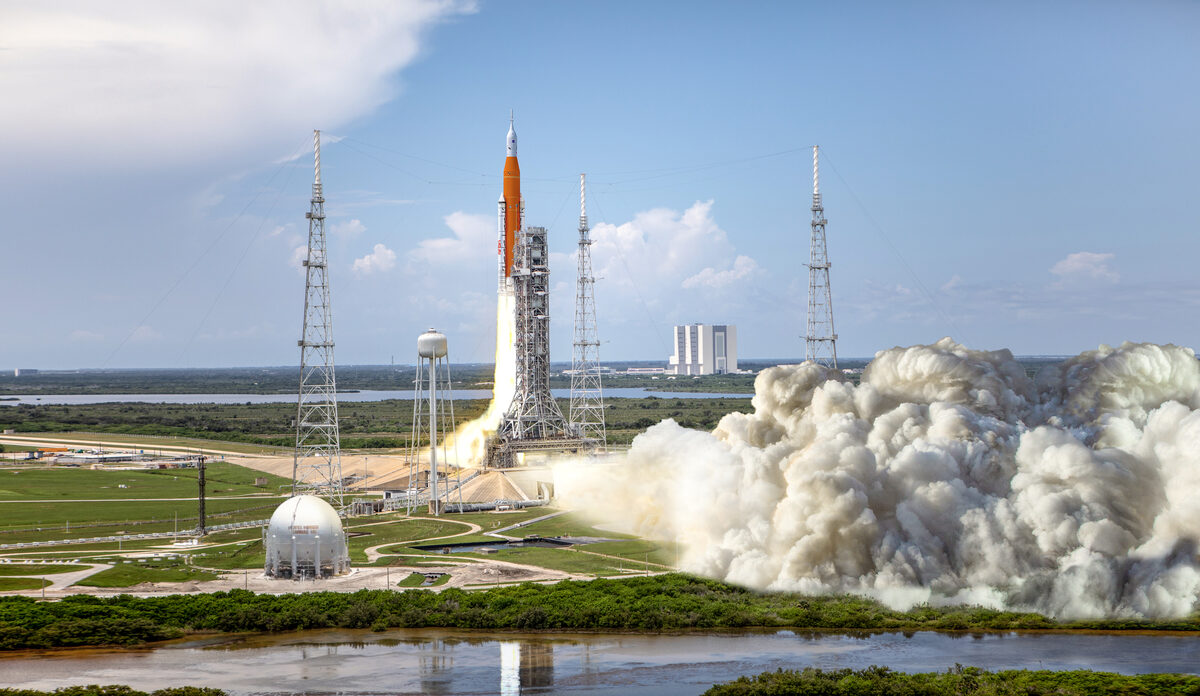
The architecture has four primary elements. The first is the Orion crew capsule and the Space Launch System, the heavy-lift rocket that carries it beyond Earth orbit. SLS has flown once — Artemis I, an uncrewed lunar flyby in November 2022 — and Artemis II, a crewed lunar flyby with four astronauts, is scheduled for 2026. Orion is designed to sustain a crew of four for up to 21 days in deep space, with life support, communication, and abort capability at every phase of the trajectory.
Gateway: the station in lunar orbit
The second element is Gateway, a small space station in a near-rectilinear halo orbit around the Moon — a highly elliptical orbit that brings it as close as 3,000 kilometers to the lunar surface at periapsis and as far as 70,000 kilometers at apoapsis. Gateway's unusual orbit is not a compromise but a design choice: it requires minimal station-keeping fuel while providing access to the full lunar surface (unlike a low lunar orbit, which is constrained by launch windows to particular ground tracks). It also serves as a staging point for surface missions and a research station in its own right. The Gateway Power and Propulsion Element — a 60-kilowatt solar electric propulsion module — is under construction. The Habitation and Logistics Outpost, a pressurized module for crew habitation, is in development.
The third element is the Human Landing System: commercial vehicles that transport astronauts between Gateway and the lunar surface. SpaceX's Starship was selected for the first crewed landing (Artemis III, targeted for 2027), and Blue Origin's Blue Moon was selected for subsequent missions. These are not government vehicles — they are commercially developed landers that NASA will purchase transportation services on, similar to the model used for ISS crew rotation with SpaceX Dragon. The commercial model reduces NASA's per-mission fixed cost and distributes development risk.
Surface systems
The fourth element is the surface infrastructure: the Lunar Terrain Vehicle, a pressurized rover capable of carrying two astronauts for multi-day excursions beyond the initial landing site, and eventually a permanent base camp at the south pole. The lunar south pole's permanently shadowed craters are believed to contain water ice that could be extracted and processed into rocket propellant — dramatically reducing the mass that must be launched from Earth for sustained operations. If confirmed in economically useful quantities, the ice is as important to the Artemis architecture as the missions themselves.
The program has faced schedule pressure, cost growth, and political uncertainty. The SLS core stage costs approximately $2 billion per flight at current production rates, with no near-term path to reusability. Congressional support has been consistent but not unconditional. International partners — ESA, JAXA, CSA, and others contributing Gateway modules and crew members — add political complexity to schedule decisions. The program's defenders note that Apollo itself was delivered under time pressure and cost overruns and was considered too ambitious by critics who turned out to be wrong. Whether Artemis resolves those tensions or becomes another promising architecture that never fully materializes is the central question of the next five years in human spaceflight.
