
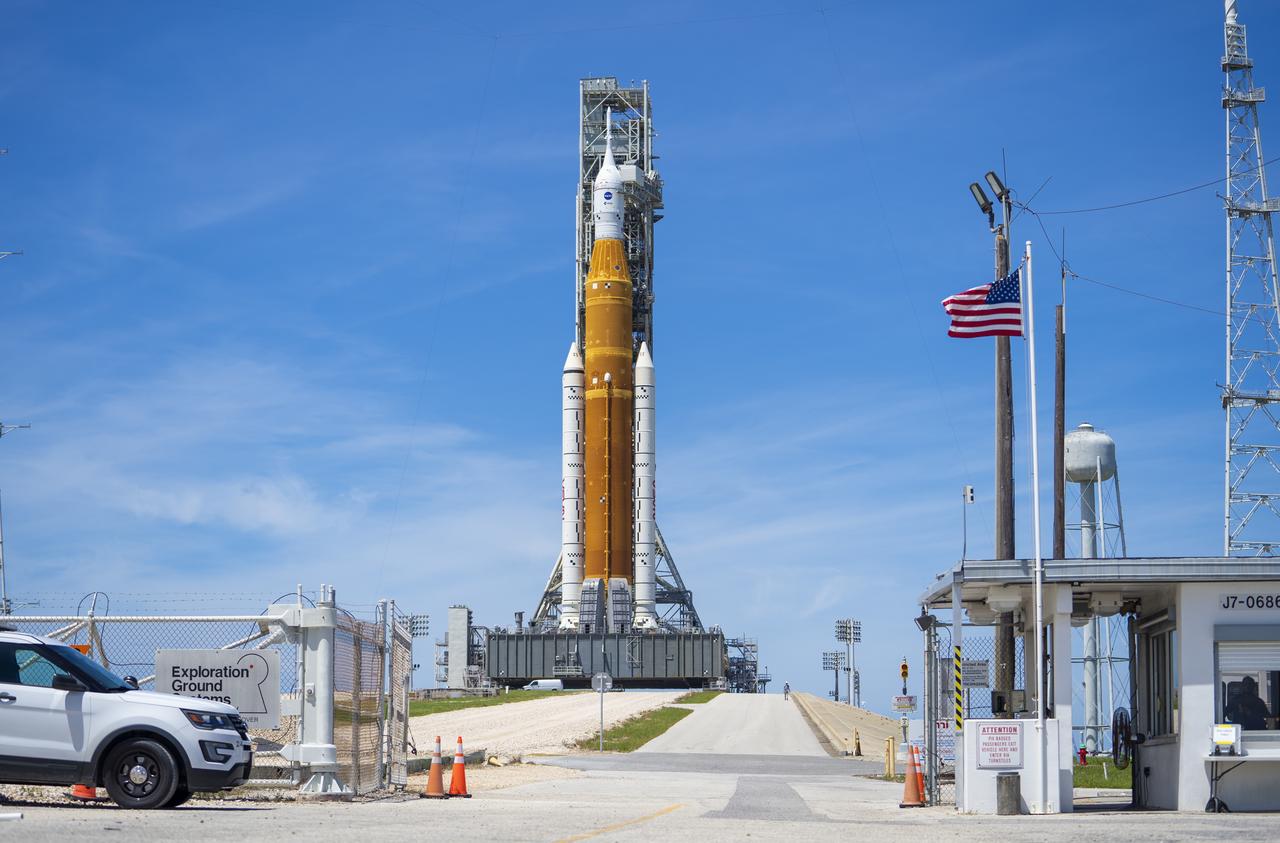
For the first time in over fifty years, the question of when humans will next walk on the Moon has a concrete answer rather than an aspiration. NASA's Artemis program — named for Apollo's twin sister — has moved past its riskiest unknowns and into the harder work of execution. Artemis II, the crewed lap around the Moon, has already flown, and on April 6, 2026 it surpassed the distance record set by Apollo 13 to become the farthest human spaceflight in more than half a century. The transportation stack that will carry crews to lunar orbit is no longer theoretical; it has been demonstrated end to end.
That changes how to read everything that follows. Apollo was a sprint — a Cold War dash to plant a flag before a decade ran out, after which the hardware was retired and the program abandoned. Artemis is built to be the opposite: a sustained campaign, assembled with international partners and commercial providers, intended to establish a presence the program can return to again and again.
The pieces that fly
The architecture's near-term elements are relatively conventional. The Space Launch System, in its Block 1 configuration, throws the Orion crew vehicle toward the Moon. Orion's life support and propulsion come from a European Service Module built by the European Space Agency — a reminder that Artemis is a coalition, not a solo effort. Orion proved itself on the uncrewed Artemis I flight, logging a 1.4-million-mile journey around the Moon, and again with a crew aboard on Artemis II.
What comes next is where the program gets genuinely novel. NASA does not build the lander that will put astronauts on the surface; it buys the service. Human Landing System contracts went to commercial providers — a variant of SpaceX's Starship and Blue Origin's Blue Moon lander. That arrangement offloads enormous cost and risk onto industry, but it also ties the program's schedule to those vehicles maturing.
The dependency that governs the calendar
This is the crux. Before a Starship-derived lander can ferry a crew from lunar orbit to the surface, it must demonstrate something no one has done at scale: launch to orbit, take on cryogenic propellant transferred from a series of tanker flights, and then perform a crewed descent. Orbital propellant transfer is the long pole, and until it is proven, the first crewed landing cannot proceed.
NASA's current plan reflects that reality. Artemis III, targeted for 2027, has been reframed as a demonstration mission to test the commercial landers — one or both of the SpaceX and Blue Origin vehicles — rather than the first surface landing itself. The first Artemis landing is now slated for Artemis IV, which NASA continues to target for early 2028, with the crew transferring from Orion to a commercial lander for the descent. The orbital element, the small Gateway station, is under construction at contractors including Northrop Grumman, though it remains the part of the architecture that draws the most debate: a reusable waypoint to its supporters, a costly detour to its critics.
Why the south pole, and why it is hard
Apollo landed in equatorial daylight. Artemis is aiming for the lunar south polar region, terrain shadowed by low sun angles and pocked with permanently shadowed craters whose floors have not seen sunlight in billions of years. Those cold traps are the prize. Orbital data point to water ice locked in the regolith, and water rewrites the economics of exploration: split into hydrogen and oxygen it becomes rocket propellant and breathable air; melted, it is something to drink. A base that can mine local ice is one that does not have to import every consumable from Earth — the precondition for any lasting presence. The same ice is also a scientific archive of how water was delivered across the early inner solar system.
The real test ahead
Strip away the hardware and Artemis is a wager that the Moon is the right rehearsal stage for Mars — close enough to abort in an emergency, far enough that the lessons transfer. Habitats, life support, surface operations, and resource extraction can all be tested three days from home rather than the many months a Mars transit demands. The risks that remain are mostly programmatic rather than technical: multi-administration timelines, congressional budgets, and the readiness of commercial partners are the variables most likely to move the landing date, and every one of them has moved it before. With Artemis II behind it, the program has answered its hardest early questions. Whether the cadence holds through the landings is the open question now worth watching.
