
The headline number for Artemis III is three: three rockets, launched in succession, to stage a rendezvous in low Earth orbit that ends with a splashdown and no lunar footprints. But the number that actually tells you something is two — two commercial lander test articles, built by two companies working from the same NASA contract requirements, that have almost nothing in common in how they will meet a crewed Orion.
NASA's Human Landing System program published a detailed breakdown of the demonstration mission on July 15, 2026. The mission flies in 2027, with the first crewed lunar South Pole landing now assigned to Artemis IV in 2028. Those dates have been chewed over already. What hadn't been laid out in this much detail is the hardware — and the hardware is where the divergence lives.
Two Test Articles, Two Answers
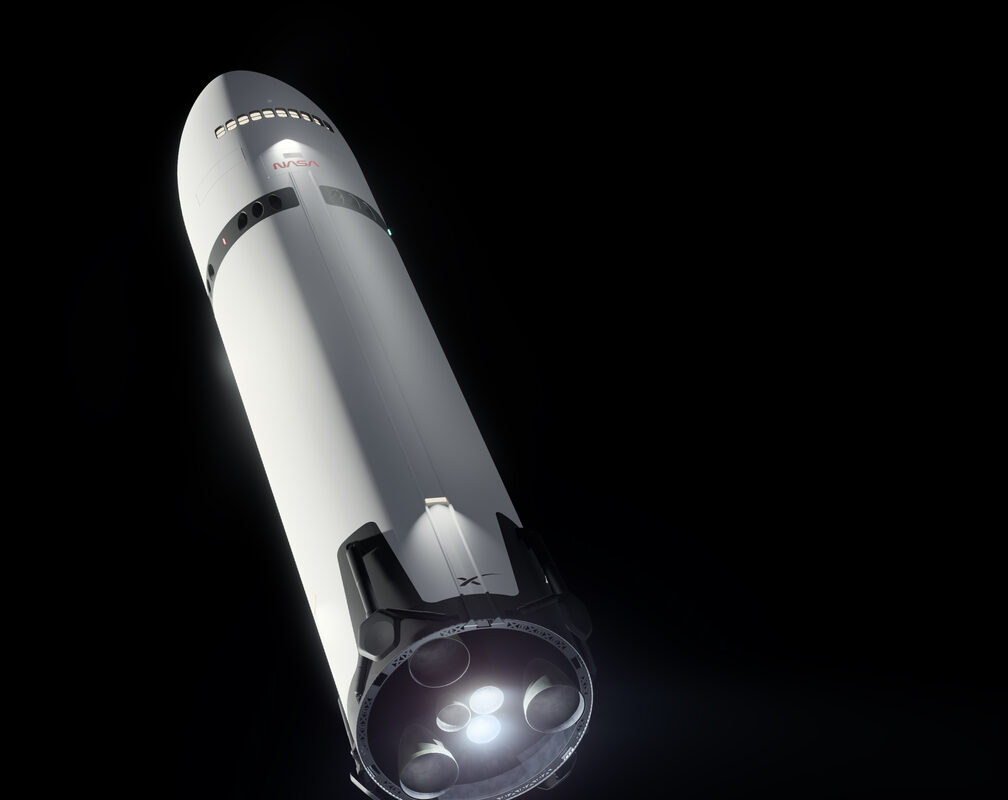
Start with SpaceX. The test article is Starship Version 3: 171 feet tall, 52 meters, which is to say a vehicle roughly the height of a 15-story building being asked to perform delicate proximity operations with a capsule carrying four crew members. It has a docking system added to its nose. It docks nose-to-nose with Orion. And the crew will never enter it.
That last point is worth sitting with. NASA states plainly that astronauts will not enter the Starship test lander during Artemis III. Its job is narrower and, in a sense, more fundamental. NASA and SpaceX are still identifying the specific controllability and communications tests the flight will carry, and the agency intends to evaluate how the entire integrated stack of Orion and the Starship test lander interact. It is a test of the vehicle as a vehicle, not as a habitat.
Blue Origin took the opposite tack. Blue Moon Mark 2 docks along the side, adjacent to its crew cabin. Up to two crew members, wearing orange Orion crew survival system suits, will open the hatch and enter the test lander. The vehicle can loiter in space for as long as 30 days, allowing orbital checkouts before SLS and Orion even leave the pad. It also carries an instrumented lunar surface spacesuit mass simulator — a stunt double for the hardware that will eventually walk on the Moon, wired to provide real-time feedback about the environment inside the Blue Moon crew cabin.
One test article is being evaluated as a machine. The other is being evaluated as a place.
Steve Creech, program manager for the Human Landing System Program at NASA's Marshall Space Flight Center, put it with characteristic understatement: "Each human landing system provider has taken a different approach to the Artemis III mission." He added that both companies "have put forward a list of aggressive objectives and goals intended to complement upcoming uncrewed demonstration missions."
The Docking Geometry Is the Story
Nose-to-nose versus side-adjacent is not a stylistic choice. It follows from what each vehicle is.
Starship's nose is where a docking system can plausibly be bolted on. Its side is a stainless steel cylinder that has spent the entire vehicle's development history being optimized for other things — propellant volume, thermal protection, structural load paths. If you want a docking port on a 171-foot vehicle designed the way Starship is designed, the nose is where it goes. And once the port is on the nose, the mission profile follows: Orion approaches the tip of a skyscraper, and the two vehicles mate end to end.
Blue Moon Mark 2 puts the port beside the crew cabin because getting people in and out is the point. The geometry serves the hatch. That is a lander conceived around crew transfer from the outset, and its test article is being flown to prove exactly that: can astronauts open the door, and can they get in?
Then there is the launch order, which reads like a stage direction. Blue Origin goes first. SLS with Orion follows from Kennedy Space Center's Launch Complex 39B. SpaceX goes last. Two separate, back-to-back rendezvous and docking operations, then the crew splashes down.
Jeremy Parsons, the Artemis program manager, called Artemis III "a highly choreographed dance with a demanding launch sequence across multiple launch pads." The phrase is doing a lot of work. Choreography implies that every dancer has to hit their mark, and that the sequence has a critical path.
What Could Go Wrong
Space.com framed the risk succinctly: three giant rocket launches, two private moon landers, and one big question — can it all work together? That's the integration problem, and it is not a rhetorical flourish. Each of these elements has its own development schedule, its own failure modes, and its own history of dates moving. Sequencing them means the mission inherits the slippage of whichever piece runs latest.
Scientific American read the same architecture and saw something else in it: a mission that "pits the two aerospace companies head-to-head as they vie to be first to flight-test their in-development crewed lunar landers." NASA's official framing is that the providers took different approaches. The competitive framing says those approaches are being measured against each other, in flight, in front of everyone.
Both readings can be true. The divergence in test article design means NASA isn't running a controlled experiment — it can't hold everything constant and vary one thing. It will get two very different data sets. Blue Origin's tells NASA about crew interfaces, loiter duration, and cabin environment. SpaceX's tells NASA about controllability, communications, and integrated stack dynamics on a vehicle unlike anything that has docked with a crewed capsule before.
What NASA won't get is an apples-to-apples comparison. That may be by design, but it does complicate any narrative about a winner emerging from 2027.
Why It Matters
The test article divergence is the most concrete public evidence yet of how differently the two HLS providers are thinking about crewed lunar flight — and NASA is buying both philosophies simultaneously.
Blue Origin is proving the human side early: hatch, cabin, suits, loiter time. That front-loads the questions that get people killed and answers them in low Earth orbit, where an Orion is right there and a splashdown is hours away rather than days. It is a conservative sequencing of risk.
SpaceX is proving the vehicle first and deferring crew ingress. A 171-foot Starship with a docking system on its nose and no astronauts stepping aboard is a statement that the hard problem is making the thing fly and behave predictably next to a crewed capsule — and that the interior can be demonstrated later, once the outside is trustworthy. That is also a defensible reading of where the risk actually sits. It just means the crew-interface questions get answered on a later flight.
Neither approach is obviously wrong. But they resolve to different things being known by the end of 2027, and the first crewed lunar South Pole landing is planned for 2028 — one year later. The demonstration mission's value depends on it surfacing problems early enough to fix them. A test that defers a category of question defers the discovery of whatever is wrong in that category.
The three-launch sequence is the schedule risk everyone can see. The asymmetry between what the two test articles will actually prove is the one that requires reading the fine print.
Sources
- How NASA's Artemis III Lander Test Will Pave Way for Moon Landings — NASA Human Landing System Program, July 15, 2026
- NASA Marches Toward Artemis III Mission in 2027, Names Crew Members — NASA
- NASA's next Artemis mission pits SpaceX against Blue Origin in a race to the moon — Scientific American
- NASA's ambitious Artemis 3 mission includes 3 giant rocket launches, 2 private moon landers and 1 big question — Space.com
