
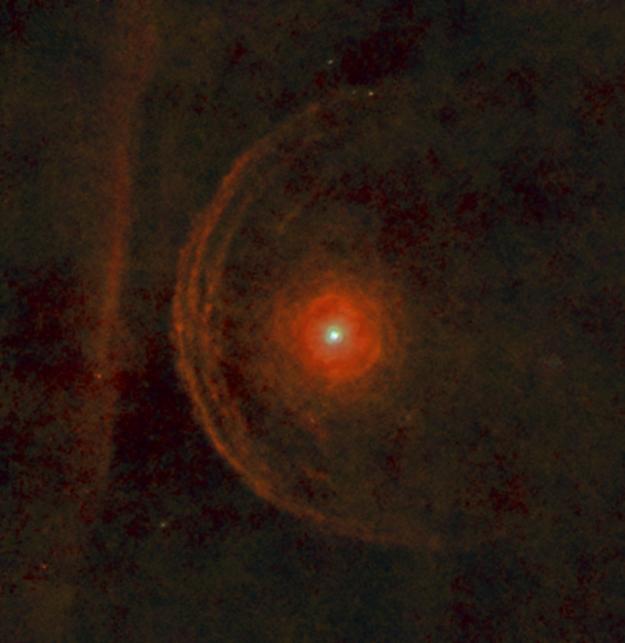
Betelgeuse has never been a quiet neighbor. The red supergiant marking Orion's shoulder has spent the past several years dimming unexpectedly and generally giving astronomers reasons to keep a telescope pointed at it. The latest reason arrived this week in the form of the sharpest radio images yet taken of the star's photosphere — and they show something that shouldn't, by the textbook, still be there.
Using the Atacama Large Millimeter/submillimeter Array (ALMA), a team led by W. Dent imaged two bright patches on Betelgeuse's surface, the brighter of which runs roughly 800°C hotter than the photosphere around it. Together, the pair contributes about 1% of the star's total light output at the observed wavelength — a modest fraction, but a striking one given how long the spots have apparently been sitting there. Comparing the new images to ALMA data taken roughly seven years earlier, the researchers found the hot-spot structure has barely changed. In a star this large and this turbulent, that kind of stability is the real story.
Why It Matters
Red supergiants like Betelgeuse move heat around through convection — hot plasma rises, cools, sinks, and repeats, the same basic process that boils a pot of water, just on a stellar scale. Standard convection models predict that the giant cells doing this work on a star's surface should churn and reorganize over periods far shorter than seven years; a single convective cell is expected to rise, spread, and dissipate long before it could be caught twice in the same place. Betelgeuse's hot spots not moving, or barely moving, over that stretch suggests either that something is anchoring the convection pattern in place, or that current models of how energy moves through a star this size are missing a mechanism entirely. Betelgeuse is also close enough — and, at more than 650 times the Sun's radius, large enough — that it's one of the only stars where astronomers can actually resolve surface features like this directly, rather than inferring them indirectly. That makes it a rare testbed for convection physics that otherwise has to be taken largely on faith.
A star that keeps outgrowing its models
Betelgeuse packs roughly 14 solar masses into a body that, were it dropped into our own solar system, would swallow the orbit of Jupiter. That combination — huge mass, huge radius, and a late-life evolutionary stage that makes it prone to instability — has made it a favorite target for testing stellar models against reality. It's also the star behind the dramatic, unexplained dimming episode that grabbed headlines a few years ago — a brightness drop severe enough that some astronomers speculated the star might be nearing its supernova. That explosion hasn't happened, and scientists are now less convinced it's imminent, but the episode cemented Betelgeuse's reputation as a star worth watching closely.
The new ALMA work adds a different kind of anomaly to that record. Rather than a one-off eruption, it points to a standing feature — hot regions that persist through years in which the star's outer layers should, by convection theory, be in constant churn. The researchers link the persistence to the hot spots' location near the star's proposed poles, pointing to a pattern of enhanced, comparatively stable polar convection — cells that behave differently, and last longer, than the giant convective cells modeled in typical red-supergiant simulations.
Does the companion star have anything to do with it?
One wrinkle complicating the picture: Betelgeuse isn't alone. Earlier imaging identified a faint companion, informally named Siwarha (Betelgeuse B), orbiting close to the giant star. Coverage of the new ALMA results has floated the possibility that Siwarha's orbit around the much larger star could be shaping or reinforcing the hot-spot pattern — potentially explaining why the same regions keep showing up hotter than their surroundings instead of convection randomizing their location over time.
That idea remains speculative rather than demonstrated. Confirming a link would mean tracking the hot spots' position relative to Siwarha's orbit over further observing campaigns, checking whether the spots move — or fail to move — in step with the companion rather than with the star's own rotation or convective churn on their own schedule.
What comes next
For now, the finding is less a solved mystery than a sharpened one. ALMA's imaging is described as among the most detailed views yet obtained of Betelgeuse's turbulent, bubbling surface, giving researchers a genuinely new baseline to compare against future observations. If the hot spots are still sitting in roughly the same place the next time astronomers check, that will only strengthen the case that something besides ordinary convection is at work. If they've finally shifted, it may simply mean seven years wasn't long enough to catch the cycle in action. Either way, the preprint has been accepted to Astronomy & Astrophysics, putting it on track for formal peer-reviewed publication — a step that will let other teams pick apart the imaging and modeling in detail.
Betelgeuse is due to end its life as a supernova at some point, though scientists now say that explosion isn't as imminent as the earlier dimming episode once led some to fear. Until then, its surface keeps offering up puzzles that a star this close and this large is uniquely positioned to let us actually see.
