
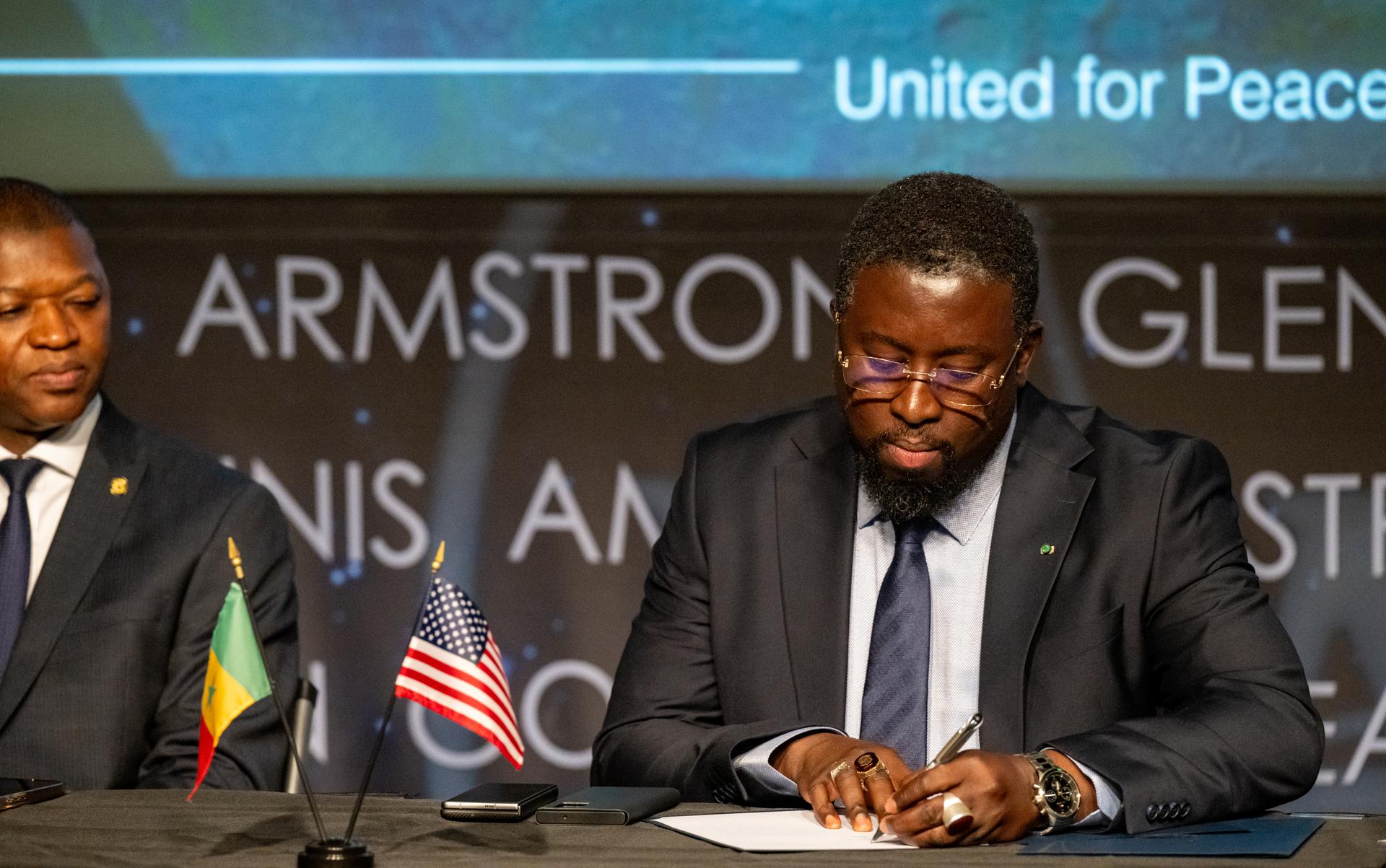
On September 21, 2026, inside the Mary W. Jackson NASA Headquarters building in Washington, D.C., a small Balkan nation with two satellites to its name joined a list of more than seventy countries betting on a shared set of rules for exploring space. Albania became the 73rd signatory of the Artemis Accords, the non-binding framework the United States has spent the past six years assembling to govern how spacefaring nations behave on the Moon, Mars, and beyond.
The ceremony began at noon Eastern time and, according to event details published by SpacePolicyOnline.com, was held strictly in person — no livestream, no remote option, just officials in a room putting signatures on paper. Albania's Minister for Europe and Foreign Affairs, Ferit Hoxha, signed on behalf of his government. NASA Deputy Administrator Matt Anderson signed for the agency, marking the moment with a line that has become something of a ritual at these signings: "It is my privilege to welcome the Republic of Albania as the 73rd signatory of the Artemis Accords."
Also in the room were Albania's ambassador to the United States, Ervin Bushati, and Connor Tomlinson, a deputy assistant secretary at the State Department — a pairing that underscores how the Accords function as much as a diplomatic instrument as a technical one.
Why It Matters
The Artemis Accords are not a treaty in the legal sense — they carry no enforcement mechanism and create no new international law. What they do is establish a common vocabulary among signatory nations: commitments to transparency in space operations, interoperability of systems and standards, registration of space objects, and open sharing of scientific data. For a nation like Albania, without a national space agency or launch capability of its own, signing is less about unlocking a specific mission and more about signaling where it stands in an increasingly crowded and competitive orbital and lunar environment.
That environment is exactly why the Accords' growth is being watched closely. Every additional signatory nudges the framework closer to becoming the de facto rulebook for space behavior, particularly as NASA's Artemis program works toward returning astronauts to the lunar surface and as commercial and governmental activity in cislunar space accelerates. Space Brief's September 22 roundup led with Albania's signing as its top story of the day, describing the Accords in the same terms NASA uses when it announces each new signatory: a framework built on transparency, interoperability, and the release of scientific data.
A Small Country's Case for Signing
Albania's pitch for joining wasn't built on ambitious future missions — it was built on a track record, however modest. In January 2023, the country launched two Earth-observation satellites, Albania-1 and Albania-2, aboard a SpaceX Falcon 9. Those satellites gave Albania its first operational presence in orbit, a foundation the country has since built on with domestic participation in NASA's Space Apps Challenge, the agency's annual global hackathon that invites teams to build tools using NASA's open data sets. Neither the satellites nor the hackathon involvement make Albania a major space power, and nothing in NASA's announcement suggests the agency was billing it as one. But together they gave the country a concrete, citable basis for signing — evidence that it already operates in the domain the Accords are meant to govern, rather than joining purely as an aspirational gesture.
What the Accords Actually Commit Signatories To
Since the United States and its founding partner nations first signed the Accords in 2020, the framework has expanded through the same basic ceremony repeated dozens of times: a foreign minister or equivalent official travels to Washington, signs alongside a senior NASA official, and the agency adds a country to its running tally. The substance underneath that ceremony, per the principles NASA has consistently attached to each signing, centers on a handful of ideas — public disclosure of space policies and activities, use of common technical standards so systems and hardware from different nations can work together, registration of objects a country sends into space, and open release of scientific data gathered from space missions. Those commitments matter more as the number of actors in space grows. A framework that only the U.S. and a handful of established space powers observe does little to prevent friction; one that ropes in dozens of nations — spacefaring or not — establishes a broader norm that transparency and data-sharing are simply how responsible actors in space are expected to behave.
