
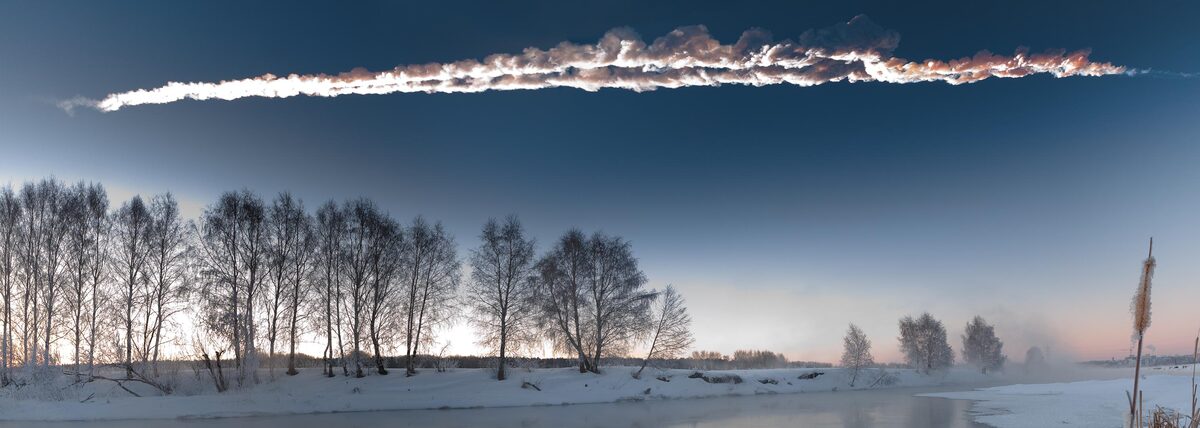
At 20:53:59 local time on April 17, 2026 (18:53:59 UT), a bright fireball crossed the sky over Poland's Greater Poland and Lodz Voivodeships. It stayed visible for more than 18 seconds. Five days later, two members of Poland's Skytinel camera network recovered a 2.9-kilogram lump of iron from a field in the municipality of Zadzim, about 40 centimeters below the surface.
The Zadzim meteorite now has a detailed scientific write-up. In a new arXiv paper, Jiri Borovicka and colleagues reconstruct the fireball's trajectory, dynamics, light curve, spectrum and orbit. They then use it, together with seven other iron fireballs, to test how metal meteoroids lose mass and give off light in the atmosphere. Their answer is that iron behaves quite differently from stone, and models built for stony bodies don't fit it well.
From Camera Network to Meteorite in Five Days
The recovery happened fast. According to the Skytinel network's account, 25 of its stations recorded the event. Two networks observed the fireball: Skytinel and the European Fireball Network. Pavel Spurny and Jiri Borovicka of the Institute of Astronomy at the Czech Academy of Sciences helped narrow down where any surviving material was likely to have landed.
On Sunday, April 19, 26 Skytinel members went out to search. The find came the following Wednesday, April 22, when Anna and Pawel Walczak spotted a small crater and recovered the meteorite about 40 cm down. TVP World described it as the first iron meteorite in Poland found so soon after an observed fall.
Prof. Szymon Kozlowski of the University of Warsaw helped clean the specimen. Skytinel says measurements of short-lived isotopes are scheduled at the National Centre for Nuclear Research in Swierk. That timing matters: isotopes produced by cosmic-ray exposure in space decay after the rock lands, so the sooner a fresh fall is measured, the more of them can be detected.
A Body That Refused to Break
The surprising result in the paper is about strength. Based on the light curve, the team estimates the meteoroid weighed about 19 kg when it entered the atmosphere, with an effective size of 17 cm. On the way down it faced a peak dynamic pressure of 5.2 MPa, the force of air hitting a body moving at hypersonic speed. The authors call that pressure relatively large, but the Zadzim body did not fragment.
Stony meteoroids usually behave differently. They tend to crack, shed fragments and sometimes break up suddenly, producing flares in their light curves and scattered fields of small meteorites on the ground. Zadzim seems to have stayed in one piece the whole way, eroding gradually until a single 2.9 kg mass reached the ground. That matches the recovery: one meteorite, not a strewn field.
Iron Glows Brighter
To get a mass from a fireball, researchers have to know how much of the meteoroid's kinetic energy becomes visible light. That fraction is called the luminous efficiency. If the assumed value is too low, the inferred mass comes out too high, and the reverse is also true.
Borovicka and colleagues found that the Zadzim light curve could only be fitted with a luminous efficiency about three times larger than the value used for stony meteoroids. In practice, an iron body of a given mass shines noticeably brighter than a stony one of the same mass. If a fireball is wrongly assumed to be stone, its size can be overestimated.
The team did not rest this conclusion on a single event. They also fitted seven other iron fireballs, with sizes from 2.5 to 13 cm. That puts Zadzim, at 17 cm, at the top of the size range in their sample.
How Fast Iron Melts Away
The second key parameter is the ablation coefficient, which describes how much mass a meteoroid loses for each unit of energy it absorbs. The paper reports a strong dependence on size. In the small iron meteoroids, the ablation coefficient reached about 1 kg/MJ, meaning they lost material very efficiently. In Zadzim it never went above 0.08 kg/MJ, and toward the end of the luminous flight it relaxed to 0.023 kg/MJ.
That is more than an order of magnitude below the peak values in the small bodies. The larger iron object lost mass far less efficiently per unit of energy, and late in its flight the rate dropped further. This helps explain how a body that started at roughly 19 kg still put almost 3 kg into a field in central Poland.
Why It Matters
Meteorites in collections are physical samples of asteroids, but most come with no information about where they came from. A fall that is filmed by a camera network, reconstructed and then recovered gives both the rock and its orbit. Skytinel notes that earlier iron meteorites in Poland came from ancient falls and were usually found by accident, so Zadzim offers a rare chance to tie a metal meteorite to its observed path.
The atmospheric results matter just as much. Fireball networks estimate meteoroid masses, sizes and expected meteorite yields from light curves and decelerations, and those models depend on values like luminous efficiency and ablation coefficient. If iron bodies glow about three times more efficiently and lose mass very differently depending on size, then models that treat everything like stone are likely to misjudge iron fireballs. That affects predictions of whether anything survives and where searchers should look. The Zadzim event shows that a fairly large iron body can withstand dynamic pressures in the megapascal range without breaking up, which is useful for understanding how metal-rich objects behave at entry.
The recovery also shows how much a well-coordinated amateur network can contribute. Volunteer cameras supplied the data, professional astronomers helped refine the search area, and volunteers searching the ground found the meteorite within days. That speed matters for the planned isotope measurements, which Skytinel calls crucial for freshly found meteorites.
