
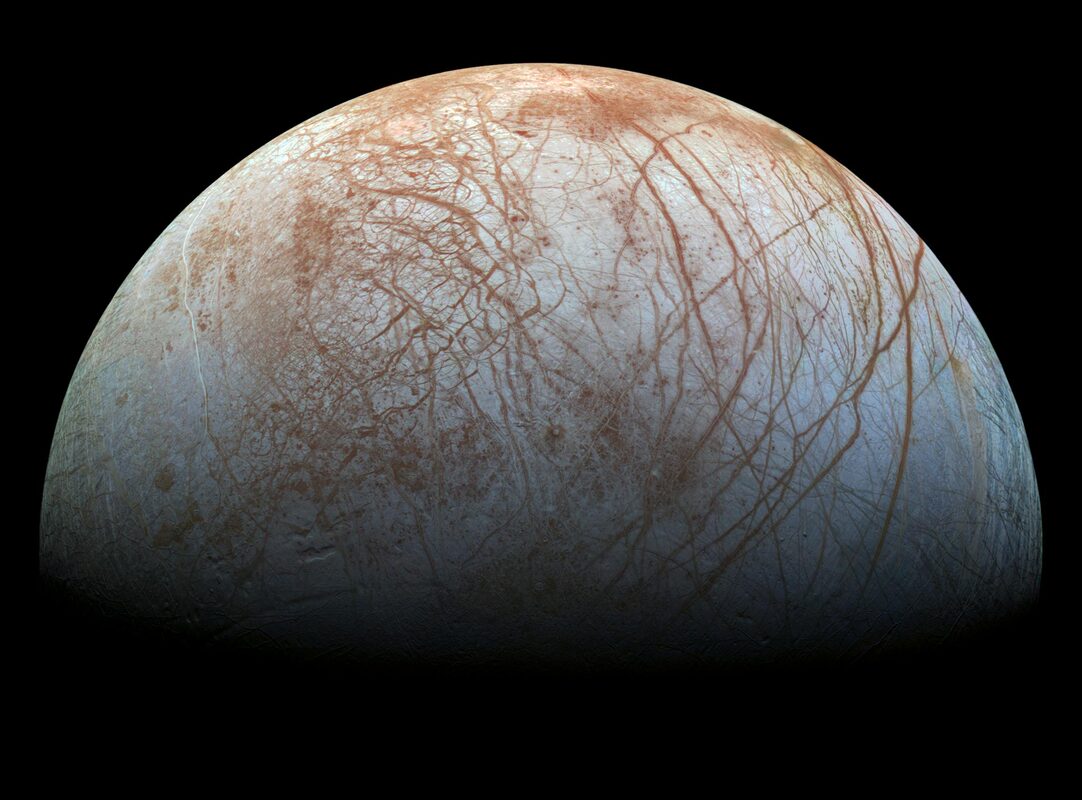
Few places in the Jupiter system stay quiet for long. Io is volcanically active, and Jupiter's magnetosphere fills the space around its moons with plasma whose conditions keep changing. So the most interesting result in a new study of Europa is that one thing hardly changed: a faint cloud of sodium gas around the icy moon has stayed remarkably stable for more than 20 years.
The work comes from a team led by Boston University and was published in the Journal of Geophysical Research: Space Physics. It draws on more than two decades of observations with the HIRES spectrograph at the W. M. Keck Observatory, which announced the result on November 19, 2026. The researchers argue that this stability tells us where the sodium comes from. In their reading, it is not being blown over from Io's volcanoes. It starts inside Europa itself, in the salty ocean thought to lie beneath its ice shell.
A cloud that ignores its neighbor
The reasoning works by elimination. Io is a volcanic moon that sprays sodium around the Jupiter system. If Europa's sodium were mostly material from Io, you might expect the cloud to shift with Io's volcanic activity and with the changing plasma around Jupiter. Over twenty-plus years of data, the team did not see that. Keck says the stability is surprising given both of those influences.
"What we observe originates in Europa's saltwater and not in Io's volcanoes," said Carl Schmidt of Queen's University Belfast and Boston University, a co-author on the study. In his words, Europa is "indifferent to Io's volcanic activity."
The cloud is large. According to Universe Today, it is oblong and more than 46,800 kilometers across, about 30 Europa radii. Keck describes it as elongated in the east-west direction.
The hard part: seeing gas next to a bright moon
Detecting the cloud far from Europa is one thing. The new step, according to Keck, is the first link between the sodium at high altitude and the sodium close to Europa's disk. That connection is what lets the team tie the large cloud back to the moon's surface and, by extension, to what lies underneath.
Measuring gas near the surface is much harder than it sounds. Europa's ice is highly reflective, and the sunlight bouncing off it overwhelms the faint signal from the thin gas just above it. The team got around this in two ways. They used HIRES in a long-slit configuration, which measures sodium's spectral fingerprint while preserving spatial information around the moon. And they timed observations for when Europa was passing through Jupiter's shadow. With no direct sunlight reflecting off the ice, the glare goes away and the much fainter sodium emission can be detected.
It is a patient approach, and it only works because the archive is so long. The team combined newer observations with archival Keck data dating back to 1999, and by changing the instrument's orientation at multiple locations they mapped the cloud rather than measuring it at a single point. A single snapshot could not show that the cloud holds steady. Two decades of comparable measurements can.
Why sodium?
Sodium is useful here largely because of what it implies. It is a component of ordinary table salt, and salt is exactly what planetary scientists expect to find in an ocean that has spent a long time in contact with rock.
There is already evidence on Europa's surface. In 2019, scientists at Caltech and NASA's Jet Propulsion Laboratory reported in Science Advances that yellowish regions on Europa, including the area known as Tara Regio, contain sodium chloride. As NASA described it at the time, the finding suggested the subsurface ocean may be chemically more like Earth's oceans than previously thought.
The new study adds to that picture from a different direction. Instead of reading salt deposits on the surface, it follows sodium that has escaped into space and makes the case that its steady supply comes from the moon's own interior.
"We don't know a lot about Europa's hidden ocean and icy surface, but its atmosphere offers a window into this potentially habitable world," said lead author Emma Lovett, a graduate student at Boston University.
Why It Matters
Europa's ocean is one of the most promising places in the solar system to look for conditions suitable for life, but it sits under ice we cannot yet sample directly. That makes indirect tracers valuable, and a tracer is only useful if you know where it comes from. If the sodium around Europa comes from Europa, and not from a volcanic neighbor next door, the cloud can be read as a signal from the moon's own salty water and not as contamination from Io. Keck is careful to note that the cloud is not a direct measurement of the ocean, but understanding where its sodium originates helps scientists build a fuller picture of the moon's chemistry.
The length of the record matters too. Stability over two decades is a strong constraint, and it came from a ground-based telescope and a method designed to get around one of the hardest problems in observing Europa: its own brightness. The link between near-surface and high-altitude sodium gives future observations a framework. If the cloud is a steady product of Europa itself, it becomes a baseline to compare against. The team is already using the Hubble Space Telescope to look for magnesium, another possible ingredient of Europa's ocean salts.
The study does not answer the larger questions about Europa's ocean, such as its full chemistry or whether anything lives in it. It does make one of the moon's faintest features easier to interpret, and it shows that a patient, long-running observing program can still turn up something new about Jupiter's icy moon.
