
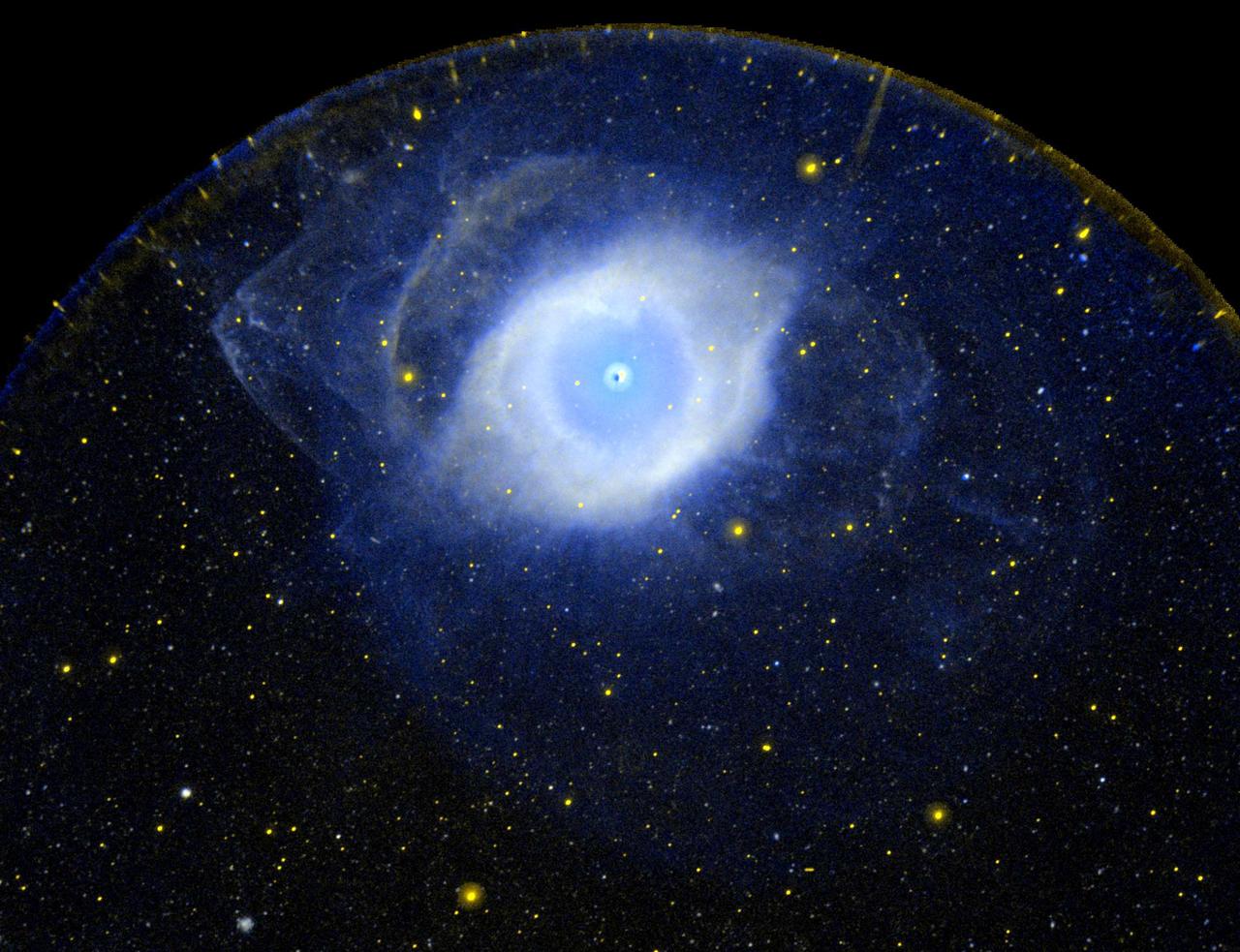
Stars like the one at the heart of IRAS 06530-0213 don't fade quietly. Late in life, they shed their outer layers in stages, and each stage leaves its own mark in the gas around them. A team led by Raghvendra Sahai of NASA's Jet Propulsion Laboratory has now used the Atacama Large Millimeter/submillimeter Array (ALMA) to read one of those marks: a ring of gas about half a light-year across that the team describes as a fossil of the star's last thermal pulse.
"We've caught, for the first time, a star's final nuclear heartbeat, frozen in gas," Sahai said in the NRAO announcement. The paper appeared in The Astrophysical Journal. Space.com reports that it was published Friday, November 20.
A Ring From 6,500 Years Ago
IRAS 06530-0213 is a pre-planetary nebula about 12,000 light-years away in the constellation Monoceros. It is a short-lived stage between a red giant's swollen, mass-shedding phase and the fully lit planetary nebula that may come later. According to the team's arXiv preprint, the central object is a carbon star. The star's progenitor was on the asymptotic giant branch (AGB), and the star has since moved into the post-AGB phase.
ALMA observed the system at wavelengths of 0.44 and 0.88 millimeters, with resolutions of roughly 0.1 to 0.5 arcseconds. The data show an extended circular ring. Based on its size and expansion, the researchers estimate the shell was blown off about 6,500 years ago. The authors call it the first evidence of the last thermal pulse before the post-AGB phase in a carbon star. A thermal pulse is a burst of helium burning in a shell inside the star. The NRAO release calls the ring the first direct evidence of the final pulse before this type of star enters its last phase.
This matters because thermal pulses are central to models of late stellar evolution, but they happen deep inside stars and are hard to observe directly. The ring is a record left in the gas. Its shape and expansion carry a timestamp you can measure.
Reading the Timeline
The ring is not the only structure ALMA found. The researchers pieced together a sequence of events from the layers of gas around the star:
- About 6,500 years ago: the thermal pulse ejects the shell that is now the circular ring.
- The next ~2,000 years: the star's mass loss drops.
- The following ~1,000 years: mass loss rises sharply, producing filamentary arcs in the outflow.
- The last ~700 years: a central bipolar, hourglass-shaped nebula and a torus form. Expansion ages suggest the star moved into the post-AGB phase within roughly this window.
A timeline like this is useful because the phase it covers is so brief. In astronomical terms, 700 years is nothing. Catching a star this soon after the transition, with the pulse shell still clearly visible farther out, lets astronomers line up the star's outflow history with a dated thermal pulse.
The Parts That Don't Fit
The results also cut against standard models in two ways.
The first is chemistry. Space.com reports that the team found an unexpectedly high abundance of heavy isotopes of carbon, oxygen and nitrogen around the star, and that this does not fit standard models. The NRAO release adds that similar fingerprints have been seen in a few other odd objects, and that some researchers have proposed bursts of explosive nuclear burning as the cause.
The second concerns a companion that may not exist. The preprint notes that the arcs are likely part of a spiral structure generally attributed to a binary companion. Dying stars known to have companions typically sit inside a compact disk of dust. But ALMA found no compact continuum source or disk at the center. Space.com describes this as a failure to detect the dust disk expected if a binary companion were present. The NRAO release says any disk there would be more than 50 times fainter than those around well-known cases such as the Red Rectangle, and that one possibility is a disk that existed briefly, helped sculpt the hourglass with a short burst of jets, and then faded.
Sahai put it this way in the NRAO release: "IRAS 06530 shows that the story is more complicated than the tidy explanation we've been using."
Why It Matters
Space.com framed the finding as one that "challenges what we know about our sun's eventual death," and the reasoning is straightforward. Models of how stars lose their outer layers at the end of their lives depend on assumptions about thermal pulses, mass-loss rates and the shaping effects of companions. Until now, the final pulse had been inferred rather than observed. IRAS 06530-0213 offers a dated record of it, along with a detailed history of the outflow afterward.
That record turned up some problems. The isotope ratios disagree with standard predictions, and the shapes that usually signal a binary appear without the disk that should go with one. Neither is proof that the models are wrong. It is one object, and one star can be unusual. But a clear measurement that refuses to match expectations is exactly the kind of result that forces theorists to look at their assumptions again.
The NRAO release says the observations are part of PANORAMA, an ALMA survey of dying stars transitioning to planetary nebulae, and that IRAS 06530 is the first object from the survey to be presented in detail. Results from the rest of the survey should show whether this star is typical or an outlier.
