
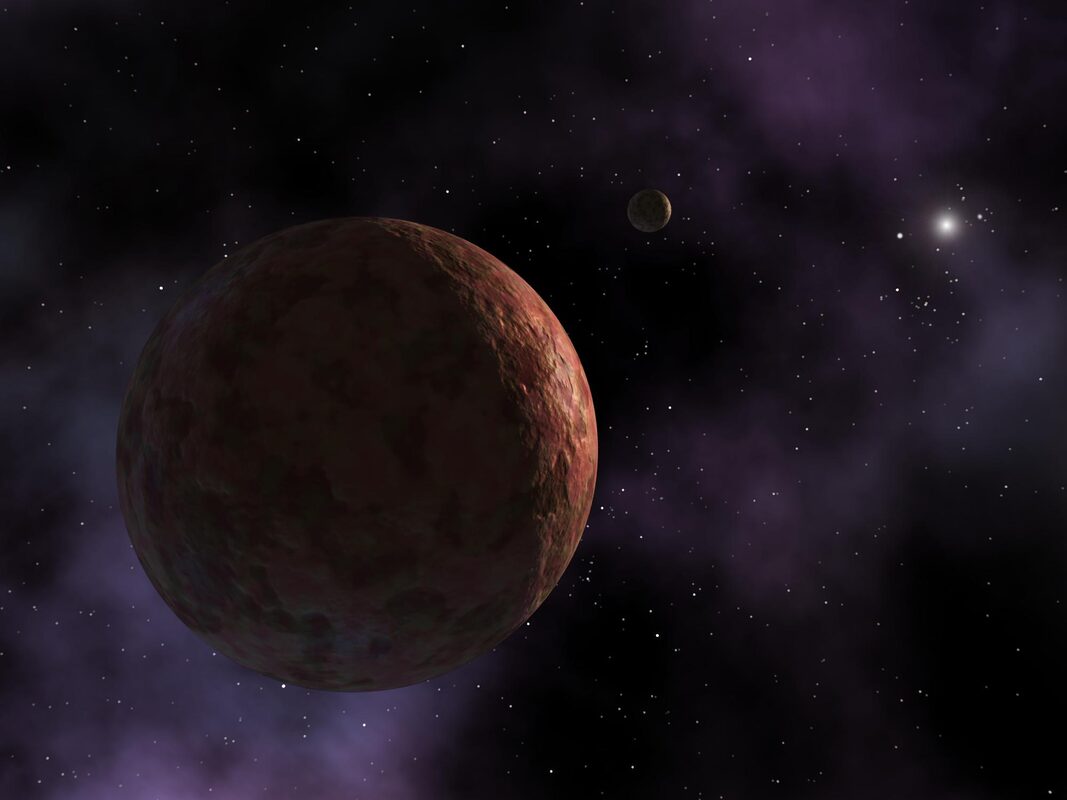
For years, the search for a hidden planet in the outer solar system has meant looking for something big. The best-known candidate, Planet Nine, would be a world of roughly 5 to 10 Earth masses circling the Sun far beyond Neptune. A new study published in Monthly Notices of the Royal Astronomical Society proposes a smaller suspect. It would have about the mass of Earth and would sit hundreds of astronomical units away. If it exists, it could account for many of the same orbital oddities.
The paper, titled "Signatures of an Earth-class Planet in the Distant Solar System," was led by Patryk Sofia Lykawka of Kindai University and UniSQ. It describes a hypothetical body the team calls Planet X2, or PX2. According to the Royal Astronomical Society, the simulated planet has roughly 1.5 to 2 Earth masses and an orbit that never brings it closer to the Sun than about 200 AU.
A sense of scale
The distances involved are hard to picture. One astronomical unit (AU) is the average distance between Earth and the Sun. Neptune, the outermost of the known major planets, orbits at about 30 AU. Past Neptune lies the Kuiper Belt, a ring of icy debris that extends from roughly 38 to 50 AU.
PX2 would sit much farther out than either. EarthSky reports that the proposed planet follows an elliptical orbit with an average distance of about 350 to 500 AU. Planet Nine models place their larger planet at an average distance of 290 to 460 AU, so the two candidates would occupy broadly overlapping regions. The main difference between them is mass. PX2 would be an Earth-class world, while Planet Nine would be five to ten times heavier than Earth.
The objects whose orbits drive this debate are also extreme. Sedna, one of the best-known distant bodies, travels on an orbit that ranges from about 76 AU to 937 AU from the Sun and takes roughly 11,400 years to complete. Over the past two decades, astronomers have found a growing population of distant objects on unusually tilted or elongated orbits that are difficult to explain through the gravity of the known planets. That raises the question of what shaped their paths.
What the simulations show
The new work builds on an earlier proposal. In 2023, Lykawka and Takashi Ito published "Is There an Earth-like Planet in the Distant Kuiper Belt?" in The Astronomical Journal (AJ 166, 118). That paper used N-body simulations to argue that an Earth-like planet of about 1.5 to 3 Earth masses on a distant, inclined orbit could explain several properties of the distant Kuiper Belt, including detached objects, high-inclination objects and extreme orbits such as Sedna's. The new MNRAS paper takes up the idea of an Earth-class planet again, using simulations that span 4.5 billion years of solar system evolution.
The researchers do not present the result as settled. In the Royal Astronomical Society release, Lykawka said the model reproduces several of the orbital patterns seen among distant objects, but that differences between the model and the observations still need to be investigated. EarthSky adds that there is still much uncertainty, and that both Planet X2 and Planet Nine could exist, or neither.
The caution is justified. The case for any hidden planet so far rests on simulations and on the orbits of small, faint bodies, not on a direct detection. A model that fits some patterns well and others less well is a hypothesis worth testing, not a discovery.
Smaller planet, different fingerprints
Why does the mass matter so much? Because a planet's mass and orbit determine how strongly and in what way it disturbs its surroundings. An Earth-mass planet a few hundred AU out would be expected to affect the outer solar system differently from one five or ten times heavier on a similar orbit. According to the Royal Astronomical Society, the simulations show PX2's gravity could separate icy objects from Neptune's gravitational influence or tilt their orbits to unexpectedly high angles.
That is why the paper is framed around "signatures." Proposing that a planet might exist is not enough. A useful hypothesis has to say what we should see if it is right, and it has to say so differently from the alternatives. If PX2 and Planet Nine leave distinguishable fingerprints on the orbits of distant objects, a bigger catalog of those objects could in principle favor one model over the other, support both, or rule out both.
Why It Matters
The outer solar system is one of the least-explored regions within our reach. If a planet of 1.5 to 2 Earth masses really is orbiting a few hundred AU from the Sun, our planetary census would be missing an entire world, and an Earth-sized one at that. The Royal Astronomical Society notes that such a planet could change how we understand the history of the solar system and how its most distant objects came to follow such unusual orbits. Even a negative result would be useful, because it would tell astronomers that the odd orbits of distant bodies need some other explanation.
The question is also close to being testable. Co-author Jonti Horner says future observations, including the Vera C. Rubin Observatory's Legacy Survey of Space and Time (LSST), could help test the study's predictions, according to the Royal Astronomical Society. As a large survey finds more distant objects, the patterns in their orbits should become clearer, and the hidden-planet models will face tighter constraints than they do today.
That is the real value of the new paper. It does not claim to have found a planet. It gives observers a specific idea to check. Planet X2 now joins Planet Nine as a hypothesis that upcoming data could help confirm or rule out, and, as EarthSky notes, the answer may turn out to be both, or neither.
