
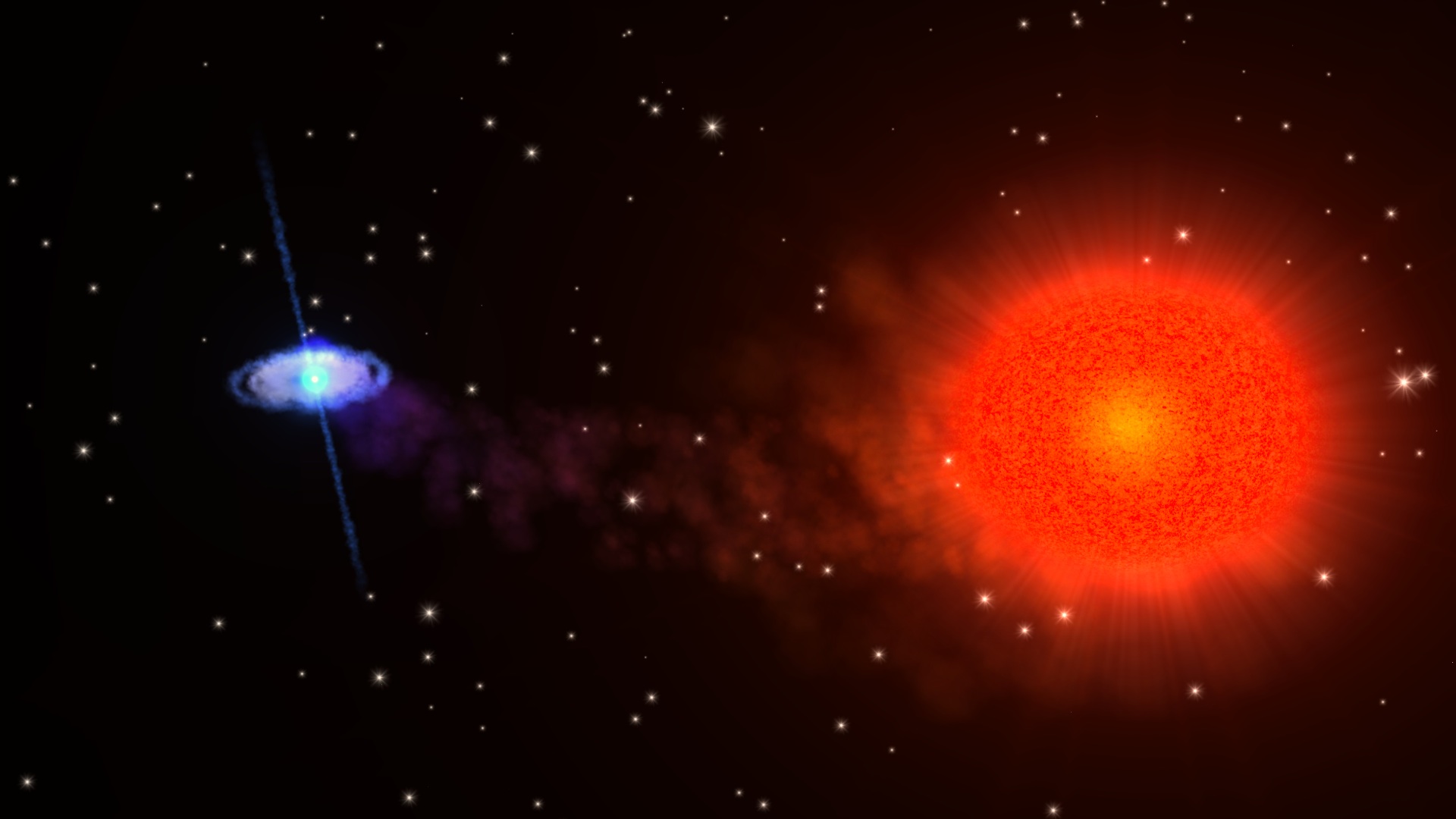
Astronomers have long assumed that a neutron star orbiting a giant companion feeds on that star's wind. Watching the meal happen is a different matter. A new study using the NASA-JAXA XRISM observatory, published September 18, 2026 in Science Advances, reports what its authors describe as direct spectroscopic evidence of wind plasma falling onto a neutron star. Its signature is a set of iron lines that changed character over the course of a single X-ray flare.
Lead author Roi Rahin puts the significance plainly in NASA's announcement: "We've never before seen clear indications of wind plasma falling onto a compact object."
The Setup: A Pulsar in a Hypergiant's Wind
The target is GX 301-2, an X-ray pulsar in the binary system BP Crucis, about 13,000 light-years away in the constellation Crux. The pulsar is a neutron star roughly 12 miles (20 km) across that rotates once every 11 minutes. Its companion is Wray 977, which NASA describes as a blue hypergiant of about 40 solar masses and 60 solar radii.
The two orbit each other every 41.5 days. As the neutron star moves through the wind blowing off its enormous partner, it captures some of that material, which lights up in X-rays. In the NASA account, the plasma moves toward the pulsar at 335,000 mph (540,000 kph), and the neutron star takes about four days to cross the stream.
The system is not new to astronomers. An earlier arXiv paper on the system, by other authors and based on MAXI monitoring, notes that GX 301-2 (also cataloged as 4U 1223-62) had its rapid variability identified in 1971 papers by McClintock et al. and Lewin et al. That paper classifies the companion as a B1 Ia+ hypergiant of about 43 solar masses and 62 solar radii, with a surface temperature of 18,000 K and a luminosity of about 5x10^5 times the Sun's. It gives the orbit an eccentricity of 0.462 and the pulsar a spin period of about 685 seconds, which is consistent with NASA's 11 minutes. The masses and radii differ slightly from the NASA figures, a reminder that different analyses of the same star give somewhat different numbers. The paper also puts the distance at about 3.55 kiloparsecs, based on Gaia data. That works out to roughly 11,600 light-years, a separate estimate from the 13,000 light-years quoted by NASA.
That earlier work also describes the system's rhythm. It reports a regular strong flare tied to the pre-periastron passage, the point in the orbit where the two stars are closest, and a much weaker periodic flare near apastron, where they are farthest apart, which the paper says is not always detectable.
What XRISM Saw
XRISM observed the system for about 16 hours on February 1, 2025, using its Resolve spectrometer. During an X-ray flare, the team tracked iron lines that were redshifted, meaning shifted to lower energies. Redshift indicates motion away from the observer, while NASA describes the plasma as moving toward the pulsar.
The key finding, according to the abstract, is how those lines evolved. At the start of the observation they appeared as absorption lines: the plasma was dimming X-rays from the source behind it. By the end they appeared as emission lines. The authors read that progression as direct evidence of material accreting onto the neutron star.
The change also carries geometric information. The authors report a dynamic accretion geometry that shifted from radial inflow to a disk-like configuration. In plain terms, the plasma first fell more or less straight in, and later looked more like material organizing into a flattened structure around the pulsar. That is an inference drawn from spectra, and a spectrum constrains geometry only indirectly, so caution is warranted.
Why It Matters
Wind-fed accretion is a standard picture for high-mass X-ray binaries, but NASA's own framing, that clear indications of wind plasma falling onto a compact object had never been seen before, shows how thin direct evidence has been. Seeing absorption give way to emission in iron lines over the course of a 16-hour observation ties the inflow to a measurable velocity and a changing geometry. It gives theorists something concrete to match.
The radial-to-disk transition is the piece to watch. A single 16-hour observation of one flare cannot settle how or when a wind-fed neutron star builds a disk. But it shows that Resolve can resolve the lines well enough to follow the changing state of the flow over hours. The study lists 13 authors, including Roi Rahin of UMBC and NASA Goddard as lead, along with Nazma Islam and Maurice Leutenegger. Brian Williams, mission project scientist at Goddard, is credited in the NASA account.
What We Don't Know Yet
A few caveats apply. This is one flare, observed once. The finding that the geometry moves toward a disk-like configuration rests on how the spectral lines are interpreted, and a single observation cannot show how general it is. And the earlier MAXI work notes that the weaker apastron flare is not always detectable, a hint that the system does not behave identically every orbit, so whether other flares show the same evolution is an open question.
A note on our own sourcing: the Science Advances page returned an access error when we tried to read it directly. Details of the paper here come from its Crossref record and abstract, along with NASA's account, not from the full text. Anything beyond the abstract, such as fit parameters or uncertainties, is not covered in this article.
