
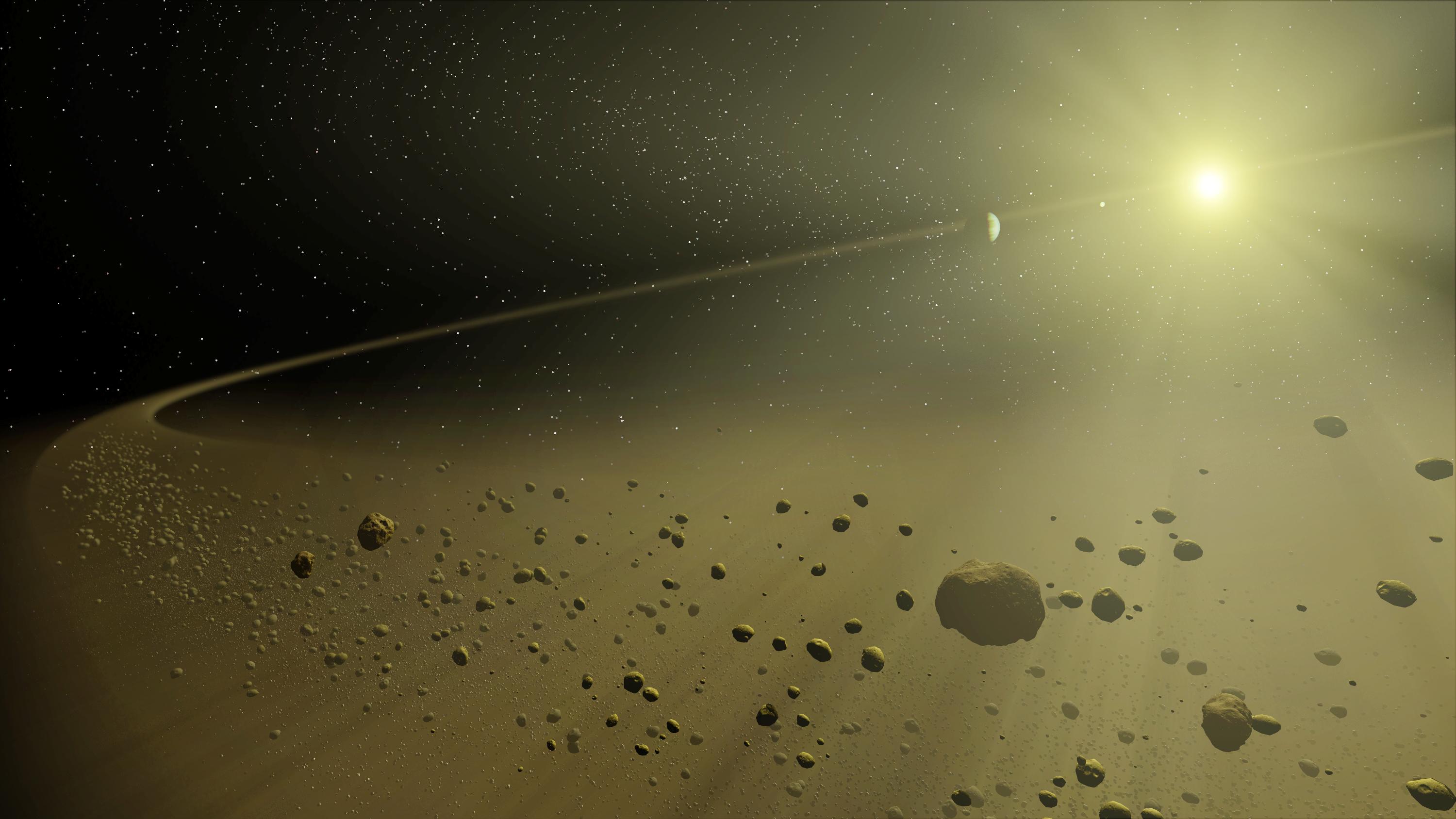
When JWST turned its infrared instruments on Beta Pictoris in 2024, it found something odd sticking out of the star's well-studied debris disk: a long, curving secondary feature that astronomers nicknamed the "Cat's Tail." It glowed clearly in thermal infrared. In visible light, where Hubble has been watching the same system for years, it seemed to be missing.
The tail was there all along. It was just extremely dark. A team led by University of Arizona doctoral student Arin Avsar stacked six epochs of Hubble Space Telescope coronagraphic imaging, taken between 2012 and 2025, and pulled out the scattered-light component of the Cat's Tail for the first time. The faintness turns out to be the useful part. It tells the team what the dust is made of, and from that, roughly how large the objects that crashed to make it must have been. The answer is objects on the scale of the dwarf planets in our own outer solar system.
The paper, "Deep HST/STIS Coronagraphic Imaging of the Beta Pictoris Debris Disk: On the Scattered Light Component of the Cat's Tail," was submitted on Sept. 24, 2026, and has been published as Avsar et al. 2026 in The Astrophysical Journal Letters (ApJL 1010 L10). Avsar works at the Lunar and Planetary Laboratory with Daniel Apai and Kevin Wagner.
A young system with a long tail
Beta Pictoris sits 63 light-years away in the constellation Pictor. Its debris disk is young, having formed only a few million years ago, which makes it a natural laboratory for the violent period when planetary systems are still being assembled and rearranged. The Cat's Tail stretches about 1,000 astronomical units, or roughly 1,000 times the distance between Earth and the Sun.
"It's the aftermath of a collision between large bodies — think something like Pluto," Avsar said in the University of Arizona's announcement, noting that the structure had previously been seen only by JWST in the infrared.
Squeezing a faint signal out of Hubble
The new detection depends mostly on depth. A single coronagraph observation blocks the star's glare well enough to show the bright main disk, but the Cat's Tail is far fainter than that. Combining six STIS epochs gave the team enough signal to detect the disk out to 500 au. The paper describes this as the first time STIS has traced it that far. Across much of the disk midplane between 50 and 200 au, the signal-to-noise ratio exceeds 100.
Against that background, the Cat's Tail is barely there. Its scattered-light brightness is only 0.1 to 0.4 percent of the flux JWST recorded through its MIRI F1550C coronagraphic filter. Even in the deep Hubble images the tail looks shorter than in JWST's view, because dust farther from the star receives and reflects less starlight.
"We think the Cat's Tail has eluded our observations in visible light until now because of what it's made of," Avsar explained in the University of Arizona's announcement. The material is organic refractory matter, heavily carbon-based, and it absorbs visible light, so the dust is very dark.
From dust color to dwarf planets
The key inference comes from comparing how much light the grains reflect with how much heat they emit. Dust that shines in the infrared yet scatters almost no visible light has to be very dark and absorbent. Modeling the two datasets together, the team concluded that the grains are highly porous and made almost entirely of organic refractory material, meaning tough, carbon-bearing compounds that survive heating instead of evaporating.
That composition limits what could have produced the debris. To put this much nearly pure organic dust into a 1,000 au structure, the colliding bodies would need large reservoirs of the stuff. The authors calculate that each of the two progenitors must have had a mass of at least 1 to 3 x 10²¹ kilograms. That is comparable to Charon, Pluto's large moon, or the dwarf planet Makemake.
The team also checked whether a Pluto-like world would be a good match. Pluto's surface is coated with reddish organic compounds called tholins, but according to Universe Today's account of the paper, those tholins make up too small a fraction of Pluto's mass to supply a tail like this one. The authors instead compared the inferred grain makeup with organics found in the local interstellar medium and on comet 67P. The authors point to organic material from the interior of the disrupted planetesimals as the likely source of the tail's dust.
So "Pluto-scale" refers to the size of the bodies, not to an exact copy of Pluto. The paper estimates the progenitors by using the organics content of Solar System dwarf planets and of dust in the local interstellar medium as a proxy, and the Universe Today account adds that the objects would have had radii of roughly 600 to 800 kilometers, assuming densities like those of Solar System dwarf planets.
A warped halo and a hint of planets
The Cat's Tail is the headline, but the deeper imaging shows other structure too. The disk's outer dust halo has a warped shape and a brightness asymmetry. The paper suggests that both features may come from interactions between the disk and planets. The authors present this as a possibility rather than a firm conclusion, and it gives future observations a clear target.
Why It Matters
The University of Arizona release notes that the early solar system was shaped by space rocks smashing into each other and blowing each other apart, and young debris disks like Beta Pictoris offer a look at that kind of chaos in another system. Here the size estimate for the colliding bodies comes from combining Hubble's scattered-light measurement with JWST's infrared data. The measured ratio between the two is what let the team model the grains as highly porous, nearly pure organic material, and that composition is what sets the lower limit on the progenitors' masses. The paper notes this agrees with the earlier JWST/MIRI findings.
The result also shows the value of long, repeated observing campaigns with older instruments. The scattered-light tail could only be detected after more than a decade of STIS observations were stacked. Some features of young planetary systems may stay hidden until enough data accumulate or until a second observatory shows where to look.
The composition result raises its own question, which the authors put directly: do dwarf planets in exo-Kuiper Belts like that of Beta Pictoris contain enough organic material to create the Cat's Tail? Comparing the dust to interstellar organics and to comet 67P is how they approached it. Avsar also said in the release that no one fully understands how grains this small can be this porous, and co-author Wagner suggested that collision velocities may have been high enough to vaporize the carbon grains, which then recondensed as they cooled. That explanation is speculation, and the Universe Today piece notes that future large telescopes may study the tail further.
Sources
- An enormous 'Cat's Tail' tells of cosmic collision 63 light-years away (University of Arizona News)
- Deep HST/STIS Coronagraphic Imaging of the Beta Pictoris Debris Disk: On the Scattered Light Component of the Cat's Tail (arXiv)
- Colliding Dwarf Planets Created a 'Cat's Tail' 1,000 Astronomical Units Long (Universe Today)
