
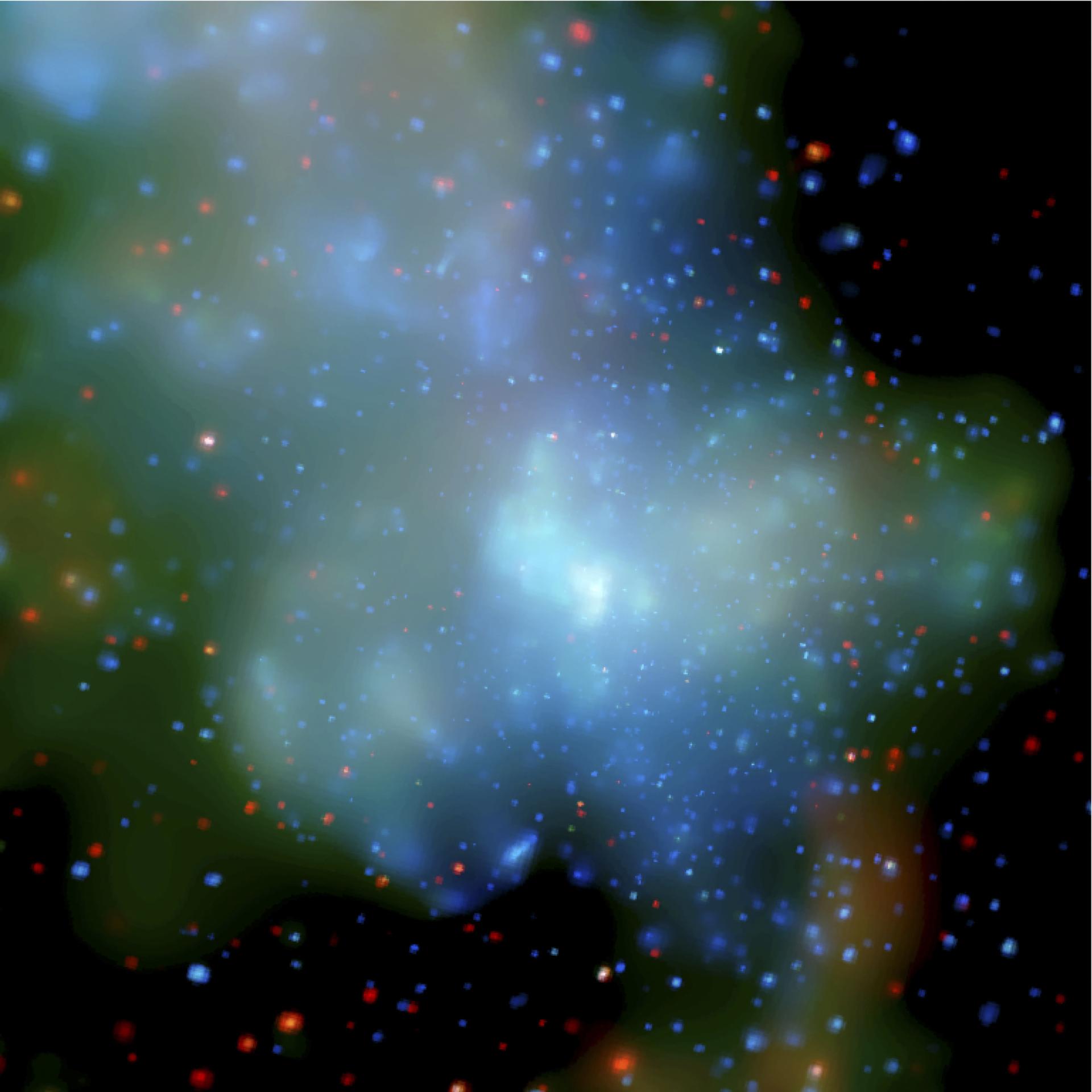
Mapping our own galaxy from the inside has always been an exercise in frustration. We're stuck in one of its dusty side streets, unable to step outside and take a photograph, so the shape of the Milky Way's spiral arms has been reconstructed piecemeal from star counts, gas velocities, and a fair amount of statistical inference. A new study published July 1 in Astronomy & Astrophysics sidesteps most of that guesswork by using something almost nobody expected to double as a cosmic tape measure: the fading X-ray afterglow of gamma-ray bursts that went off years to decades ago.
The result, led by PhD student Beatrice Vaia of the Scuola Universitaria Superiore IUSS Pavia and the University of Trento, is a geometric — not statistical — recalculation of where the Milky Way's outer arms actually sit. The Outer arm and the more distant Outer Scutum-Centaurus arm, the paper finds, are roughly 10% farther from the galactic center than earlier estimates suggested. Along the way, the team also sized up a previously unmeasured dust cloud sitting in that outermost arm at about 3,500 light-years across.
How do you triangulate a galaxy using a burst of gamma rays?
The technique hinges on a quirk of X-ray astronomy called a light echo. When a gamma-ray burst (GRB) fires off a brief, intense pulse of X-rays, that light travels outward in all directions — including toward clouds of interstellar dust that sit off to the side of the direct line between the burst and Earth. X-rays scatter off dust grains at very small angles, and because the scattered path is longer than the direct path, that scattered light arrives at our telescopes later than the burst's own initial flash.
The upshot is an expanding ring of X-ray light centered on the burst's location, visible in Chandra and XMM-Newton images taken days to weeks afterward, growing outward the way ripples spread from a stone dropped in a pond. Because the ring's growth rate depends on the burst's distance, the dust cloud's distance, and the time elapsed, measuring how the ring's diameter changes lets astronomers solve for the geometry directly — no calibration against uncertain standard candles required.
Vaia's team, working with co-authors Ilaria Fornasiero and Andrea Tiengo, applied this to three gamma-ray bursts that are, by GRB standards, practically historical artifacts: GRB 031203 (from 2003), GRB 160623A (2016), and GRB 221009A (2022). Suitable events are rare: as Tiengo has noted, of the gamma-ray bursts detected over roughly 25 years of observations, only a handful have been bright enough — and well-placed enough relative to the Milky Way's own dust — to produce a usable light echo. Each of the three bursts used here scattered its X-ray light off dust in the galaxy's spiral arms on the way to Earth, which is precisely what let the team measure those arms' distances.
What did they actually find?
By measuring the ring diameters in Chandra and XMM-Newton observations, gathered across observations spanning from December 2003 to November 2022, and cross-checking against optical data from Pan-STARRS, the team geometrically triangulated distances to dust associated with the Perseus, Outer, and Outer Scutum-Centaurus arms — the latter being one of the most distant known structures in our galaxy's disk. The Outer and Outer Scutum-Centaurus arms came out about 10% farther from the galactic center than prior estimates, a modest-sounding revision that, over distances measured in tens of thousands of light-years, amounts to a meaningful redraw of the galaxy's outer geography. The Perseus arm's distance, by contrast, held steady with earlier measurements.
The same data let the researchers measure the physical size of a dust cloud embedded in the outermost arm, coming in at roughly 3,500 light-years across — a level of structural detail about a feature that far from Earth that's difficult to obtain through most other methods.
Why It Matters
Every previous map of the Milky Way's spiral structure has depended on some chain of assumptions: the intrinsic brightness of certain stars, the relationship between a star's motion and its distance, or models of how gas clouds should be moving if the galaxy has the shape we think it does. Those methods work, but their uncertainties stack up, especially far from the Sun. A distance measurement built instead on light-travel-time geometry — essentially the same principle used to time an echo bouncing off a canyon wall — doesn't care what kind of star is nearby or how fast something is moving. It only needs a bright enough flash and a well-placed cloud of dust.
That makes GRB light echoes a rare, largely independent check on the galaxy's structural map, and this study suggests the outer disk is puffier than charted. A 10% revision to the Outer and Outer Scutum-Centaurus arms' distance from the galactic center doesn't just move some lines on a diagram — it affects estimates of the Milky Way's total mass distribution, the extent of its gas reservoirs, and models of how spiral arms wind and evolve over time. It's also a reminder that gamma-ray bursts, usually studied for what they reveal about dying stars and black hole formation billions of light-years away, can double as surveying tools for our own cosmic backyard, so long as a burst happens to go off behind the right patch of dust — and, as Tiengo's own count of usable events suggests, those lucky alignments don't come along often.
