
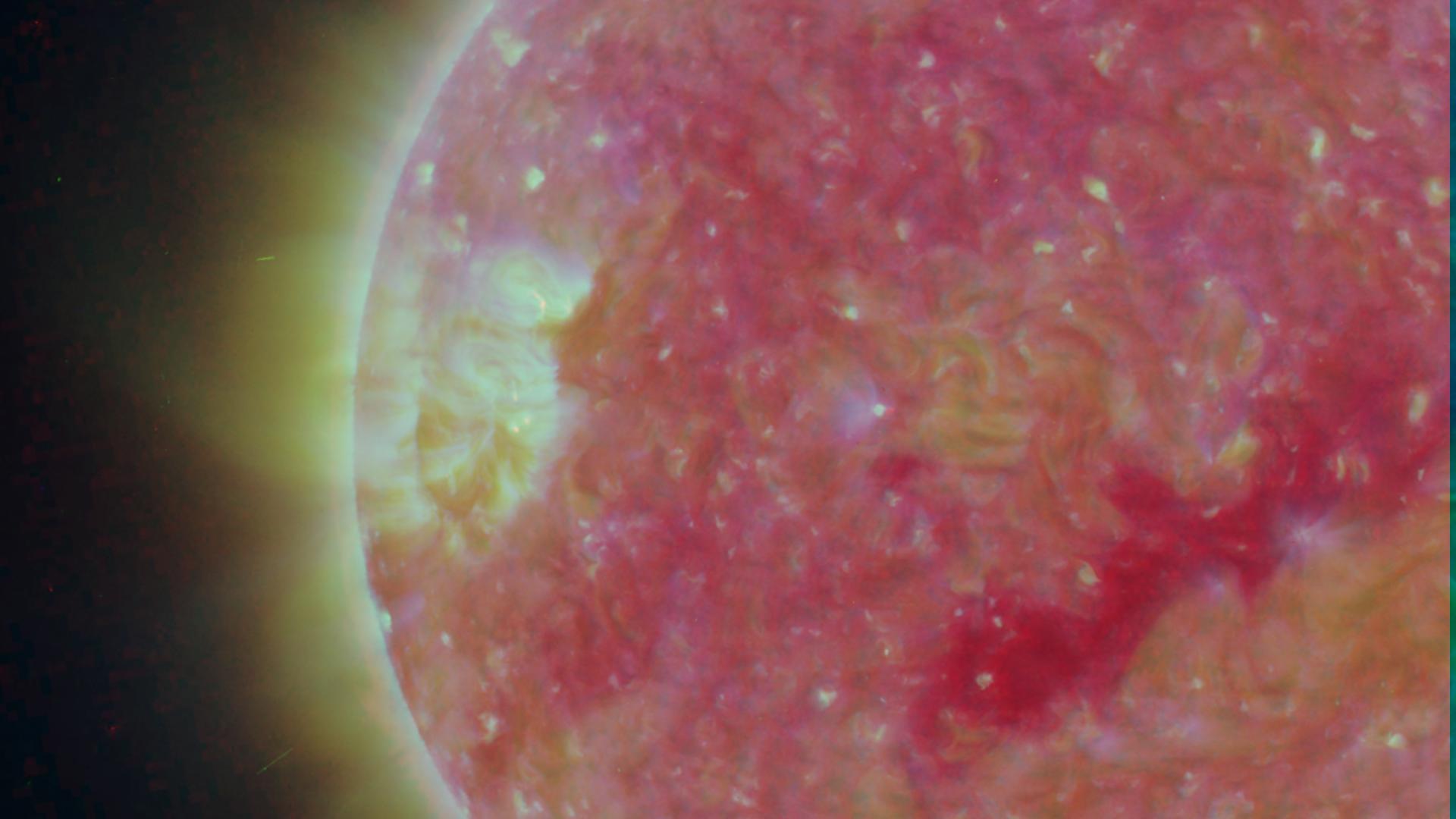
The Sun has a temperature problem that physicists have argued about for the better part of a century. Its visible surface, the photosphere, simmers at roughly 5,500 degrees Celsius. Yet the corona — the tenuous outer atmosphere you glimpse as a pearly halo during a total eclipse — blazes at somewhere between one and three million degrees. Move away from a fire and you expect to get cooler, not hundreds of times hotter. Explaining that inversion is the coronal heating problem, and it has stubbornly resisted a clean answer.
A study published this week in The Astrophysical Journal adds a new and somewhat unexpected suspect to the lineup: dust. Specifically, the tiny charged grains that drift through the space near the Sun. According to work led by Syed Ayaz, a graduate research assistant at the University of Alabama in Huntsville's Center for Space Plasma and Aeronomic Research (CSPAR), those grains may meaningfully change how energy travels through the corona — enough that the models used to explain coronal heating might need to account for them.
The waves that carry the heat
To understand why dust could matter, it helps to know how energy is thought to move through the Sun's outer atmosphere in the first place. The corona is a plasma — a soup of charged particles laced with magnetic fields — and one of the leading candidates for ferrying energy outward is a class of disturbances called kinetic Alfven waves. Think of the Sun's magnetic field lines as taut strings; pluck them and the vibration propagates, carrying energy that can eventually dissipate as heat. Where and how efficiently those waves give up their energy is central to any coronal heating story.
Ayaz and his co-authors — CSPAR director Dr. Gary Zank and Dr. Lingling Zhao — asked what happens to those waves when you drop charged dust grains into the plasma. The answer, it turns out, is not nothing. The grains introduce two competing effects. Dust is heavy compared with the electrons and ions around it, so its mass tends to slow the waves down. But dust also carries electric charge, and that charge strengthens the way the waves interact with the surrounding plasma. The two effects pull in opposite directions, and the net outcome shapes how — and where — the waves deposit their energy.
That tug-of-war is the heart of the finding. A dusty plasma is not simply a cleaner plasma with a bit of grit added; it is a genuinely different medium in which the physics of wave propagation and dissipation shifts.
Why nobody was looking at dust before
There is a good reason coronal heating models have largely ignored dust until now: everyone assumed it could not survive there. Grains of cosmic dust venturing that close to the Sun should, by conventional expectation, be cooked out of existence by coronal temperatures. If the dust vaporizes long before it reaches the hot regions that need explaining, it can hardly be part of the explanation.
That assumption started to look shaky thanks to NASA's Parker Solar Probe, the spacecraft that has repeatedly dived closer to the Sun than any mission before it. Parker carries an instrument suite called FIELDS, and while it was designed to measure electric and magnetic fields, it turned out to be an accidental dust detector. When a grain slams into the spacecraft at high speed, it vaporizes into a small puff of plasma that FIELDS registers as a sharp voltage spike. Count the spikes and you can map where dust actually is.
What Parker found is that dust is present and active far closer to the Sun than models had assumed — surviving in regions where it was expected to be long gone. That observational anchor is what makes the new theoretical work more than an abstract exercise. If the grains are genuinely there, in the hot inner reaches where coronal heating happens, then their influence on plasma waves becomes a legitimate variable rather than a rounding error.
A new field, not a solved case
It is worth being precise about what the study claims and what it does not. This is not a declaration that dust heats the corona, nor a finished replacement for existing models. It is an argument that charged dust alters how key plasma waves travel and dissipate energy, and that this influence is large enough that it should be folded into how researchers think about heating in the corona and the young solar wind streaming away from it. The team frames the result as opening a new line of inquiry — a dusty-plasma approach to coronal physics — rather than closing the book on an old one.
Zank, who directs CSPAR, described the direction as exciting, and the enthusiasm is understandable: coronal heating is one of those problems where a genuinely new ingredient does not come along often. Most of the debate over the years has centered on variations of two mechanisms — waves that carry and dump energy, and magnetic reconnection events that release it in bursts. Adding charged dust as a factor that modifies the wave physics itself is a different kind of move. It does not throw out the wave picture; it complicates it in a way that is now testable against real spacecraft data.
Why It Matters
The coronal heating problem is not a niche curiosity. The corona is the launchpad for the solar wind, the stream of charged particles that fills the solar system and drives the space weather capable of disrupting satellites, power grids, and communications on Earth. Understanding what heats the corona is tied up with understanding how the solar wind gets its energy and how the whole system behaves. If charged dust genuinely reshapes the plasma waves in play, then models of both coronal heating and the young solar wind may be leaving out a real ingredient.
There is also a broader lesson in how this result came together. A spacecraft built to measure fields ended up detecting dust as a side effect, and that data overturned a long-standing assumption that dust could not survive close to the Sun. That, in turn, gave theorists license to revisit the physics. It is a reminder that the coronal heating problem has endured this long not for lack of ideas but for lack of the right measurements — and that flying instruments into places we previously could not reach keeps producing suspects nobody had thought to question.
Sources
- UAH Researcher Finds Cosmic Dust Could Play Key Role in Cracking Solar Corona Heating Mystery — University of Alabama in Huntsville
- Cosmic dust could play key role in cracking long-standing mystery of solar corona heating — Phys.org
- UAH Researcher Finds Cosmic Dust Could Play Key Role... Opening New Field in Heliophysics — Newswise
