
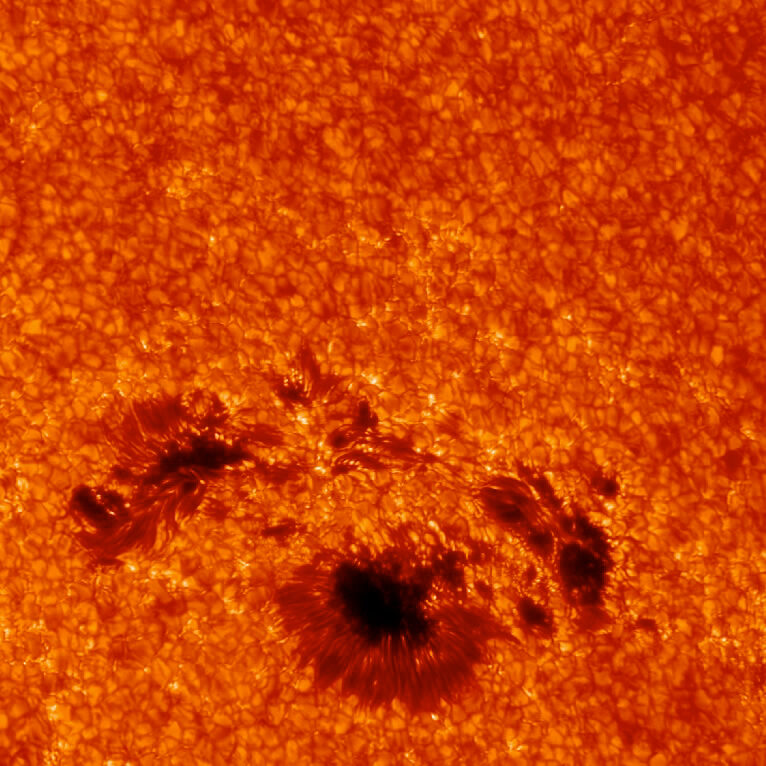
The Sun picked a busy week to remind everyone it is still near the top of its game. Over roughly 24 hours spanning the end of June, a single sunspot cluster catalogued as Active Region 4479 fired off about ten flares, capped by an X1.1 eruption—the strongest class the Sun produces—and hurled a series of coronal mass ejections in Earth's general direction. On July 2, NOAA's Space Weather Prediction Center turned that flurry into something concrete for skywatchers: official geomagnetic storm watches at the G1 (Minor) and G2 (Moderate) levels for July 3 and July 4.
The upshot is a genuine aurora window over the Fourth of July weekend, and one that forecasters say could push the northern lights far enough south to be seen from the northern-tier United States.
What AR4479 actually did
The headline event was an X1.1 flare, which The Watchers logged at around 20:50 UTC on June 30 and classed as an R3 (Strong) radio blackout on NOAA's scale. Flares are ranked by their peak X-ray output—C, then M, then X, each step a tenfold jump—so an X1 sits an order of magnitude above the M-class flares that made up the bulk of AR4479's output. Space.com counted roughly ten flares from the active Sun inside a single 24-hour stretch, an unusually dense run of activity even for a solar-maximum-era spot.
Flares matter for radios and satellites, but it is the coronal mass ejections—billion-tonne clouds of magnetized plasma—that drive auroras. Several of AR4479's eruptions launched CMEs with an Earth-directed component, and EarthSky has since confirmed both the X1.1 flare and that at least one of those clouds is on its way here. When multiple CMEs leave in close succession, they don't necessarily arrive as one clean punch; they can stack, merge, or sweep up the slower material ahead of them, which makes both the timing and the final intensity harder to pin down.
The forecast: a staggered arrival
That messiness is exactly what the current forecast reflects. Rather than a single hit, The Watchers reports the CMEs are expected to reach Earth in stages between July 3 and July 6. NOAA's watches are concentrated on July 3 and July 4, when the strongest combined effects are anticipated, but the extended arrival window means elevated conditions could linger into the weekend.
SWPC's guidance is deliberately measured. The agency forecasts the clearest effects mainly poleward of 55 degrees geomagnetic latitude—the usual high-latitude auroral zone—with aurora possibly visible across northern-tier U.S. states if the storming reaches the upper end of the watch. The Watchers puts a finer point on the geography, suggesting the lights could be glimpsed as far south as New York, Wisconsin, and Washington state under favorable conditions.
Those are ceilings, not promises. G1 to G2 is the low-to-moderate end of the five-step geomagnetic storm scale, and how far south an aurora is actually seen depends on the orientation of each CME's embedded magnetic field—specifically whether it points southward when it arrives, which lets it couple efficiently with Earth's magnetosphere. That parameter can't be measured until the cloud reaches the spacecraft parked upstream at the L1 point, roughly an hour before impact.
A fresh escalation, not a rerun
Regular readers may feel a flicker of déjà vu. Cosmic Herald covered a separate storm window at the June 30-July 1 turn, and it's worth being clear that this is a distinct, newer development. The watches at issue here were issued on July 2 for arrivals spanning July 3 to July 6—driven by AR4479's late-June eruption sequence—rather than the earlier bulletin. In other words, the same restless active region is still producing, and the space-weather outlook has escalated rather than wound down.
Why It Matters
For most people, a G1-G2 storm is a chance to see something rare and beautiful, and a holiday weekend is close to ideal timing for it. But geomagnetic storms are not purely scenic. Even moderate storming can nudge satellite drag in low Earth orbit, degrade high-frequency radio and GPS precision at high latitudes, and induce currents in long conductors like power lines and pipelines. G2 sits well below the thresholds that threaten grids in earnest, so the practical risk this weekend is modest—but the same physics that lights up the sky is why agencies like NOAA run an operational forecast desk at all.
There is also a bigger-picture point. AR4479 throwing an X-class flare and a cluster of M-flares in one day is a reminder that the current solar cycle still has teeth. Each episode like this is a live test of how well forecasters can translate a flare on the Sun into a usable, geographically specific prediction on Earth—and getting that translation right is what stands between a pleasant aurora surprise and an unprepared operator.
How to make the most of it
If you're chasing the lights, the practical advice is unglamorous but effective. Get away from city glow, find a clear view toward the northern horizon, and give your eyes time to adjust. Cameras and phones on a long exposure routinely pick up auroral color that's too faint for the naked eye, so it's worth pointing a lens north even if the sky looks empty. And because the arrival timing is uncertain across the July 3-6 window, the best strategy is to check NOAA's live aurora and storm products before heading out rather than banking on any single night.
The Sun, for its part, isn't done. AR4479 remains in view, and as long as it stays magnetically complex, more flares—and more forecasts—are on the table.
Sources
- Alerts, Watches and Warnings — NOAA Space Weather Prediction Center
- Sun fires off 10 solar flares in 24 hours as multiple Earth-bound CMEs raise northern lights hopes for July 4 weekend — Space.com
- Sun news: Confirmed! X flare sun-stuff on its way to Earth — EarthSky
- Multiple CMEs forecast to impact Earth through July 6 after repeated eruptions from Region 4479 — The Watchers
