
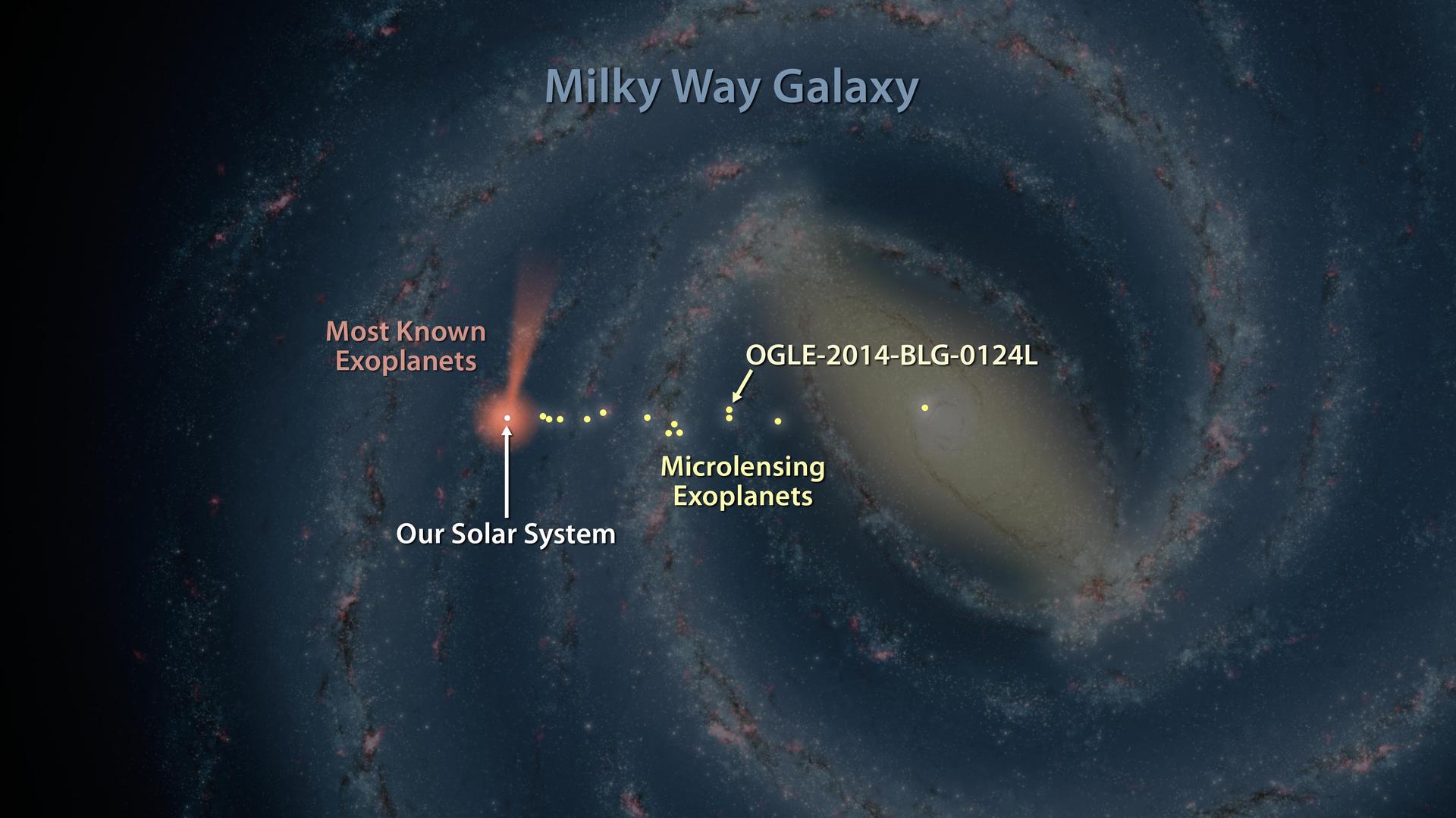
NASA's Transiting Exoplanet Survey Satellite has built its entire career on catching planets in the act of walking in front of their stars. So when a paper published July 1, 2026 in the Astrophysical Journal Letters announced that TESS had bagged a new world using a completely different method — one that has nothing to do with transits at all — it was a small surprise wrapped inside a bigger one. The planet itself, a super-Jupiter named Gaia23bra b, sits roughly 40,000 light-years away, toward the galactic plane. TESS normally hunts for planets within about 150 light-years of Earth. This one is more than 260 times farther out than the satellite was ever designed to see.
The trick that made it possible comes courtesy of Albert Einstein: gravitational microlensing, in which the gravity of a foreground star (and any planet orbiting it) bends and briefly magnifies the light of a background star passing behind it. It's the same physics behind gravitational lensing on a galactic scale, just shrunk down to stellar dimensions and stretched out over weeks instead of being a permanent cosmic fixture.
How a Transit Satellite Found a Microlensing Planet
The discovery started with ESA's Gaia mission, which continuously monitors the brightness of stars across the sky and flags anything unusual. In this case, Gaia's alert system caught a star suddenly brightening — a telltale sign of a microlensing event. But Gaia's own observations of the event were too sparse in time to reveal much beyond "something is lensing this star."
That's where TESS came in, not as an active hunter but as an accidental archivist. The satellite had already been staring at that patch of sky, recording brightness measurements at a much denser cadence than Gaia's alert system could manage. Researchers went back through TESS's archived data covering the same window of time and found extra features embedded within the main lensing brightening — a signature consistent with a planet, not just its host star, contributing to the lensing effect.
"The discovery implies that there are probably other so-called microlensing planets hiding in TESS's data that we hadn't previously thought to look for," said Diana Dragomir, a University of New Mexico professor and co-author on the study, which was led by UNM Ph.D. candidate Mallory Harris. Their work, described in both the NASA release and a companion statement from UNM's Department of Physics and Astronomy, effectively repurposed years-old TESS observations that had already been searched once for transit signals — and found something transits could never have caught.
What Gaia23bra b Actually Is
Based on the modeling of the lensing signal, Gaia23bra b comes in at about 1.6 times the mass of Jupiter, orbiting an orange dwarf star with roughly 80% of the Sun's mass. The planet sits at a Jupiter-like distance from its star — meaning, unlike most transiting exoplanets discovered in tight, scorching orbits, this one occupies a more temperate, outer-solar-system-like position relative to its star.
None of that would be knowable through a transit, because from Earth's vantage point Gaia23bra b never crosses in front of its star. Microlensing doesn't care about orbital alignment or eclipses; it only requires that the foreground system pass, from our perspective, close enough to a background star's line of sight to bend its light measurably. As Harris put it, "Microlensing events happen once and they're gone — they don't repeat." That one-time geometric coincidence is also what makes microlensing planets so hard to find and — crucially — impossible to revisit. Once the alignment is gone, it's gone.
Why It Matters
Transits remain the workhorse of exoplanet science by a wide margin. Transits account for roughly 75% of the more than 6,000 confirmed exoplanets, while microlensing has produced under 5%, according to NASA's and the research team's own figures. That imbalance isn't because microlensing planets are rare — it's because the method is logistically brutal. It requires catching a random, non-repeating alignment of two unrelated stars, in real time, with instruments dense enough in their observing cadence to resolve the signal. Most microlensing surveys are purpose-built for exactly this, watching dense starfields toward the galactic bulge where the odds of alignment are highest. TESS was never one of those instruments — it was built to watch nearby stars for periodic dimming.
That's what makes Gaia23bra b more than a one-off oddity. It demonstrates that TESS's own archive — described in NASA's release as encompassing nearly eight years of accumulated observations — is a resource that can be mined for microlensing events after the fact, using Gaia's alerts as a pointer to when and where to look. Nobody needs to build a new telescope to try this again; the data other astronomers already searched for transits is sitting there, waiting to be searched a second time with different eyes.
The timing also matters. NASA's Roman Space Telescope, set to launch August 30, 2026, is expected to be a microlensing powerhouse, projected to find around 1,000 microlensing planets over its mission — a small fraction compared to the roughly 100,000 planets expected via transit surveys, but a huge jump from what ground-based microlensing surveys manage today. Gaia23bra b is a preview of the kind of planet population Roman is built to chart in bulk: worlds at wide, cool orbits around distant, faint stars that transit surveys structurally cannot see. TESS just showed that even a transit-hunting satellite, pointed the right way after the fact, can get a look at that population too.