
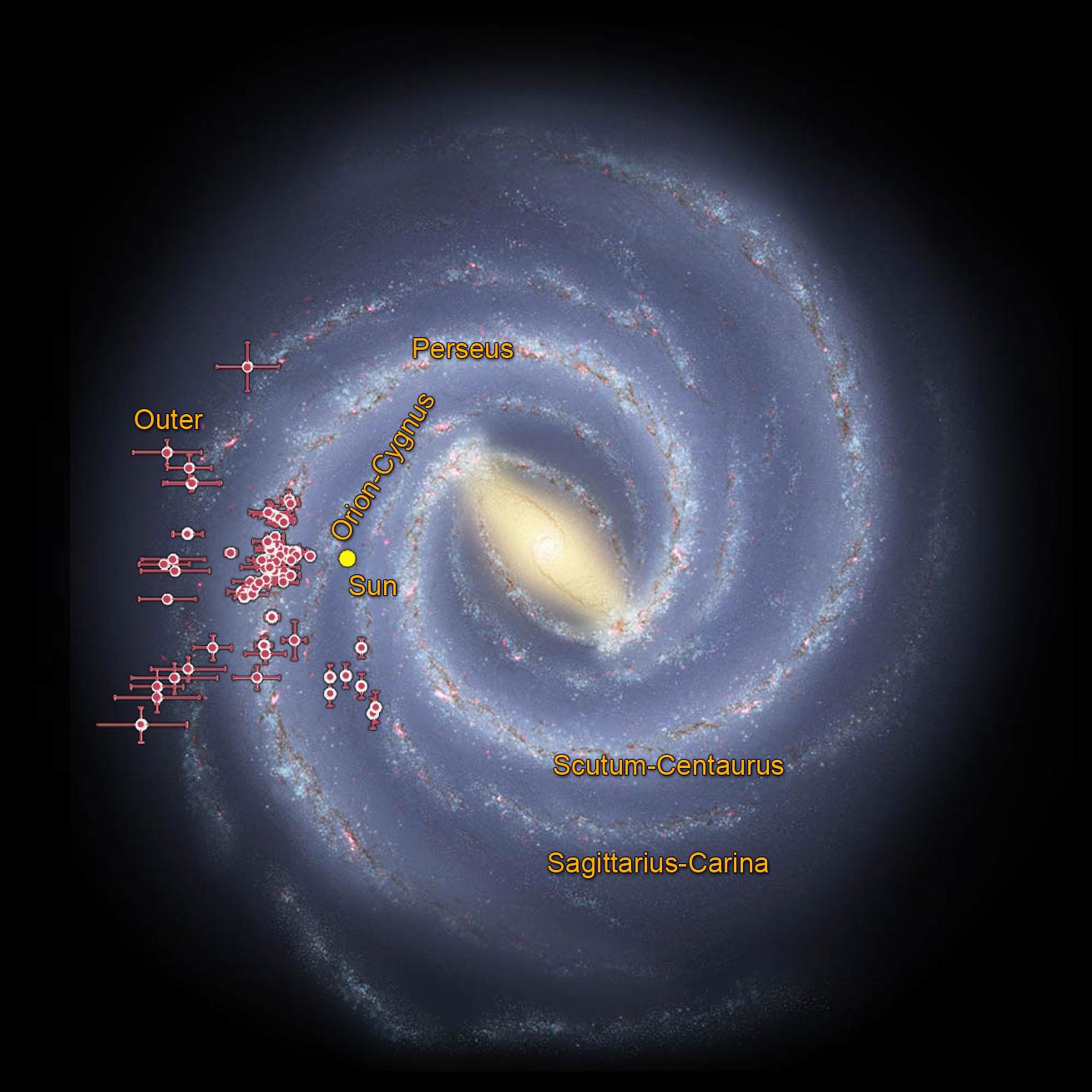
Mapping the Milky Way is a strange kind of cartography: we are stuck inside the thing we are trying to draw, buried in one of its spiral arms, peering out through gas and dust at a structure we can never see from the outside. So it should not be surprising that our best maps still carry meaningful error bars — and that a clever measurement can occasionally shove a whole spiral arm several thousand light-years in one direction.
That is roughly what has just happened. A team led by Beatrice Vaia, a PhD researcher affiliated with Italy's INAF and working across IUSS Pavia and the University of Trento, has re-measured the distances to two of the galaxy's outer spiral arms and found them to be about 10% farther away than previously believed. The result, published in Astronomy & Astrophysics, redraws a modest but real piece of our home galaxy's outer structure.
The two features in question are the Outer Arm and the Outer Scutum-Centaurus Arm — distant structures on the far side of the galactic disk, notoriously hard to pin down. What makes this study interesting is not just the revised numbers but how they were obtained: not by assuming how the galaxy spins, but by watching the light from long-dead stellar explosions bounce off clouds of interstellar dust.
The trick: light echoes in X-rays
The core technique is elegant. When a gamma-ray burst — the catastrophic death cry of a massive star or a compact-object merger — goes off, it floods space with a brief, intense pulse of high-energy radiation. If that radiation passes through a sheet of dust between us and the source, some of the X-rays scatter off the dust grains rather than travel straight to our telescopes.
Because scattered light takes a slightly longer path, it arrives later, and it arrives spread out into an expanding ring centered on the burst's position. Watch that ring grow over days and weeks, measure its angular diameter, and the geometry does the rest. The size of the ring, combined with the known time delay, yields the distance to the intervening dust cloud directly — no assumptions about galactic rotation required. It is essentially a cosmic surveying instrument built out of a dead star and a dust bank.
That model-independence is the whole point. Traditional distance estimates for far-flung spiral arms often lean on kinematic models — how fast material at a given location should be orbiting the galactic center. Those models are useful but circular in a subtle way: you use assumptions about the galaxy's structure to measure the galaxy's structure. The X-ray echo method sidesteps that entirely, which is why ESA describes the resulting distances as "highly accurate," and why the technique reaches usefully far across the disk.
Three bursts, two decades, two observatories
The study drew on three gamma-ray bursts spread across nearly twenty years of observations: GRB 221009A, an exceptionally bright burst detected in 2022; GRB 160623A from 2016; and GRB 031203 from 2003. The dust-scattered X-ray emission from these events was captured by ESA's XMM-Newton and NASA's Chandra X-ray Observatory, with observations spanning December 2003 to November 2022. Optical data from the Pan-STARRS survey rounded out the analysis.
Each burst effectively lit up the dust clouds sitting along its line of sight, turning otherwise invisible material into a distance marker. By working through the echoes, the team traced where the intervening dust — and therefore the spiral arms threaded through it — actually sits. One dust cloud in the most distant arm turned out to be roughly 3,500 light-years across, a reminder that these are not thin filaments but vast, structured regions of the disk.
Alongside Vaia, the paper — titled "Accurate distances of the Galactic spiral arms from dust-scattered X-ray emission of gamma-ray bursts" — lists co-authors including Ilaria Fornasiero and Andrea Tiengo. It appeared in Astronomy & Astrophysics, with the journal and the two space agencies dating the publication to June 29 through July 1, 2026.
How big a deal is a 10% shift?
It is worth being clear-eyed here. A 10% revision to the distance of two outer arms is not a revolution in our picture of the Milky Way. The galaxy's broad architecture — a barred spiral with the Sun sitting partway out in a minor arm — is unchanged. What has moved is the fine detail at the outer edges, precisely the region where our maps have always been shakiest.
But the shift is not trivial, either. Push an arm 10% farther out and you change its inferred size, mass distribution, and how it connects to the rest of the disk. For the Outer Scutum-Centaurus Arm in particular — one of the most remote coherent structures known in the galaxy — a firmer distance helps anchor where the Milky Way's stellar disk actually ends.
Why It Matters
Every attempt to understand galaxies as a class — how spiral arms form, how they wind, how much mass they carry — has to be calibrated against the one galaxy we can study up close. If our internal map of the Milky Way is off, so is the yardstick we use for everything else. A method that delivers distances without leaning on rotation models cuts one of the oldest circularities in galactic astronomy, and it does so using events that are already being observed for entirely different reasons.
There is also a nice piece of scientific recycling at work. Gamma-ray bursts are studied as some of the most violent events in the universe; here, their afterglow becomes a ruler for measuring the quiet dust of our own galaxy. As archives of XMM-Newton and Chandra observations grow, and as future bursts light up new sightlines, the same trick can be applied again and again — steadily sharpening the map of the galaxy we happen to live inside, one echo at a time.
