
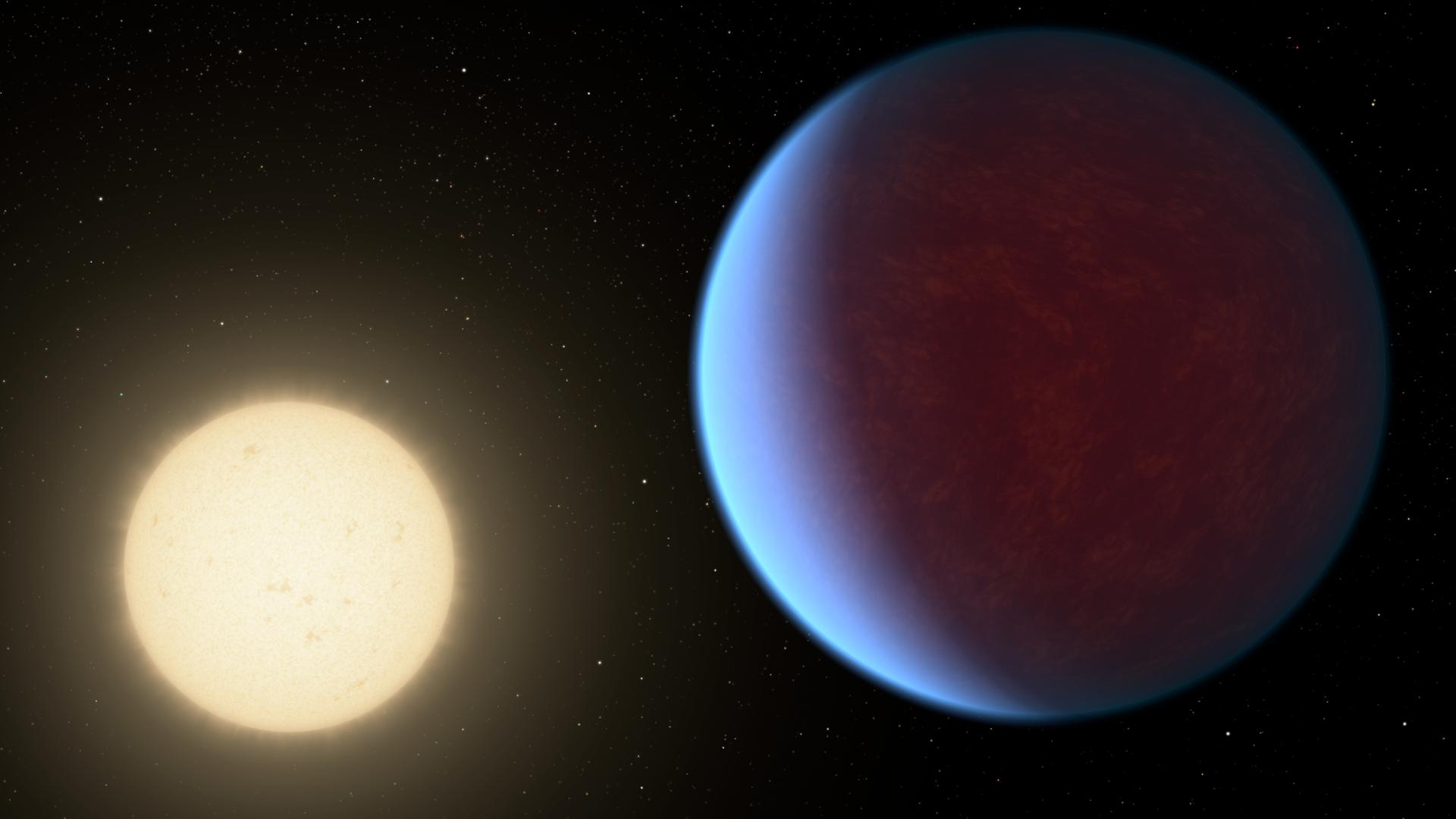
Discovering an exoplanet and characterizing it are two very different jobs. The first tells you a planet is there; the second tells you whether it is worth caring about. On June 30, 2026, a team led by UC Irvine assistant professor of astronomy Paul Robertson published the second kind of result — a refinement rather than a first sighting — and it nudged a nearby world into more interesting territory. Their revised mass and orbital period for GJ 3378 b, reported in The Astrophysical Journal, place the roughly twice-Earth-size planet squarely inside the habitable zone of its host star, a red dwarf about 25 light-years from the Sun.
The paper's title does not undersell the stakes: "A Revised Mass and Period for the Habitable Zone super-Earth GJ 3378 b: A Planet Straddling the Cosmic Shoreline." That phrase — the cosmic shoreline — is the part worth slowing down for.
What the "cosmic shoreline" actually means
In exoplanet science, the "cosmic shoreline" is a conceptual boundary separating worlds that can hold onto an atmosphere from those that have had theirs stripped away. On one side, planets retain the gaseous envelope that makes surface chemistry — and potentially life — possible. On the other side, stellar radiation and a planet's own modest gravity conspire to leave a bare rock. A planet described as "straddling" that line is precisely the kind of ambiguous, high-value case that observers want to point their best instruments at, because it is not obvious in advance which side it falls on.
GJ 3378 b's revised numbers put it right on that edge while also placing it inside the star's habitable zone — the orbital band where temperatures could, in principle, allow liquid water. Being in the habitable zone is necessary but not sufficient; a planet also has to keep an atmosphere to make that real estate matter. That is exactly why the mass-and-period refinement counts as news rather than bookkeeping.
How the measurement was made
The updated figures come from radial-velocity data — the technique that watches a star for the tiny back-and-forth wobble induced by an orbiting planet's gravity. The team drew on two instruments: the Habitable-zone Planet Finder (HPF) on the Hobby-Eberly Telescope (HET), and NEID on the WIYN telescope. Both are precision spectrographs built to chase exactly this kind of small signal around cool, low-mass stars.
Red dwarfs like GJ 3378 are the natural hunting ground for this work. They are dim and cool, so their habitable zones sit close in, which makes the planetary wobble larger and easier to detect than it would be around a Sun-like star. Combine that with a system only 25 light-years away — practically next door by galactic standards — and you get a target that is both measurable now and reachable by future missions.
Why the follow-up path matters
Robertson's group and the coverage around the announcement, including a June 30 write-up in Forbes, frame the result the same way: this is a better candidate for life than it looked before, largely because of where it sits and how close it is. Proximity is not a minor detail. The nearer a planet, the more photons a telescope collects from it, and the more feasible it becomes to tease out the faint fingerprint of an atmosphere.
That is where NASA's planned Habitable Worlds Observatory enters the picture. According to UC Irvine, the mission — envisioned for the 2040s — could directly image GJ 3378 b to confirm whether it has an atmosphere at all, the necessary first step before any world can seriously be assessed for signs of life. A well-characterized, nearby, habitable-zone super-Earth is exactly the sort of pre-vetted target such an observatory needs on its list before it launches. You do not want to spend a flagship mission's precious observing time figuring out basic orbital parameters; you want those nailed down in advance, which is the quiet, unglamorous service this paper provides.
A few caveats worth keeping
None of this is a detection of life, or even of an atmosphere. The measurement refines mass and orbit; it does not reveal what the planet's surface or air is like. "Straddling the cosmic shoreline" is an honest description of uncertainty, not a euphemism for habitability confirmed. The planet could turn out to be an airless rock. The point is that we currently cannot tell — and that the tools to find out are on the drawing board rather than in operation.
It is also worth remembering that "twice the size of Earth" is a super-Earth, a class with no analog in our own solar system. Whether such worlds tend to be scaled-up rocky planets or scaled-down gas-rich ones is still an open question, and it bears directly on habitability. GJ 3378 b is now a data point that future work will lean on to help settle that debate.
Why It Matters
The headline-friendly version of this story is "astronomers find a nearby world that could support life." The more accurate version is quieter and, arguably, more useful: a team did the careful, instrument-heavy work of pinning down a planet's mass and orbit well enough to promote it from "known to exist" to "worth a flagship mission's attention." Habitability studies live or die on that kind of groundwork. When the Habitable Worlds Observatory eventually goes hunting for planetary atmospheres in the 2040s, it will draw from a shortlist of pre-characterized nearby targets — and thanks to this refinement, GJ 3378 b now has a strong claim to a spot on it. At 25 light-years, it is close enough that the question "does it have an atmosphere?" is answerable in principle, which is more than can be said for most of the galaxy's real estate.
Sources
- UC Irvine astronomers discover a new Earth-like exoplanet (UC Irvine News, June 30, 2026)
- A Revised Mass and Period for the Habitable Zone super-Earth GJ 3378 b: A Planet Straddling the Cosmic Shoreline (arXiv 2605.16499)
- Could This Nearby 'Super-Earth' Support Life? Scientists Just Found A Reason To Think So (Forbes, June 30, 2026)
