
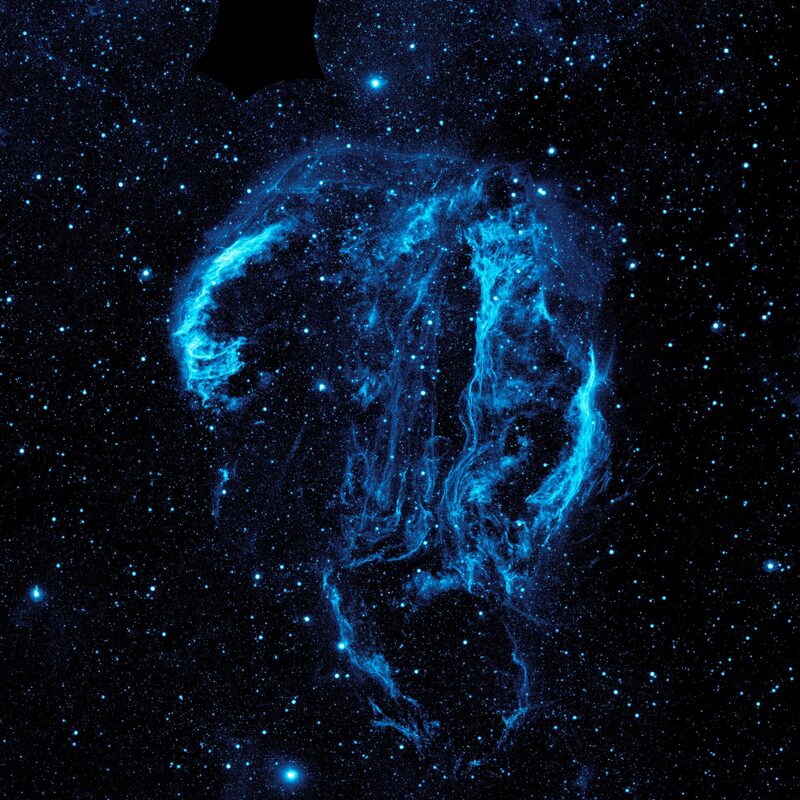
Most deep-sky discoveries these days arrive from billion-dollar facilities and survey pipelines crunching petabytes. This one started with a small amateur telescope and a long stare at a familiar object. In a paper submitted to arXiv on June 25, 2026, David Martinez-Delgado and a team that mixes professional astronomers with seasoned astrophotographers report an oddly clean, almost surgical feature crossing the eastern Veil Nebula: an extremely narrow, trail-like filament that shows up in the light of hydrogen and essentially nothing else.
The Veil is the visible part of the Cygnus Loop, the tattered shell of a star that exploded roughly 20,000 years ago and now sprawls across the constellation Cygnus at roughly 2,400 light-years. It is one of the most photographed objects in the northern sky, a lacework of red hydrogen and teal oxygen filaments that has been imaged exhaustively by amateurs and observatories alike. That makes the new find all the more striking: it was hiding in plain sight, threaded through a nebula that thousands of people have already pointed cameras at.
What exactly did they find?
The feature is, above all, thin. The team measures a median width of just 1.63 arcseconds. At the Cygnus Loop's distance, that works out to about 1,200 astronomical units across — small enough, in cosmic terms, that calling it a "thread" or "trail" is not hyperbole. And it stays that way: along its length, the filament keeps a near-constant width and a near-constant brightness, with a surface brightness measured at 22.32 plus or minus 0.13 H-alpha magnitudes per square arcsecond. Structures in space rarely hold such uniform geometry over their full extent, which is part of what makes this one interesting.
The other defining trait is its color, or rather its lack of variety. The filament appears only in H-alpha, the deep-red emission line of hydrogen. There is no detectable counterpart in [SII], the sulfur emission that normally accompanies the cooling gas behind a typical supernova-remnant shock, and no optical-continuum source — no star, no fuzzy blob — sitting along it. In a nebula defined by its mix of hydrogen and oxygen filaments, a pure-hydrogen streak with no sulfur signature stands out as genuinely unusual.
A citizen-science find, professionally vetted
The discovery did not rest on a single lucky frame. The feature was first noticed in deep narrow-band H-alpha images taken with a small amateur telescope, then confirmed across more than a dozen separate amateur and professional images spanning two decades. That archival depth matters: a faint artifact, a cosmic-ray streak, or a satellite trail would not persist, unchanged, across twenty years of independent observations by different people using different equipment. The author list reflects the collaboration's hybrid character, pairing researchers such as Martinez-Delgado, M.A. Perez-Torres, E.J. Alfaro, and J-N. Pippert with well-known astrophotographers including Mark Hanson and Giuseppe Donatiello.
It is a tidy demonstration of how amateur deep-sky imaging — long integration times, narrow-band filters, and dark skies — has become capable of surfacing structures faint and fine enough to warrant a professional follow-up paper.
So what is it?
The team lays out three candidate explanations and works through them.
The first is a Herbig-Haro jet: the collimated outflow launched by a young, still-forming star. HH objects are narrow and trail-like, so the geometry fits at first glance. But they are powered by a driving star, and they characteristically glow in [SII] as well as hydrogen. This filament has neither a visible driving source nor any sulfur emission, so the authors rule a Herbig-Haro jet out.
The second possibility is the trail of a high-velocity object plowing through the nebula's gas. The third — and the explanation the authors favor — is a Balmer-dominated non-radiative shock produced where the Cygnus Loop's expanding blast wave slams into a pocket of denser gas. In that scenario, the shock front sweeps up neutral hydrogen, which briefly lights up in the Balmer lines (H-alpha among them) before the gas has cooled enough to emit the usual forbidden lines like [SII]. That neatly accounts for the filament's signature: bright in hydrogen, invisible in sulfur, with no central star required. The pure-H-alpha emission is not an oddity to be explained away; it is the fingerprint of the shock itself.
Why It Matters
Balmer-dominated shocks are valuable to astronomers because they trace the leading edge of a remnant's blast wave directly, before the gas behind it cools and complicates the picture. They offer a relatively clean way to gauge shock velocities and the physics of how supernova ejecta couple to the surrounding interstellar medium. Finding a sharp, well-defined example threading the Cygnus Loop — already one of the best-studied remnants in the sky — gives researchers a fresh, geometrically simple target to probe that process.
Just as notable is how the feature came to light. It surfaced not from a flagship survey but from deep amateur narrow-band imaging, then earned credibility through two decades of archival cross-checks. That a structure spanning roughly 1,200 AU could lurk undetected in one of the most imaged nebulae in the heavens is a reminder that careful, long-exposure observation of familiar objects still pays off — and that the line between backyard astrophotography and professional research keeps getting blurrier.
