
For most of the 20th century, globular clusters were astronomy's reassuringly simple objects. Picture a tightly bound swarm of tens of thousands to millions of stars, all born together from the same cloud of gas, all the same age, all sharing the same chemical fingerprint. They were treated as fossil snapshots — clean, single-burst populations that could be used to calibrate the age of the universe itself. A new Hubble Space Telescope image released on June 26, 2026 adds to a steady accumulation of evidence that this tidy picture was wrong.
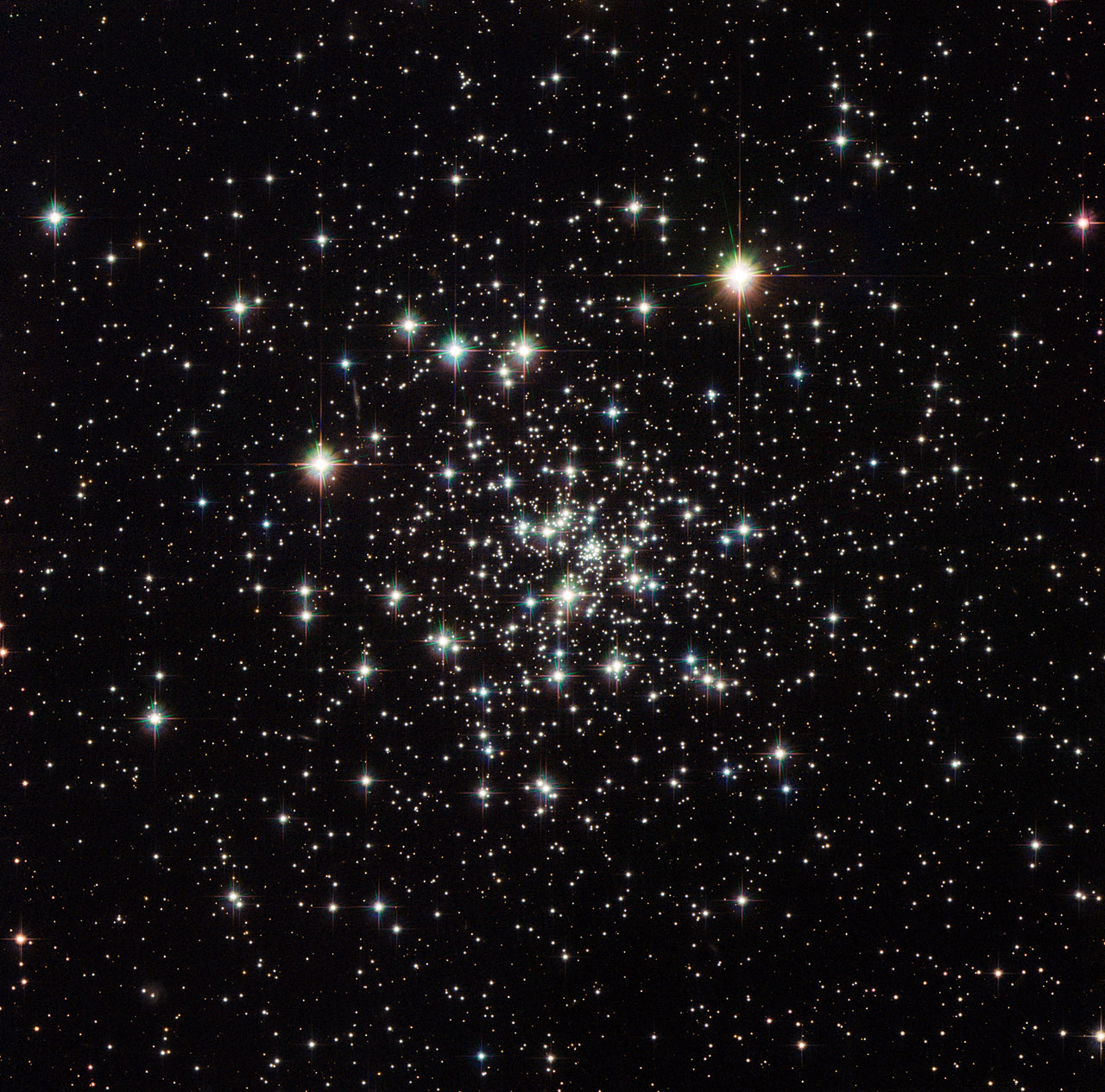
The image, a joint NASA and ESA release, features NGC 6723, an ancient cluster nicknamed the "Chandelier Cluster" sitting roughly 27,000 light-years away in the constellation Sagittarius. Its stars are old even by the standards of old things: many exceed 10 billion years in age, placing them among the most venerable stars in the Milky Way. But when astronomers combined Hubble observations across visible, near-infrared, and ultraviolet light, the cluster gave up a secret. Its stars did not all form at once.
Two bursts, not one
The key finding is that NGC 6723 hosts evidence of two closely spaced periods of star formation rather than a single founding event. According to NASA, the second burst occurred within 634 million years of the first. In cosmic terms — against a backdrop of stars older than 10 billion years — that is a relatively narrow window, but it is decisively more than a single instantaneous flash of star birth.
That distinction matters because it directly contradicts the long-standing assumption that every star in a globular cluster shares one age and one composition. Astronomers once thought these clusters formed in a single coordinated event, the stars condensing together and then quietly aging in lockstep. Hubble's detection of distinct stellar populations inside NGC 6723 is exactly the kind of observation that overturns that model.
How do you see this in a 10-billion-year-old cluster?
The answer is wavelength. A single optical image of a star cluster shows you a beautiful but flattened view. By layering observations in visible, near-infrared, and ultraviolet light, astronomers can separate stars by temperature, evolutionary stage, and subtle differences in chemistry that betray when and how they formed. Ultraviolet data in particular is sensitive to hot, evolved stars and to chemical variations that mark different stellar generations.
The conclusions about NGC 6723 draw on two distinct Hubble observing programs: program #10775, which gathered the visible and near-infrared data, and program #13297, which contributed the ultraviolet observations. Together, that multi-wavelength campaign is what made it possible to disentangle the cluster's two populations and to put a number — 634 million years — on the gap between them.
ESA's Hubble team, which highlighted NGC 6723 as its June 2026 Picture of the Month under the title "Starry chandelier," emphasized both the sheer scale of the object — tens of thousands to millions of ancient stars — and the multi-wavelength observing strategy behind the portrait. The "chandelier" nickname is easy enough to understand once you see the image: a dense, glittering core fanning out into looser strands of light.
Why It Matters
Globular clusters are among the oldest structures in any galaxy, and astronomers have leaned on them for decades as cosmic chronometers. If you assume every star in a cluster is the same age, you can fit the whole population to a single model and read off a date — a technique used to constrain the minimum age of the universe. But if clusters actually contain multiple generations of stars separated by hundreds of millions of years, those age estimates and the formation models behind them need to be more nuanced.
NGC 6723 is not an isolated curiosity. It is one more data point in a growing realization that globular clusters carry surprisingly complex, multi-epoch histories. Each cluster that reveals distinct stellar populations forces theorists to explain how a second wave of star formation could ignite within an already-formed cluster — whether from gas shed by the first generation of stars or from material swept up later — and to account for why these systems retained enough raw material to do it twice. The simple, single-burst fossil is giving way to something richer: a layered record of star birth written into objects that have been quietly orbiting the galaxy for more than 10 billion years.
