
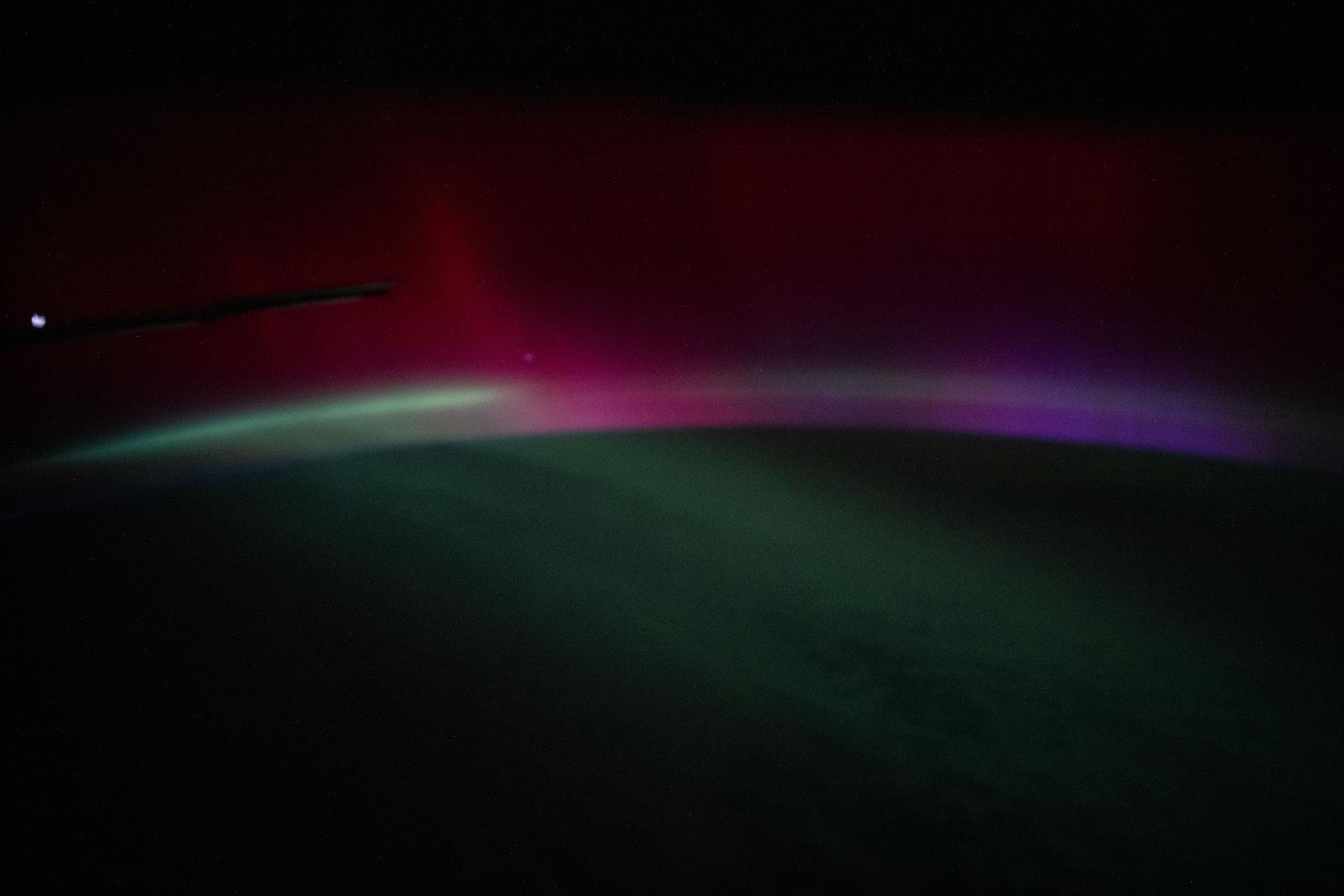
The sun did not wait for anyone to finish their fireworks. Heading into the Fourth of July weekend, NOAA's Space Weather Prediction Center forecast that a series of coronal mass ejections (CMEs) would likely push Earth's geomagnetic field to G1-to-G2 ("Minor" to "Moderate") storm levels on July 3 and 4, with the UK Met Office flagging a slight chance the disturbance could climb as high as G3 ("Strong"). A CME shock front reached Earth on July 3, according to EarthSky's solar-activity tracker, arriving on the heels of residual effects from CME activity earlier in the week. Ahead of the impact, a Forbes report citing SpaceWeather.com and NOAA had named up to 26 US states — a list stretching as far south as Kentucky, Virginia, and Maryland — as possible aurora-viewing locations depending on which storm level ultimately materialized.
Later that same day, the sun added an exclamation point. At 20:41 UTC on July 4, a newly numbered sunspot cluster called Region 4482 unleashed an X1.3 flare — strong enough to trigger an R3 "Strong" radio blackout, according to a bulletin NOAA issued at 21:53 UTC that evening. For sky-watchers who spent the Fourth craning their necks north, it capped a holiday that combined two fronts of solar activity: a shot at an aurora display overhead and a reminder that the current solar cycle still has plenty of punch left.
Why It Matters
Geomagnetic storms are graded on a G1 (Minor) to G5 (Extreme) scale, and even the possibility of a jump from a forecast G1/G2 to G3 matters far beyond aurora photography. Stronger-than-predicted storms can degrade high-frequency radio communications, disturb satellite navigation signals, and induce currents in long-distance power infrastructure. The R-scale radio blackout triggered by the July 4 X1.3 flare (R3, "Strong") reflects a separate but related risk: X-ray and extreme ultraviolet radiation from the flare ionizes the upper atmosphere within minutes, degrading high-frequency radio on the sunlit side of Earth and affecting low-frequency navigation signals used by aviation and shipping. For the public, the payoff is a shot at aurora at latitudes that rarely see it; for grid operators, airlines, and satellite operators, an under-forecast storm is a genuine operational headache. It's also a useful case study in the limits of space weather prediction — CME strength and geoeffectiveness are notoriously hard to nail down until the plasma is nearly on top of us.
There's also the matter of what comes next. Region 4482 is a newly emerging sunspot cluster that forecasters expect to keep producing activity as it rotates across the solar disk — and whether it swings into a more direct Earth-facing position is a geometry that would make any further eruptions from that region considerably more consequential for terrestrial effects.
The Pre-Holiday Forecast
Ahead of the holiday, coverage citing SpaceWeather.com and NOAA laid out state-by-state aurora visibility odds under G1, G2, and G3 scenarios, with a Forbes piece published July 3 naming 26 states as possible viewing locations depending on which storm level materialized. NOAA's own outlook favored G1-to-G2 conditions, while the UK Met Office flagged only a slight chance of reaching G3. That if/then framing — laying out scenarios rather than a single confident call — reflects just how much uncertainty still attaches to CME forecasting in the final day before impact.
That's the persistent challenge with CME forecasting: a coronal mass ejection's speed, density, and — critically — the orientation of its embedded magnetic field can only be measured with real precision once it passes spacecraft stationed between the sun and Earth, leaving forecasters little time to fine-tune a storm-level call before the plasma actually arrives.
The Sun Didn't Slow Down
The X1.3 flare from Region 4482 wasn't an isolated event. EarthSky's live-updated solar activity tracker reported six M-class flares and fifteen C-class flares in the 24 hours spanning July 5 and 6 — most from Region 4479, plus one M1.4 flare from Region 4478 — a brisk pace that underscores just how active the current stretch of the solar cycle has been. The strongest of the batch, an M5.3 flare from Region 4479, peaked at 17:51 UTC on July 5 and triggered its own R2 (Moderate) radio blackout. Geomagnetic conditions, meanwhile, settled into an unsettled-to-active Kp index range of 2 to 3 by July 6.
For anyone who missed the July 4 show, the near-term outlook is mixed. Aurora visibility is expected to retreat back to its usual high-latitude haunts — think northern Scandinavia, Iceland, and northern Canada — for the next several days. But forecasters are flagging a possible G1 (Minor) storm window around July 9, tied to a high-speed solar wind stream from a coronal hole, which could offer another, more modest chance at aurora for observers at higher latitudes.
Tips If the Sky Cooperates Again
The viewing guidance that circulated ahead of the July 4 storm still applies to any future geomagnetic activity: look toward the northern horizon, with the best odds typically clustering around local midnight. A camera capable of long-exposure shots — even a smartphone in night mode — will often reveal color and structure in faint aurora that's invisible to the naked eye. Given how quickly space weather forecasts can shift from one scenario to another, it's also worth keeping half an eye on official alerts through the coming days rather than assuming the show is over.
