
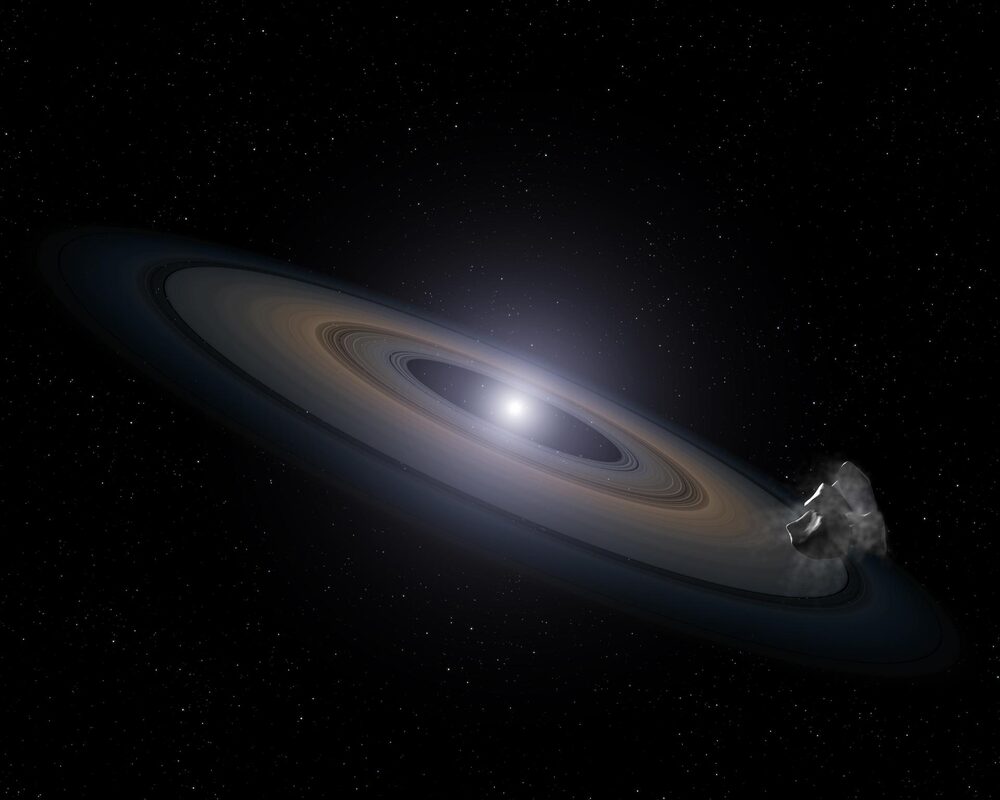
Since 2021, radio astronomers have been finding a type of object that doesn't fit the usual categories. These long-period transients, or LPTs, give off bright, coherent radio pulses, but they repeat every few minutes or more, which is far slower than a typical pulsar. Around a dozen have been found so far. The open question has been what produces them.
A new paper in Nature Astronomy adds a useful data point. The object, GPM J071507-114153, sits about 5,000 light-years away. It pulses every 7.9 minutes, and optical spectroscopy shows it is a binary: a low-mass white dwarf paired with a G-type star, the same broad class as the Sun. Earlier confirmed companions in these systems were red dwarfs, and Space.com describes a sun-like partner as rare.
A clock that moves
The white dwarf is the clock. Space.com reports that it spins about once every eight minutes, and the radio pulse period is 7.9 minutes. A second, slower rhythm sits on top of that: the pulses are modulated over about 1.3 days. The team reads this as the orbital period, so the two stars circle each other in a little more than a day.
That orbit is where the system becomes useful. Team leader Sam McSweeney, a commissioning scientist at the SKA Observatory, told Space.com that this is the first time the pulses have been clean enough to watch the white dwarf move along its orbit. That matters because it pins down where the emission starts. If pulse timing follows the white dwarf's motion, McSweeney said the pulsations therefore come from a region close to the white dwarf, or possibly from the white dwarf itself.
Timing also limits how the pair interacts. According to the paper's abstract, the timing suggests the G star does not fill its Roche lobe. The Roche lobe is the region in which a star's own gravity holds on to its material. A star that overflows it spills gas onto its partner. This star does not appear to be doing that, so whatever powers the radio pulses is probably not heavy mass transfer from one star to the other.
Seeing the companion's weather
Because the pulses are so regular, the white dwarf works like a probe. Its beam passes through the space around the companion star, and that space leaves marks on the signal.
One mark is the rotation measure. Polarized radio waves crossing magnetized plasma have their polarization angle twisted, an effect called Faraday rotation. The amount of twist depends on the plasma's density and magnetic field along the line of sight. The team saw the rotation measure change quickly near superior conjunction, the part of the orbit where the white dwarf passes behind the G star as seen from Earth. The paper says this fits Faraday rotation in the companion's corona, the hot, magnetized outer atmosphere that the Sun also has.
Natasha Hurley-Walker of the International Centre for Radio Astronomy Research (ICRAR) at Curtin University described it to Space.com as watching the white dwarf move behind a strongly magnetic region, probably a stellar prominence, which Space.com describes as a large loop of plasma erupting from a star's surface. The team also detected flares on the sun-like star. A star thousands of light-years away is being partly mapped by the beam of its smaller companion.
How it was found
The object turned up in a survey of the Milky Way, as visible from Australia, carried out with the Murchison Widefield Array (MWA). The South African MeerKAT telescope then determined its precise position, and follow-up at the W.M. Keck Observatory in Hawaii confirmed the companion is a G-type star. Both the MWA and MeerKAT are precursors to the Square Kilometre Array. This kind of handoff, where a wide survey finds something and a sharper instrument pins it down, is how the SKA is expected to work at much larger scale.
Why It Matters
The main question about long-period transients is whether they form one kind of object or several. The abstract notes that at least four of the twelve known LPTs have already been confirmed as white dwarfs paired with M dwarfs, the small, cool red stars that are the most common stars in the galaxy. That pattern supports a binary explanation. It also leaves a gap: if a companion is needed, does it have to be an M dwarf?
GPM J071507-114153 says no. The authors conclude that the coherent pulsed emission depends on an interaction with the companion, and that the companion can be a G-type star in an orbit lasting about a day. That makes the binary picture broader than before. It also means astronomers should check sun-like stars, not only red dwarfs, when they look for counterparts to new LPTs.
The result also fits with recent theory. A 2025 paper by Horvath and colleagues, whose authors include Hurley-Walker and McSweeney, proposed a binary model in which radio emission is triggered when a rotating white dwarf's magnetic axis crosses its companion's wind. They applied it to an earlier object, GPM J1839-10. That paper does not discuss the new source, and the Nature Astronomy abstract does not say whether this system matches the model in detail. Still, the general idea is the same in both: a spinning, magnetized white dwarf interacting with material from a nearby star. The new system gives that idea a well-measured test case, with a known orbit, a known companion type and a radio beam that can probe the companion's corona.
There are limits. One system is one system. The flare and prominence results come from the team's own reading of the radio data, and the full paper sits behind a paywall, so this account rests on the abstract and press coverage. But an object with an eight-minute spin, a 1.3-day orbit and pulses clean enough to time precisely gives modelers concrete numbers, which this field has been short on.
