
Explaining one billion-solar-mass black hole 900 million years after the Big Bang is already a problem. Astronomers have now found two of them in the same place at the same time, close enough together that they are very likely a genuine pair, though one test is still outstanding.
The system is catalogued as J1602+4228AB and was named Napowawaenakaulua through the A Hua He Inoa program. Larry Kimura created the name. It was announced by NSF NOIRLab and published in The Astrophysical Journal Letters. It is the most distant and most compact quasar pair known from the era astronomers call cosmic dawn, and only the third quasar pair found from that epoch at all.
"There is no definitive theoretical explanation for how a single one of these giant quasars exists so early," lead author Silvia Onorato of NOIRLab said in the announcement, "much less two."
What exactly did they find?
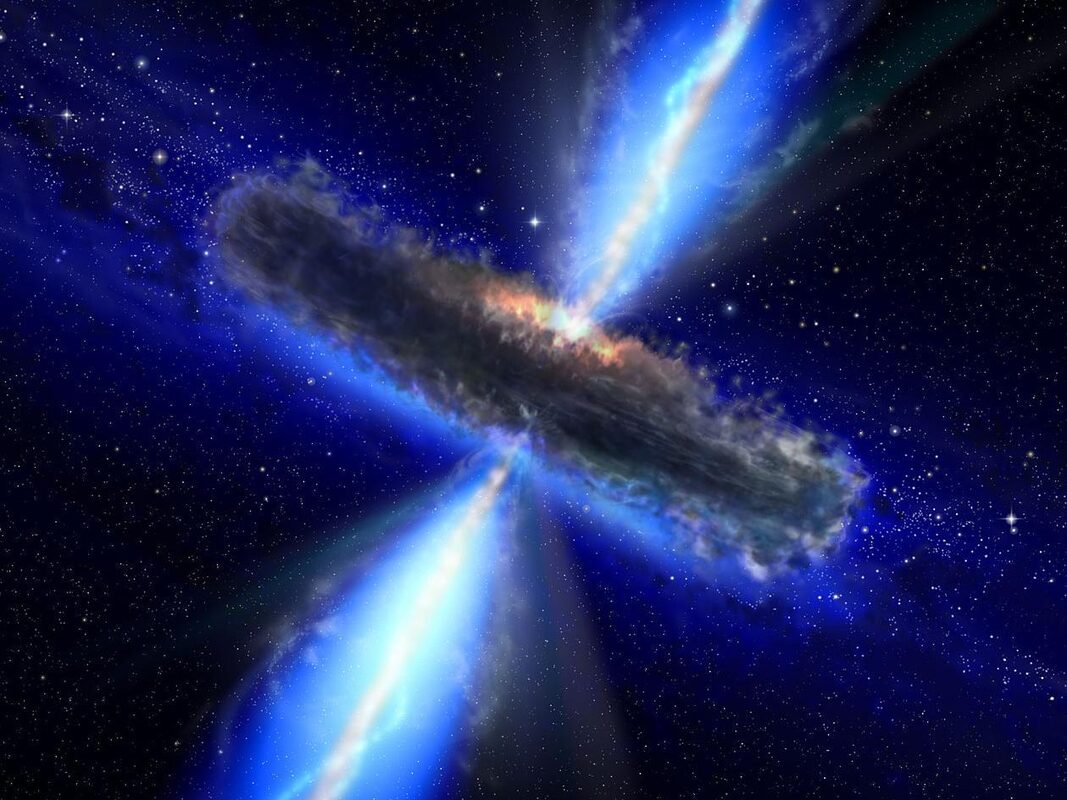
A quasar is a supermassive black hole swallowing gas so fast that the material around it outshines all the stars in its host galaxy. Napowawaenakaulua is two of them. According to the team's arXiv preprint, submitted September 25, the black holes weigh about 1.5 billion and 400 million solar masses.
On the sky they are 0.98 arcseconds apart. At a redshift of about 6.08, that works out to a projected separation of roughly 5.56 proper kiloparsecs, or about 18,100 light-years. NOIRLab puts that at about one-fifth the diameter of the Milky Way. The two systemic redshifts, 6.0781 and 6.0785, are nearly identical. The paper turns that into a line-of-sight velocity offset of only about 15 kilometers per second. By astronomical standards, these two objects are next-door neighbors.
The more surprising numbers are the Eddington ratios, about 1.23 and 1.07. The Eddington limit is the rough ceiling on how fast a black hole can feed before the radiation from its infalling material starts pushing new fuel away. A ratio above 1 means the black hole is feeding at or beyond that limit. Both of these black holes are. Neither was idling. Both were growing about as fast as physics comfortably allows, at the same moment and side by side.
How do you find something like this?
Mostly through scale. The pair turned up in data from Aether, a James Webb Space Telescope survey led by Emanuele Paolo Farina. According to NOIRLab, Aether has observed 200 quasars, or 43 percent of all quasars known from this epoch. It uses Webb's NIRSpec integral field unit, which records a spectrum at every point across a small patch of sky instead of a single combined spectrum for the whole object.
During visual inspection of the Aether data, the team noticed that quasar J1602+4228A had a companion. Confirming it took the ground. The team used the GNIRS spectrograph on Gemini North to resolve the two quasars as separate sources, collecting the data in only two nights thanks to unusually clean, sharp skies over Maunakea. NOIRLab says that observing so faint and close a companion from the ground should have been nearly impossible. They then used Gemini's GMOS instrument to address the obvious objection.
Could it just be one quasar seen twice?
That is the main alternative. A massive foreground galaxy can act as a gravitational lens and split the light of one background quasar into several images. Two images of one quasar would also share a redshift and sit close together on the sky, so the near-identical redshifts by themselves don't settle the question.
The team used GMOS to investigate lensing. According to NOIRLab, differences in the shape of the two quasars' spectra led the team to favor the interpretation that this is a real physical pair. NOIRLab's release is careful on this point, though: a lens model is still needed to rule lensing out definitively. The preprint itself calls the system a quasar pair candidate. The formal lensing check is still open, and readers should keep it in mind.
Why are pairs so hard to catch?
As Space.com's Robert Lea reports, three things work against finding them. The quasar phase is short, so two black holes have to be lit up during the same brief window. Quasars this distant are faint and hard to detect from the ground. And at such great distances and small separations, the individual members of a pair are hard to resolve.
That makes the next finding striking. The preprint compares the chance of seeing a pair like this to extrapolations from how high-redshift quasars are known to cluster at larger scales, and finds an excess of roughly two to three orders of magnitude. In plain terms, Napowawaenakaulua is something like 100 to 1,000 times more common than those extrapolations would predict.
The authors offer two possible explanations. One is an underlying population of merger-triggered quasar pairs at cosmic dawn, so that when two galaxies interact, the central black holes are fed and switch on together. The other is a denser-than-average galactic environment. NOIRLab's release likewise suggests the pair may mark an extreme peak in the matter density of the early universe, where galactic interactions simultaneously fed star formation and rapid black hole growth. These ideas need not be mutually exclusive.
Why It Matters
The timing problem behind this result has been building through the Webb era. As Space.com notes, current models say black holes should need at least a billion years to feed and merge enough to reach masses like these. Yet Webb has found quasars as early as 400 million years after the Big Bang. Napowawaenakaulua comes from a time when the universe was only about one-thirteenth of its current age, and it has two such black holes, both feeding at or above the Eddington rate.
Every early, overweight black hole tightens the limits on how the first massive black holes formed and grew. A pair adds a variable that single quasars can't show: environment. If galaxy interactions are what pushed both black holes into rapid growth, that would be a direct clue to how the earliest giants got so big so fast. Onorato describes the system as a laboratory for studying how the first massive galaxies and their central black holes assembled together through direct galaxy interactions.
The statistics are the other reason it matters. An excess of two to three orders of magnitude, if it holds up, would mean either that early quasar clustering is stronger than extrapolations suggest or that mergers play a larger role in switching quasars on than expected. One system can't decide between those options, but it gives astronomers a concrete case to test: is Napowawaenakaulua a lucky outlier or the first clear example of a common pattern?
What comes next
The immediate task is the lens model that NOIRLab says is needed to definitively exclude gravitational lensing. If the pair survives that test, natural follow-ups would be mapping the surrounding field to see whether the two quasars sit in an overdense region, and searching other early quasars for more close pairs. The Aether sample already covers 43 percent of the known quasars from this epoch, which makes it a promising place to look for more.
For now, the result adds a new and harder version of the puzzle Webb keeps raising: the early universe built very large black holes faster than models comfortably allow, and in at least this one case it appears to have built two of them side by side.
Sources
- Astronomers Discover Napowawaenakaulua, the Oldest Compact Quasar Pair in the Universe (NSF NOIRLab)
- Napowawaenakaulua: a close quasar pair at cosmic dawn in the Aether survey (arXiv preprint)
- Astronomers stunned after James Webb Space Telescope discovers the earliest pair of black hole-powered quasars (Space.com)
