
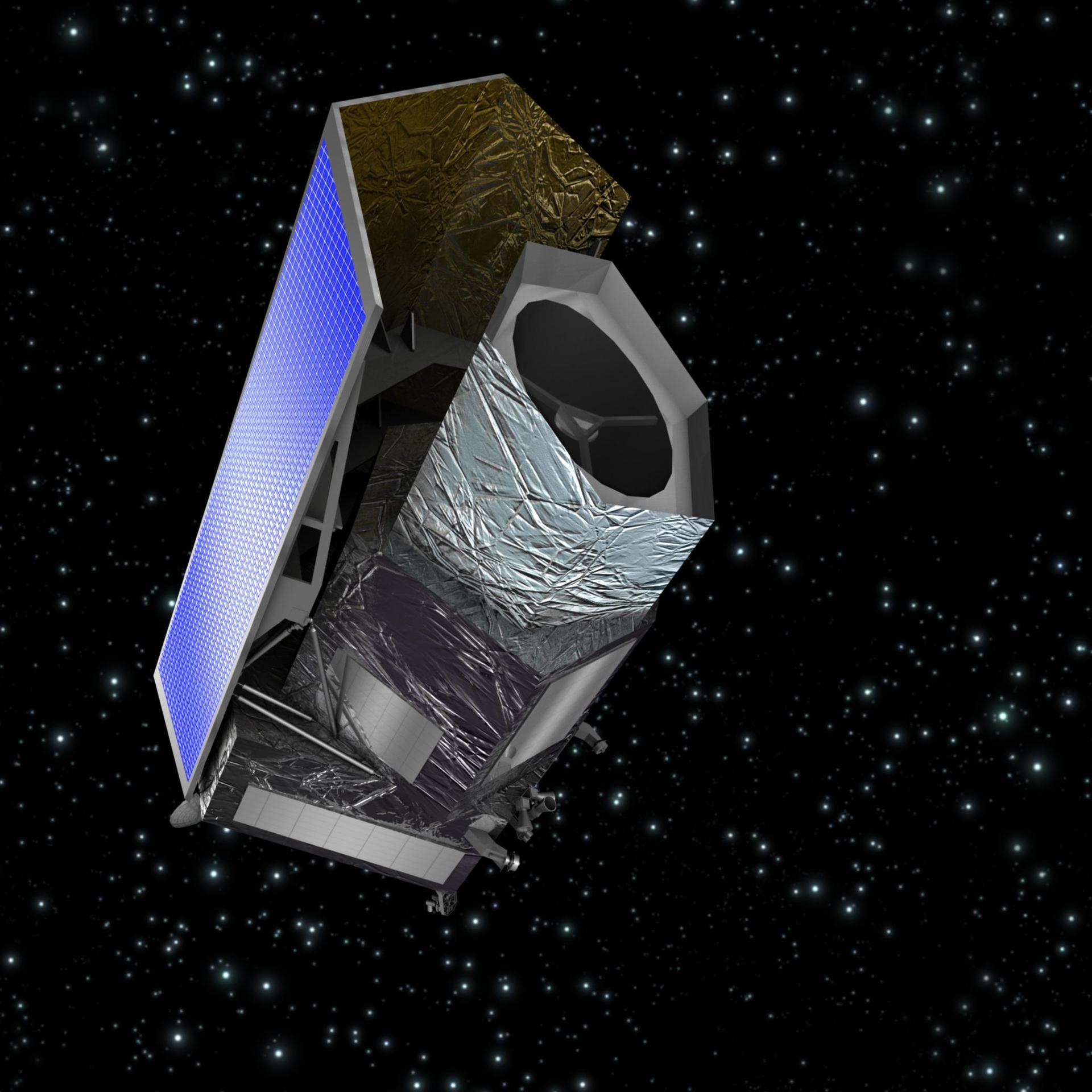
The European Space Agency's Euclid mission has spent most of its time in space collecting data quietly. On Thursday, Nov. 12, that changed. ESA published DR1-Foundation, the first major data release since the telescope launched in mid-2023. It packages about 13 months of survey observations into a public dataset. The release isn't the 3D map of the cosmos that Euclid was built to make. It's the foundation that map will rest on, and the scale of it shows how far the mission has come since its earlier releases.
What's in the box
The numbers are large. According to ESA, DR1 includes more than 900 million galaxies, around 15,000 candidate strong gravitational lenses, more than 60 million quasar candidates and spectra for over 160 million sources. Space.com reports that in total the release captures light from more than a billion objects.
The Wide Survey portion covers about 1,900 square degrees. That's an area of sky equal to roughly 9,500 full Moons, and it amounts to about 1.7 million gigabytes of data. The total sounds huge, but it is also a reminder of how big the job is. Universe Today notes that 1,900 square degrees is only about 14 percent of the sky Euclid is expected to cover over its six-year mission.
Project scientist Valeria Pettorino put the jump in perspective. Euclid's previous releases, she said, covered a few days of observations over roughly 60 square degrees. DR1 covers more than a year of observing over an area more than 30 times larger.
Two surveys, two jobs
Euclid observes in two complementary modes, and DR1 draws on both. The Wide Survey is the workhorse. Universe Today describes it as covering almost half the galactic sky in visible and near-infrared light, building the broad statistical sample of galaxies that cosmologists need. The Deep Survey covers targeted regions within the Wide Survey's footprint. It targets fainter objects, including dwarf galaxies and high-redshift sources, and it also serves as a calibration reference for the Wide Survey.
That split matters for interpreting the results. A survey this big lives or dies on systematics: small calibration errors repeated across hundreds of millions of galaxies can swamp the faint signals cosmologists want to measure. The Deep fields act as a check on the shallower, wider imaging.
The lensing haul
The figure that stands out most to specialists may be the roughly 15,000 strong-lens candidates. Strong gravitational lensing happens when a massive foreground galaxy or cluster bends the light of a more distant source into arcs, rings or multiple images. Each such system is a natural experiment in how mass, including dark matter, is distributed.
Natalie Lines of the University of Portsmouth said the catalogue is the largest collection of strong lenses ever assembled, bigger than all previous catalogues combined. ESA describes strong lenses as extremely rare, so a catalogue of this size should make population-level studies possible. These are still candidates, though, and confirming them will take follow-up work.
The same caution applies to the 60 million quasar candidates. Quasars, bright cores powered by actively feeding supermassive black holes, are useful tracers of distant structure, but a candidate list from survey imaging is the start of the analysis, not the end of it.
Pictures, too
Alongside the catalogues, ESA released showcase images. Space.com highlights views of the core of the M81 galaxy group, the ring galaxy NGC 1291 and the Horologium supercluster. Universe Today puts NGC 1291 at about 33 million light-years away. Barbara Sartoris of the Euclid Consortium, based in Nice, pointed to what the data reveal about large samples of ancient galaxy clusters that were previously out of reach.
The pretty pictures are partly public outreach. They also show the sharpness and depth that make the catalogues trustworthy. Euclid's scientific value comes from measuring tiny distortions in galaxy shapes, so image quality is the whole game.
Why It Matters
Euclid was designed to map how matter is distributed across a large fraction of cosmic history, and to use that map to probe the dark universe: the dark matter and dark energy that dominate the cosmos but can't be seen directly. ESA Director of Science Carole Mundell framed DR1 as the foundation for that effort, and the release's name says the same thing.
The obvious comparison is DESI, the Dark Energy Spectroscopic Instrument, which Universe Today identifies as the source of the largest 3D map produced so far. Universe Today expects Euclid's map to be larger still, with more depth and volume, and, because Euclid is space-based, no atmospheric interference. With only around 14 percent of its planned sky in hand, Euclid isn't ready to settle cosmological questions yet. What DR1 does show is that Euclid can survey the sky at this scale and deliver the image quality the science depends on.
There is also a practical point for the wider community. The release is public. The ESA COSMOS Euclid portal now lists the DR1 contents, accompanying papers, documentation, data-access tools, visualisation options, citizen-science projects and a known-issues page, alongside the earlier Q2 quick release. The known-issues page deserves attention. A first major release from a survey this complex will have quirks, and saying so openly is how a dataset earns trust.
What comes next
The release covers only part of the planned sky, so later releases will have to extend the coverage. The strong-lens and quasar candidates still need confirmation. For now, astronomers have light from more than a billion objects to work through, and Sartoris said the team will explore the galaxy clusters in the coming months to learn how these giants grew.
