
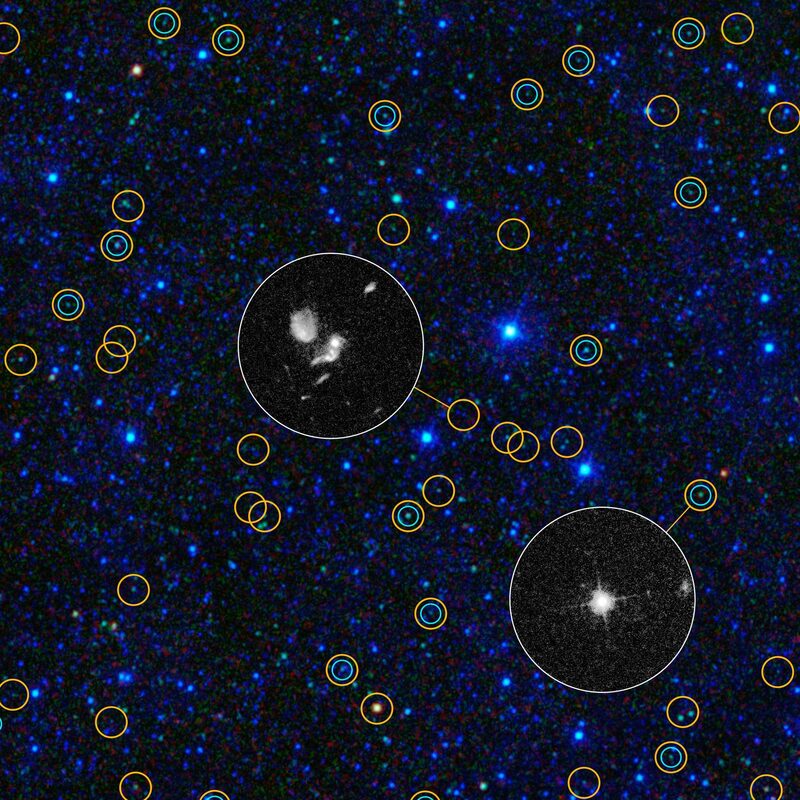
The James Webb Space Telescope keeps finding small, compact, strikingly red objects in the early universe. Astronomers have taken to calling them Little Red Dots, and nobody has settled what they are. They also seem to disappear before the universe is two billion years old. A paper in Physical Review Letters tries an idea that has been around since the 1970s but has never had direct evidence behind it: some of these objects might be powered by primordial black holes, which would have formed in the first moments after the Big Bang rather than from collapsing stars.
The researchers, a team that includes Johns Hopkins astrophysicists, did not try to explain every Little Red Dot. They tested the idea on one especially strange object, QSO1. Their conclusion is narrow and carefully hedged. If QSO1 holds a primordial black hole, the most likely route is that it started small and grew by consuming the gas around it.
Why QSO1?
QSO1 sits about 13.1 billion light-years away, so we see it as it was just 700 million years after the Big Bang. The paper describes it as a strongly lensed source, meaning a foreground mass magnifies its light.
Its chemistry is what really sets it apart. QSO1 is made almost entirely of hydrogen and helium, the first elements to form in the universe, and unlike other Little Red Dots it lacks the heavier elements that came later. Because of that, Space.com notes, it could be more pristine than other Little Red Dots. That matters for this question, since primordial black holes, if they exist, would predate stars and the heavier elements stars produce.
The paper's abstract describes QSO1 as having "extremely low metallicity and large mass." That combination provides what the authors call a stringent test of the competing formation channels, which is why it makes a good test case for an unconventional idea.
Three ways to build a black hole
The team, which includes Valerio De Luca, Loris Del Grosso, Gabriele Franciolini, Konstantinos Kritos, Emanuele Berti, Daniel D'Orazio and Joseph Silk, modeled three routes by which a primordial black hole could end up at the heart of an object like QSO1. Two of them ran into trouble.
1. Born big. The simplest idea is that the black hole formed at roughly its current mass right at the start. According to the paper, this is excluded. Forming black holes that massive in the early universe would run afoul of limits on a type of cosmic microwave background spectral distortion called a mu-distortion. Those limits are stringent enough to rule out that route.
2. Built from mergers. Another option is that lighter primordial black holes, which observations allow, merged hierarchically into a heavy one. The authors say this channel can operate depending on the merger history. In practice it faces challenges because the high-redshift dark-matter halos it requires are rare. That makes the merger route hard to rely on.
3. Grown by accretion. The third scenario starts with an intermediate-mass primordial black hole that pulls in surrounding gas and grows. The team tracked metallicity as the system evolved, so they could check whether the model also matches QSO1's near-absence of heavy elements and not just its mass. The authors identify regions of parameter space in which this growth could reproduce the observed properties of Little Red Dots. The Johns Hopkins announcement calls it the most likely of the three: a smaller primordial black hole that consumed the gas around it until it reached QSO1's size.
What the researchers are, and are not, claiming
The paper does not show that QSO1 contains a primordial black hole. What it shows is that the idea is not ruled out, and it identifies which version of the idea holds up best.
De Luca stated the ambiguity directly. Little Red Dots, he said, "could surround astrophysical black holes, and most probably many of them do, but they could also be primordial black holes, if primordial black holes exist." That last clause carries the weight. Stephen Hawking proposed primordial black holes in the 1970s, and astrophysicists still have no direct evidence that they exist.
Del Grosso described the result as a modest step forward: "The door was open on this theory, that little red dots could be primordial black holes. We've now cracked it open a little farther by showing some scenarios are more likely than others."
That is a fair description of the paper. It does not offer a discovery. It narrows the options. The direct-formation route is excluded by cosmic microwave background limits, the merger route faces the problem of rare halos, and the accretion route remains viable for at least some parameter values. Anyone who wants to argue for primordial black holes in Little Red Dots now has a more specific claim to defend, and anyone who wants to rule them out has a more specific target.
Why It Matters
Little Red Dots are among Webb's most persistent puzzles. They appear early, they challenge standard models of early galaxy formation, and they seem to vanish before the universe reaches two billion years old. Any explanation has to account for all of that.
Testing a primordial origin against a specific, strongly lensed object makes the idea more useful. QSO1's near-pristine chemistry makes it a sharp test. The authors' choice to track metallicity alongside mass is what turns the comparison into an actual test instead of a loose plausibility argument.
The stakes go beyond this one object. The Johns Hopkins team says that to prove primordial black holes exist, they would need to find a black hole either too light to be an astrophysical one or so old that it predates stars. De Luca called the existence of primordial black holes a potentially groundbreaking discovery in physics. This paper does not confirm that. Next, the researchers plan to look at the roughly 100 catalogued Little Red Dots to see how many could be primordial.
For now the honest answer to the headline question is "possibly, under specific conditions." Little Red Dots may turn out to be ordinary astrophysical black holes in unusual surroundings. They may also be windows onto something older.
Sources
- Primordial Black-Hole-Based Pathways to Little Red Dots (De Luca et al., arXiv:2512.19666, published in Physical Review Letters)
- Webb Space Telescope's little red dots could hold key to first black holes (Johns Hopkins Hub, Nov. 4, 2026, via mirror)
- Are the James Webb Space Telescope's mysterious Little Red Dots actually tiny black holes left over from the Big Bang era? (Space.com, Nov. 9, 2026)
